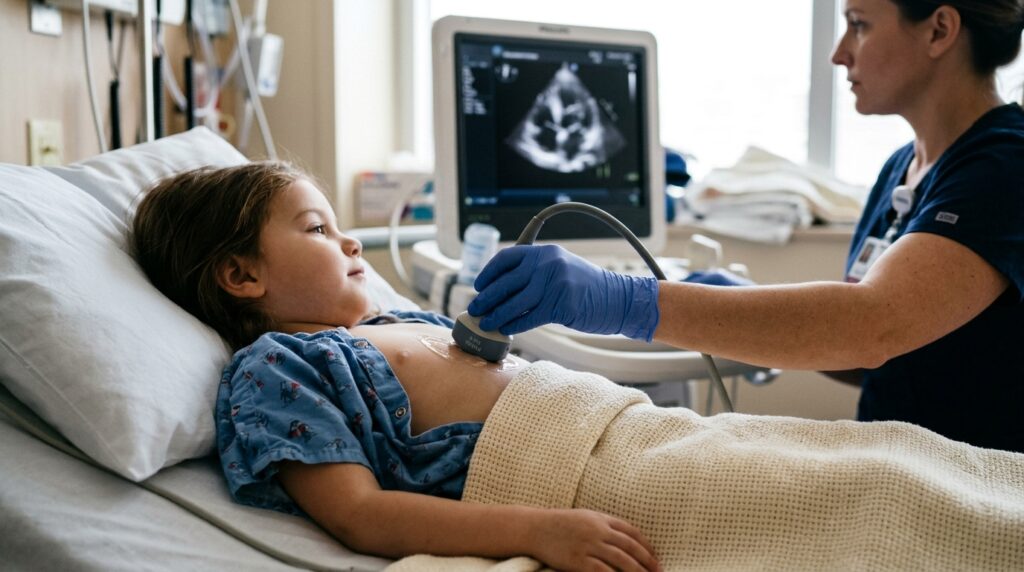
Coronary artery involvement and resistance to intravenous immunoglobulin did not differ significantly across patient age brackets in a retrospective investigation of paediatric Kawasaki disease conducted at a tertiary referral centre. Kawasaki disease most frequently develops in children between 12 and 60 months of age, prompting investigators to examine whether patients presenting outside this typical demographic window exhibit distinct clinical, laboratory, cardiac, and therapeutic courses.
The study cohort comprised 104 patients aged 18 years or younger diagnosed according to American Heart Association criteria between January 2019 and December 2025. Researchers excluded patients diagnosed with multisystem inflammatory syndrome in children as well as individuals monitored for less than six months. The participants were stratified into three distinct age brackets: 13 infants under 12 months (12.5 percent), 67 children aged 12 to 59 months (64.4 percent), and 24 patients aged 60 months or older (23.1 percent). Male patients represented 64.4 percent of the overall cohort, and incomplete Kawasaki disease was identified in 43 children, corresponding to 41.3 percent of the study group.
Coronary artery involvement served as a primary outcome measure and was detected in 60 patients, accounting for 57.7 percent of the entire cohort. This cardiac involvement included coronary dilatation in 38 patients and coronary artery aneurysms in 22 patients, representing 21.2 percent of the study population. When stratified by age bracket, coronary artery involvement was observed in 61.5 percent of infants under 12 months, 61.2 percent of children aged 12 to 59 months, and 45.8 percent of patients aged 60 months or older. These observed differences between the age groups did not reach statistical significance, yielding a p-value of 0.407.
The investigation also evaluated treatment responses, designating intravenous immunoglobulin resistance as an additional primary outcome. Resistance to initial intravenous immunoglobulin therapy occurred in 14 children, representing 13.5 percent of the total cohort. Across the respective age cohorts, resistance rates were documented at 15.4 percent in infants under 12 months, 11.9 percent in children aged 12 to 59 months, and 16.7 percent in patients aged 60 months or older, showing no statistically significant variation with a p-value of 0.759. In addition, 24 patients, or 23.1 percent of the cohort, received corticosteroid treatment, and variations in corticosteroid administration across age groups were similarly not statistically significant with a p-value of 0.089.
Exploratory analyses revealed marked clinical differences in physical signs and secondary cardiac manifestations across the different age groups. Cutaneous rash was documented in 100 percent of infants under 12 months compared with 62.5 percent of patients aged 60 months or older. Conversely, oropharyngeal changes were identified in 79.2 percent of patients aged 60 months or older, compared to 38.5 percent of infants. Furthermore, pericardial effusion was recorded more frequently among older children aged 60 months or older than among those aged 12 to 59 months, occurring in 37.5 percent versus 11.9 percent of patients, respectively.
During a median post-diagnosis follow-up interval of 17.9 months, coronary artery involvement persisted in four patients, representing 3.8 percent of the study cohort, and zero patient fatalities occurred throughout the surveillance period. The authors noted that the relatively small sample sizes within the extreme age categories limited the statistical power to detect subtle differences in coronary outcomes. Consequently, the researchers concluded that age-related variations in clinical presentation warrant careful consideration during evaluation, while larger multicentre studies remain necessary to definitively assess the relationship between patient age and coronary arterial damage.
Subject of Research: Age-related clinical presentation and coronary outcomes in paediatric Kawasaki disease
Article Title: Age-related clinical heterogeneity in Kawasaki disease: a tertiary paediatric centre experience
Article References: Torun, Ş. E., Özay, A. N. P., Gürsu, H. A., Özen, S., Azak, E., Pamuk, U., Yahşi, A., Konca, H. K., Ertem, Ş., Şentürk, C. Ç., Kaşıkçı, M., & Tekin, Z. E. (2026). Age-related clinical heterogeneity in Kawasaki disease: a tertiary paediatric centre experience. BMC Pediatrics. https://doi.org/10.1186/s12887-026-08030-8
Image Credits: AI Generated
DOI: 10.1186/s12887-026-08030-8
Keywords: Kawasaki disease, pediatric cardiology, coronary artery involvement, coronary artery aneurysm, coronary dilatation, intravenous immunoglobulin resistance, corticosteroids, incomplete Kawasaki disease, pericardial effusion, oropharyngeal changes, infant rash, tertiary paediatric referral centre, American Heart Association criteria, retrospective study, clinical heterogeneity, pediatric outcomes