Chemical engineering researchers have derived a comprehensive dynamic mathematical model and calculated missing operating parameters for the celebrated Tennessee-Eastman process, establishing a fully documented first-principles representation for one of the chemical industry’s most widely utilized reference plants. Writing in the Brazilian Journal of Chemical Engineering, investigators Mateo Arcila-Osorio, Carlos Ocampo-Martinez, and Hernan Alvarez resolved long-standing ambiguities surrounding the benchmark by introducing a rigorous deduction founded on phenomenological-based semi-physical modeling. The primary contribution of the investigation provides the broader scientific community with complete balance equations, precise initial conditions, and determined parameter values necessary to simulate the four primary operating modes of the facility. Prior to this comprehensive study, full operational datasets were openly accessible only for the base case mode, while the other three operating regimes lacked published values for critical equipment parameters and initial conditions. By meticulously establishing every governing balance across all relevant processing units, the researchers have created an open, transparent foundation that enables direct replication and simulation across chemical engineering disciplines without relying on legacy software.
The Tennessee-Eastman benchmark process originated in 1993, when corporate process control researchers Downs and Vogel from the Eastman Chemical Company formulated an intricate industrial challenge to test dynamic control strategies against realistic plant conditions through simulations. To safeguard proprietary corporate information and maintain patent protection, Downs and Vogel modified chemical components, reaction kinetics, operating conditions, and process flow arrangements while preserving the authentic underlying physical behaviors of an active commercial facility. The plant model was originally codified into proprietary FORTRAN subroutines describing non-linear material and energy balances, but the foundational mathematical equations were entirely omitted from the seminal published text. In that inaugural era, interested external researchers seeking the source code and underlying formulations were instructed to submit an email inquiry to obtain the files on a physical floppy disk. Although subsequent investigators developed diverse application frameworks, including mechanistic representations by Ricker and Lee in 1995, explicit equation derivations and operational assumptions remained largely unstated across the literature for decades.
To overcome these limitations, the research team adopted a structured phenomenological-based semi-physical modeling methodology, which integrates first-principles physical derivations with empirical parameter adjustments to capture intricate chemical phenomena. This modeling framework produces mathematical structures that combine white-box and black-box models, balancing physical interpretability with the capacity to evaluate both structural and functional parameters. The methodology progresses through ten defined steps organized into three overarching sections: model pre-construction, model construction, and model validation. During pre-construction, the investigators define the precise modeling objective, establish macroscopic hypotheses, and designate discrete process systems based on physical boundaries, phase transitions, and spatial differences across the equipment. During model construction, fundamental conservation laws are applied to each process system to formulate basic differential structures, followed by the identification of structural parameters and the derivation of extended constitutive functions. In accordance with earlier mechanistic proposals, the authors excluded explicit dynamic energy balances, treating operating temperatures across major units as controlled variables to maintain the core benchmark objectives without introducing unneeded complexity.
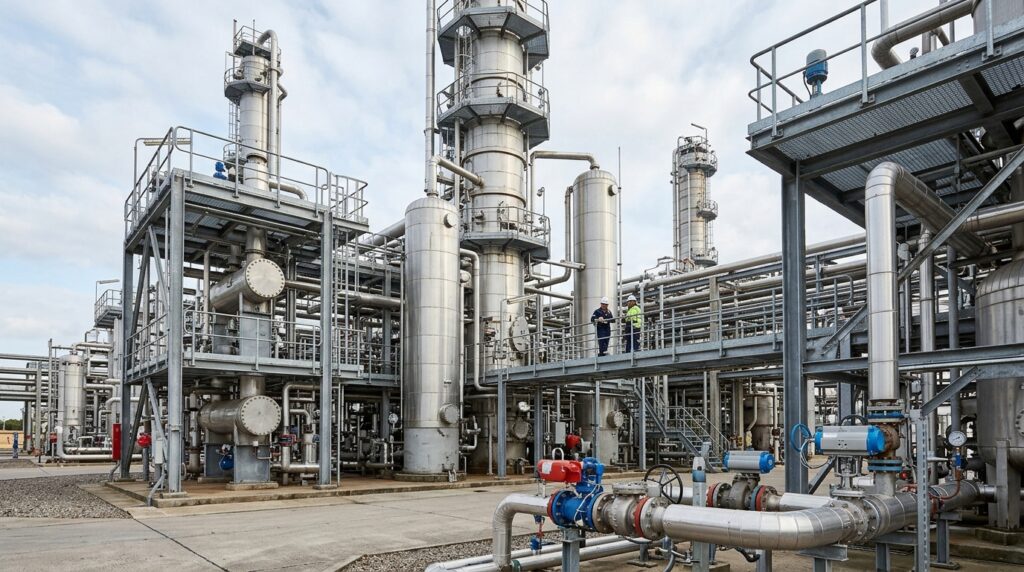
The Tennessee-Eastman facility incorporates five primary processing units arranged in a closed recycle structure: a continuous stirred tank reactor, a cooling condenser, a vapor-liquid flash separator, a recycle compressor, and a stripping column. A preceding mixing point blends recycled gases with fresh reactant streams to guarantee complete homogenization before entering the reactor vessel. The reactor functions as a two-phase continuous stirred tank wherein gaseous reactants A, C, D, and E undergo simultaneous, irreversible, exothermic chemical transformations to generate volatile liquid products G and H, alongside unwanted byproduct F, in the presence of gaseous inert B. Because kinetic data for a fourth reaction reported in 1993 was missing in the literature, the authors consolidated the chemistry into three kinetic expressions where the third equation fully captures the formation of byproduct F. Key macroscopic assumptions stipulate that permanent gases A, B, and C remain insoluble in liquid phases within the reactor and separator, while gases obey ideal behavior, liquid mixtures follow modified Raoult formulations, and internal liquid-vapor equilibria achieve instantaneous thermal and chemical stabilization.
Deriving the reactor submodel required addressing the gas-vapor chamber occupying the upper volume of the vessel and the catalyzed liquid holdup situated below. Rather than executing iterative calculations of net equilibrium flows between phases that would complicate numerical solutions, the researchers formulated dynamic material balances on a molar basis across the reactor as an integrated system. The resulting basic structure consists of eight differential equations tracking the accumulation of each chemical component, driven by inlet and outlet stream compositions alongside reaction transformation rates. Saturation vapor pressures for condensable compounds are calculated using Antoine expressions, while activity coefficients account for liquid-phase non-idealities. When evaluating reaction kinetics from empirical equations originally stated by Ricker and Lee, the investigators identified an apparent typing error in published formulations and inverted the algebraic signs inside the bracketed exponential terms, thereby preventing severe numerical deviations during continuous dynamic simulation. Molar exit flows from the vessel are governed by a pressure-gradient valve formulation linking reactor headspace pressure to flash separator conditions.
To ensure the formulated mathematical framework was structurally solvable prior to computer execution, the authors conducted an exhaustive degrees of freedom analysis across all defined process systems. The fully assembled plant model encompasses 239 total unknowns, systematically categorized into 40 dynamic state variables, 110 observable structural parameters, and 89 functional parameters defined through constitutive and assessment equations. Because the derivation produced exactly 239 independent algebraic and differential expressions, the resulting degrees of freedom equaled zero, confirming mathematical determinacy. The computational model was programmed in Python and integrated using the classical Euler method with a fixed time step of 0.001 hours, equivalent to 3.6 seconds. To prevent numerical instabilities caused by Python’s default calculation precision of up to 28 decimal places, the researchers established explicit numerical rounding protocols for the differential terms, rounding quantities larger than one to three decimal places and values below one to three significant figures, which effectively suppressed floating-point drift and preserved steady-state profiles.
A pivotal achievement of the investigation involved uncovering and resolving substantial discrepancies in physical equipment volumes and operating levels that had persisted between seminal benchmark documents. In evaluating the reactor geometry, original 1993 specifications cited a liquid inventory of 16.55 cubic meters and a 75 percent liquid level, yielding an apparent total vessel capacity of 22.07 cubic meters. However, numerical execution proved that this smaller volume distorted steady-state gas-phase molar fractions, verifying that the 36.8 cubic meter volume reported by Ricker and Lee represents the true vessel size. Consequently, the researchers determined that the genuine steady-state liquid level corresponds to 45 percent rather than 75 percent, establishing true physical phase volumes of 16.56 cubic meters of liquid and 20.24 cubic meters of vapor headspace. Similarly, calculations for the condenser-flash separator demonstrated that the reported 50 percent liquid level applies solely to the isolated flash vessel, whereas accounting for combined condenser and separator volumes yields a vapor capacity of 94.14 cubic meters and a true liquid volume fraction of roughly 5 percent.
Because the open-loop Tennessee-Eastman plant exhibits pronounced operating sensitivity, dynamic instabilities, and stiff chemical responses to external disturbances, the authors implemented a decentralized regulatory framework to evaluate closed-loop operational stability. Following established control configurations suggested by Andersen and coworkers, the team installed five classical proportional-integral-derivative feedback loops as the minimal baseline necessary to stabilize operating inventories against incoming disturbances. The controlled process variables encompass reactor pressure, reactor operating temperature, reactor liquid level, flash separator liquid level, and stripping column liquid level. These regulatory objectives are maintained by manipulating five corresponding process inputs: the gaseous purge flow rate, reactor cooling water flow rate, flash separator operating temperature, separator liquid discharge rate, and stripper product bottom flow rate. The authors retuned the proportional-integral-derivative controller gains independently across each of the four operational modes, emphasizing that these non-optimized tuning parameters were chosen arbitrarily solely to ensure stable, bounded regulatory recovery rather than to showcase optimal control performance.
The computational simulator was validated by conducting extensive dynamic tests across the base case operation and modes 1, 2, and 3, tracking dynamic responses over multi-hour simulation horizons. Following an initial ten-hour period of steady-state operation, the plant was subjected to composition disturbances in the stripper feed stream, including step shifts in reactant concentrations. The resulting trajectories for key chemical inventories across the reactor, flash tank, stripper column, and mixing node displayed smooth, physically consistent transitions toward new bounded steady states. Quantitative evaluation confirmed high model fidelity, demonstrating minimal relative errors between simulated molar holdups and historical benchmark values. Furthermore, the team assessed dynamic fault behavior against three representative process disturbances introduced after one hour of operation, comparing output responses directly against an updated modern simulator from Bathelt and colleagues. Despite structural differences in baseline loop configurations, both computational platforms demonstrated remarkable convergence of measured variables and consistent trajectory trends, providing compelling empirical evidence for the validity of the derived equations.
By establishing an accessible, fully derived mathematical structure along with comprehensive parameter tables, this research removes significant barriers that have historically restricted the Tennessee-Eastman benchmark to specialized process control studies. The published dataset provides initial holdups, reaction factors, partition ratios, and activity coefficients across all operating regimes, enabling educators, process designers, and researchers to implement the plant in modern programming environments without reverse-engineering legacy FORTRAN subroutines. Furthermore, the explicit physical derivations offer a transparent alternative to data-driven black-box neural networks that dominate contemporary chemical fault diagnosis, providing clear mechanistic insight into process phenomenology. Looking forward, the investigators highlighted vital research avenues opened by the unified formulation, including assessing computational efficiencies across stiff numerical solvers, characterizing non-linear plant metrics to evaluate potential model linearizations, and developing systematic model-reduction techniques for advanced predictive control and estimation schemes. Consequently, the newly elucidated benchmark provides an enduring open-access foundation that bridges fundamental physical principles with advanced industrial process automation.
Subject of Research: Phenomenological modeling and parameter deduction for the Tennessee-Eastman process benchmark
Article Title: A detailed model deduction and parameter values for the Tennessee-Eastman benchmark
Article References: Arcila-Osorio, M., Ocampo-Martinez, C., & Alvarez, H. (2026). A detailed model deduction and parameter values for the Tennessee-Eastman benchmark. Brazilian Journal of Chemical Engineering, 43(4), 1923-1945. https://doi.org/10.1007/s43153-026-00646-8
Image Credits: AI Generated
DOI: 10.1007/s43153-026-00646-8
Keywords: Tennessee-Eastman process, chemical process modeling, phenomenological-based semi-physical model, process systems engineering, continuous stirred tank reactor, flash separator, stripping column, material balances, process simulation, numerical integration, Euler method, parameter estimation, process dynamics, PID control, reaction kinetics, Raoult’s law, benchmark simulation, chemical engineering