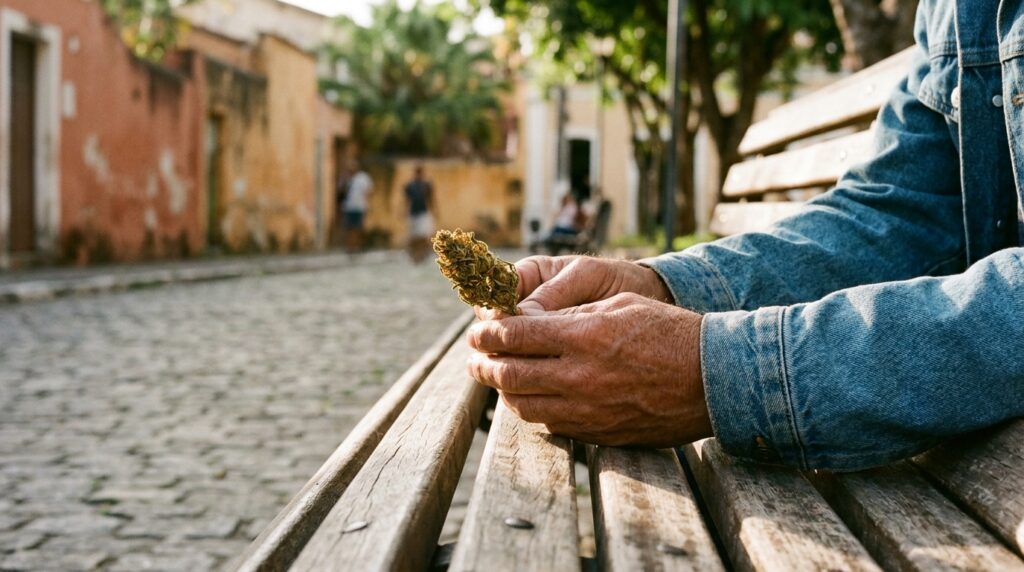
The research, published in Discover Mental Health, examined self-reported purposeful cannabis use among people experiencing homelessness who face substantial substance-use and mental-health vulnerabilities compounded by structural barriers to healthcare. Researchers sought to characterize these purposeful consumption patterns and evaluate their associations with sociodemographic traits, substance-use indicators, and mental-health metrics.
The authors noted that some individuals experiencing homelessness may use cannabis purposefully to manage personal symptoms or the perceived effects of other substances. The study was therefore organized to explore how purposeful cannabis consumption relates to specific background characteristics, substance-use indicators, and mental-health factors within this population in the Brazilian Federal District.
To gather representative observational data, investigators recruited a total sample of 812 adults experiencing homelessness through time-location sampling across the Brazilian Federal District. Field personnel administered a structured questionnaire designed to assess participants’ sociodemographic characteristics, substance-use indicators, mental-health indicators, and purposeful cannabis use. Within the survey design, the primary question concerning purposeful cannabis use assessed lifetime behavior and was presented exclusively to participants who reported having ever used cannabis.
Survey findings indicated that out of the 812 participating adults, 558 individuals reported that they had used cannabis at least once in their lives. Among these 558 participants with prior cannabis exposure, 517 respondents provided a valid answer to the lifetime purposeful-use item. From this group of valid respondents, 334 individuals—accounting for 64.6 percent—affirmed that their lifetime cannabis use had been purposeful to manage symptoms or the perceived effects of other substances.
The statistical analysis plan employed both bivariate and multivariable methods to assess relationships between purposeful cannabis use and participant characteristics. Researchers initially evaluated bivariate associations through Pearson’s chi-square tests, applying the Benjamini-Hochberg false-discovery-rate adjustment to control for multiple testing. To identify independent factors, investigators subsequently performed binary logistic regression for the multivariable analysis, designating purposeful cannabis use as the primary dependent variable and presenting associations as odds ratios with corresponding 95 percent confidence intervals.
The bivariate analyses revealed that purposeful cannabis use was associated with participant age as well as several substance-use and mental-health indicators. When researchers analyzed the final complete-case logistic regression model comprising 501 respondents—consisting of 323 purposeful-use positive participants and 178 negative participants—older age, frequent crack withdrawal symptoms, and lifetime suicide attempts remained significantly associated with purposeful cannabis use. In addition, the multivariable model identified an inverse association for crack-related problems that participants reported only sometimes.
In their concluding assessment, the authors stressed that self-reported purposeful cannabis use was common among those answering the lifetime query, but the cross-sectional data cannot establish that cannabis reduced drug-related harm or improved symptoms among people experiencing homelessness in the federal district. While some reported purposes may be consistent with harm-reduction practices, other reported reasons might instead reflect symptom management or self-medication. The team highlighted that longitudinal and clinical studies are required to determine temporal relationships, perceived benefits, and potential harms.
Subject of Research: Purposeful cannabis use among people experiencing homelessness in Brazil
Article Title: Self-reported purposeful cannabis use and its associations with substance use and mental health among people experiencing homelessness in Brazil
Article References: de Oliveira Freire, L. S., de Oliveira, A. W. C., Nakano, E. Y., Jabur, P. A. C., & Gallassi, A. (2026). Self-reported purposeful cannabis use and its associations with substance use and mental health among people experiencing homelessness in Brazil. Discover Mental Health. https://doi.org/10.1007/s44192-026-00691-2
Image Credits: AI Generated
DOI: 10.1007/s44192-026-00691-2
Keywords: cannabis use, purposeful cannabis use, people experiencing homelessness, Brazilian Federal District, mental health, substance use, harm reduction, crack withdrawal symptoms, suicide attempts, cross-sectional study, time-location sampling, logistic regression, symptom management, self-medication, odds ratios, Brazil public health