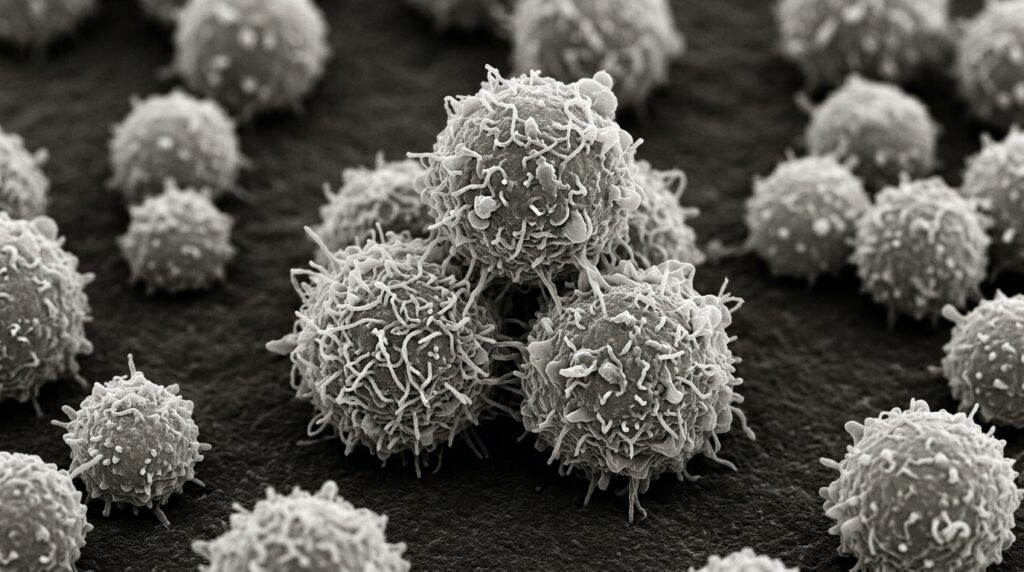
A newly synthesized chemical derivative designated DS-19 exhibits targeted in vitro antiproliferative activity against human chronic myeloid leukemia cells while physically interacting with and inhibiting the demethylase enzyme ALKBH1. The small molecule emerged from a laboratory investigation that designed and prepared twenty-one novel 4-aminoquinoline compounds utilizing a scaffold hopping strategy based on the established molecular scaffold of compound SGI-1027.
During in vitro antiproliferative activity screening across cultured human cell models, DS-19 demonstrated the highest potency among the synthesized series against K562 chronic myeloid leukemia cells and PC-3 prostate cancer cells. Quantitative testing established a half-maximal inhibitory concentration of 4.81 micromolar against these cultured lines, prompting deeper biochemical investigation into its mechanism.
Subsequent laboratory evaluations revealed that treating K562 leukemia cells with DS-19 led to a measurable elevation of intracellular 6 mA modification levels. To assess direct enzymatic interference, investigators conducted in vitro enzymatic activity assays using a purified enzyme system. These assays confirmed that the derivative inhibited ALKBH1 demethylase activity, which directly yielded increased 6 mA levels within the purified preparation.
To verify direct physical binding between the small molecule and the target protein, the study employed differential scanning fluorimetry. This thermal shift analysis indicated a distinct change in the thermal stability of ALKBH1 in the presence of DS-19, supporting a direct physical association between the compound and the enzyme in solution.
Complementary computational docking analyses provided theoretical structural insight into how the small molecule engages the catalytic macromolecule. The modeling predicted that DS-19 forms specific non-covalent interactions with three defined amino acid residues within the ALKBH1 structure: arginine at position 338, methionine at position 276, and proline at position 354.
Further assessments showed that cellular exposure to DS-19 produced phenotypic disruptions in cultured K562 leukemia cells. The agent induced cell cycle arrest at the G2/M transition phase, triggered a marked decrease in mitochondrial membrane potential, drove an elevation in intracellular reactive oxygen species levels, and provoked apoptotic cell death.
Thorough transcriptomic characterization using RNA sequencing paired with reverse transcription quantitative polymerase chain reaction confirmed widespread gene expression changes following compound administration. Differentially expressed genes were significantly enriched across biological pathways governing apoptosis, mitochondrial function, cell cycle progression, reactive oxygen species metabolism, and epigenetic transcriptional regulation.
The study authors concluded that DS-19 represents a promising chemical starting point that combines in vitro ALKBH1 inhibition with antiproliferative effects in chronic myeloid leukemia models. However, the researchers emphasized that the compound remains an early experimental lead whose precise on-target specificity and comprehensive cellular mechanisms necessitate further experimental validation.
Subject of Research: Identification and in vitro characterization of 4-aminoquinoline derivative DS-19 as an ALKBH1 demethylase inhibitor against chronic myeloid leukemia
Article Title: Identification of a novel 4-aminoquinoline derivative regulating 6 mA against chronic myeloid leukemia
Article References: Gong, Y., Li, F., Dai, Y., Wang, Y., Wang, Z., Zhou, Y., Li, C., Chen, D., Li, C., & Li, Z. (2026). Identification of a novel 4-aminoquinoline derivative regulating 6 mA against chronic myeloid leukemia. Molecular Diversity, 31(1), Article 6. https://doi.org/10.1007/s11030-026-11800-2
Image Credits: AI Generated
DOI: 10.1007/s11030-026-11800-2
Keywords: DS-19, 4-aminoquinoline, ALKBH1, 6 mA, chronic myeloid leukemia, K562 cells, PC-3 cells, SGI-1027, scaffold hopping, demethylase inhibitor, epigenetics, differential scanning fluorimetry, G2/M cell cycle arrest, mitochondrial membrane potential, reactive oxygen species, apoptosis, RNA sequencing, RT-qPCR