Many scientists first encountered G protein–coupled receptors (GPCRs) as a looping sketch across the cell membrane in an early biology textbook. That simple diagram belied the complexity of a receptor family now known to govern vision, smell, hormone sensing, and the actions of countless medicines. Yet despite their centrality, designing molecules that can precisely switch GPCRs on or off has remained one of drug discovery’s most persistent challenges.
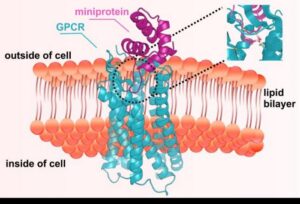
A new study led by the UW Medicine Institute for Protein Design and Skape Bio demonstrates that AI‑driven de novo protein design can finally meet that challenge. The work, published recently in Nature, shows that computationally designed miniproteins—compact proteins under 100 amino acids—can be engineered to either activate or block GPCRs with high affinity, potency, and selectivity. The paper is titled “De novo design of miniproteins targeting G protein-coupled receptors.”
The research team developed a suite of design strategies to create miniproteins capable of slipping into the deep, flexible pockets that govern GPCR signaling. These pockets shift shape depending on whether the receptor is active or inactive, making them difficult to target with conventional biologics. By designing molecules that recognize specific receptor states, the team generated agonists for receptors involved in itch and pain, and antagonists for receptors implicated in cancer, metabolic disease such as diabetes and obesity, and migraine.
“Protein design takes our understanding of how proteins fold and reverses it—asking if we can envision, with the aid of AI computing, a new protein that sticks to a target in a purpose-built way,” said senior author David Baker, PhD, director of the Institute for Protein Design, professor of biochemistry at the University of Washington School of Medicine, and a Howard Hughes Medical Institute Investigator. “This paper showcases how we can do this repeatedly for different GPCRs in ways that capitalize on their dynamic motion to either activate or inactivate them.”
Cryo‑EM structures of five designed miniproteins closely matched their computational models, underscoring the accuracy of the design pipeline. In one mouse study, a designed chemokine‑receptor antagonist mobilized hematopoietic stem and progenitor cells at levels comparable to a clinically used drug—but with fewer side effects, according to the authors.
For first author Edin Muratspahić, PhD, the moment of validation came when the designed molecules did more than bind. “Seeing computationally designed miniproteins not only bind but actually control GPCR signaling in living cells was a defining moment for me,” he said.
A second major advance reported in the study is a high‑throughput “receptor diversion” screening system that evaluates tens of thousands of designed proteins directly in living human cells. Traditional GPCR screens often require purifying or stabilizing receptors—steps that can distort their natural signaling behavior. By keeping receptors in their native membrane environment, the new system accelerates discovery while preserving biological relevance.
According to corresponding author Christoffer Norn, PhD, co‑founder of Skape Bio, the study lays out a roadmap for all‑computational design of GPCR ligands.
The methods described in the paper are already being adapted at Skape Bio to explore GPCR targets involved in metabolic, inflammatory, and neurologic pathways—areas where conventional discovery efforts have often struggled.