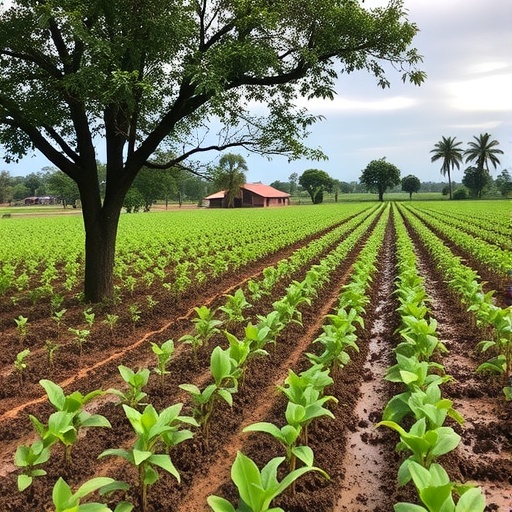
Artificial intelligence is often celebrated for its ability to predict things: yields, droughts, outbreaks, prices. But a sweeping new systematic review of research on sub-Saharan Africa argues that prediction alone is the wrong benchmark for judging what AI can do for the continent’s farmers. What matters, the authors contend, is whether machine intelligence can build genuine environmental resilience in farming systems that are chronically short of the very resource AI depends on most—data.
The review, published in the journal Smart Agricultural Technology, was conducted by Simon Adesola Adediran, Christopher Gorham, and Abiodun Olusola Omotayo, and is the first comprehensive synthesis to explicitly integrate four themes that previous studies have treated separately: artificial intelligence, data scarcity, adaptive agricultural systems, and environmental resilience in sub-Saharan Africa. Drawing on ninety-eight peer-reviewed studies published between 2010 and 2025, the authors map where AI is already strengthening climate adaptation—and where the technology runs into the hard limits of infrastructure, institutions, and economics.
The stakes could hardly be higher. Agriculture provides livelihoods for more than sixty percent of sub-Saharan Africa’s population and underpins national GDPs and export earnings across the region’s forty-seven countries. Yet productivity growth has been the slowest of any major world region over the past two decades, held back by weak irrigation, degraded soils, underdeveloped markets, and limited mechanization. Climate change acts as what the authors call a threat multiplier: erratic rainfall, prolonged droughts, floods, heatwaves, and pest invasions such as fall armyworm and locusts repeatedly destabilize already fragile food systems. More than ninety-five percent of cultivated land in the region is rain-fed, leaving harvests hostage to the weather. Climate models project further yield declines in vulnerable countries including Nigeria, Angola, Kenya, and Namibia if nothing changes.
Technically, the review organizes AI’s contribution into five interlocking domains. Machine learning models—random forests, support vector machines, and deep neural networks including long short-term memory (LSTM) networks and convolutional neural networks—learn nonlinear relationships from large datasets to forecast yields, pest outbreaks, drought onset, and market prices. Remote sensing and computer vision tools, drawing on satellite imagery, drones, and in-field sensors, process vegetation indices such as the Normalized Difference Vegetation Index (NDVI), Soil-Adjusted Vegetation Index (SAVI), and Enhanced Vegetation Index (EVI) to detect crop stress, nutrient deficiency, and infestation before symptoms become visible to the eye. Decision support systems fuse climate models, soil databases, crop growth simulations, and real-time sensor feeds to deliver site-specific advice on planting dates, irrigation scheduling, and fertilizer application. Robotics and smart mechanization address labor shortages through machine vision and sensor fusion. Finally, digital advisory platforms—mobile apps, SMS services, and chatbots powered by natural language processing—deliver forecasts, pest alerts, and market intelligence directly to farmers, often in local languages and through voice interfaces that sidestep literacy barriers.
In data-rich environments, these tools have matured rapidly. In sub-Saharan Africa, the picture is more complicated, and this is the crux of the review. AI models are only as good as the data behind them, and the region’s agricultural data ecosystems are fragmented, incomplete, outdated, and spatially coarse. Satellite imagery suffers from cloud contamination precisely during the rainy seasons when monitoring matters most. Datasets are stored in isolated institutional repositories using incompatible formats and non-standardized interfaces, undermining the model transferability that would allow a system trained in one agroecological zone to work in another. The result is a persistent gap between laboratory performance and field-level usefulness.
The authors frame their analysis with Resilience Theory and the Risk-Management Decision Perspective, treating farming systems as dynamic socio-ecological entities that must absorb, adapt to, and recover from climate shocks. Within this framework, AI functions as an adaptive information system: it does not directly modify physical production, as a drought-tolerant seed or a new irrigation canal would, but strengthens the informational and anticipatory capacity of the entire system. Resilience outcomes are layered, from immediate gains such as reduced uncertainty and timely responses, through intermediate improvements in productivity and reduced input costs, to long-term outcomes including food security, income stability, and environmental sustainability.
Crucially, the review insists that AI should complement, not replace, existing adaptation pathways. Conventional indigenous strategies—crop diversification, intercropping, mixed farming, and adjusting planting dates—remain the backbone of smallholder resilience, cheap and deeply embedded in local knowledge, but they lose reliability as climate patterns shift beyond historical experience. Emerging agronomic innovations such as drought-tolerant varieties, conservation agriculture, and precision irrigation offer high potential but suffer uneven adoption due to cost and weak extension systems. AI, the authors argue, works best as a third layer that enhances both: sharpening weather forecasts that guide planting decisions, improving the timing of agronomic interventions, and bridging the information gaps that limit extension services.
Practical applications reviewed in the study span the full range of climate hazards. AI-driven drought prediction fuses satellite remote sensing, soil moisture observations, and reanalysis data to give earlier and more spatially resolved warnings, allowing farmers to shift planting calendars, prioritize early-maturing varieties, and adjust irrigation. Machine learning flood models integrate satellite rainfall estimates, river discharge, soil saturation, and topography to anticipate flash floods, giving farmers time to protect assets and relocate livestock. Heatwave and rainfall variability monitoring supports seasonal alignment of crop choices and water conservation. Beyond the farm gate, AI is reshaping financial resilience: index-based insurance schemes triggered by NDVI anomalies or evapotranspiration rates can pay out automatically without costly field assessments, while machine learning-based claims verification detects flood damage and yield declines rapidly, cutting administrative delays and building trust among farmers who have historically avoided insurance.
But the review is equally candid about the barriers. Digital infrastructure remains the foundational constraint: unreliable electricity, limited broadband, and patchy mobile coverage cripple real-time AI services, and infrastructure gaps fall hardest on the rural, remote communities most exposed to climate risk. Affordability compounds the problem—IoT sensors, drones, and cloud platforms carry upfront and recurring costs that push adoption toward larger commercial farms, risking a widening digital divide. Policy and governance are lagging too: most countries lack comprehensive AI strategies, harmonized data governance frameworks, and clear rules on privacy, ownership, and algorithmic accountability. The authors also flag a subtler concern—environmental trade-offs—warning that energy-intensive AI deployment, if powered by non-renewable sources and applied without agroecological safeguards, could inflate the carbon footprint of farming even as it boosts efficiency.
What emerges is a call for hybridization. The most promising systems, the review concludes, are those that combine computational intelligence with indigenous knowledge and farmer experience, because purely data-driven models inevitably miss contextual information about local traditions and experiential expertise. Hybrid decision support architectures have shown greater acceptance and practical relevance in developing-country contexts, and the authors argue that explainability and usability must be balanced against raw predictive accuracy if farmers are to trust and act on AI recommendations.
The paper closes with a policy agenda. Governments and development partners, it says, should prioritize investment in rural electrification, mobile broadband, and interoperable data systems; establish coherent regulatory frameworks for data governance and ethical AI; and promote financial mechanisms—subsidies, concessional financing, public-private partnerships, and pay-as-you-go models—that keep AI from becoming a privilege of large agribusiness. Future research, the authors argue, must be interdisciplinary, pairing technical modeling with socio-economic and environmental analysis to assess long-term impacts on livelihoods and ecosystems, and must grapple with questions that remain underexplored: how AI interacts with indigenous knowledge systems, how transparency and traceability can be embedded in food system applications, and how data-scarce conditions reshape the robustness of algorithms designed elsewhere.
The message of the review is ultimately one of conditional optimism. Artificial intelligence can transform sub-Saharan African agriculture from a reactive, risk-prone enterprise into a proactive, climate-smart one—provided the technology is designed for the region’s realities rather than imported from data-rich contexts. Prediction, in other words, is the beginning of the story, not the end. Resilience is built where algorithms, infrastructure, institutions, and farmers’ own knowledge converge.
Subject of Research: The role of artificial intelligence, under conditions of data scarcity, in building adaptive capacity and environmental resilience in agricultural systems across sub-Saharan Africa.
Subject of Research: Agriculture
Article Title: From prediction to environmental resilience: artificial intelligence, data scarcity, and adaptive agricultural systems in sub-Saharan Africa
Article References: Adediran, S. A., Gorham, C., & Omotayo, A. O. (2026). From prediction to environmental resilience: artificial intelligence, data scarcity, and adaptive agricultural systems in sub-Saharan Africa. Smart Agricultural Technology, 15, Article 102495. https://doi.org/10.1016/j.atech.2026.102495
Image Credits: AI Generated
DOI: 10.1016/j.atech.2026.102495
Keywords: artificial intelligence, sub-Saharan Africa, climate resilience, data scarcity, smallholder farmers, precision agriculture, machine learning, decision support systems, climate-smart agriculture, food security
Cite Scienmag News
APA MLA Chicago
Sloane Callahan. (September 5, 2026). AI Helps Data-Scarce African Farms Build Climate Resilience. Scienmag. https://scienmag.com/ai-helps-data-scarce-african-farms-build-climate-resilience/
Copy citation Download RIS
Tags: adaptive agricultural systems for climate changeadaptive agricultural systems in AfricaAI for improving crop yields in data-scarce environmentsAI in African agricultureAI-driven climate resilience in sub-Saharan African farmingAI-driven drought prediction in Africabuilding environmental resilience with AIclimate adaptation strategies for African farmersclimate resilience through artificial intelligencedata scarcity challenges in agricultural AI applicationsdata scarcity challenges in sub-Saharan farmingeconomic and institutional barriers to AI adoptioneconomic implications of AI for African agricultural productivityenhancing foodimpact of artificial intelligence on smallholder farmersinfrastructure and institutional barriers to AI adoption in African agricultureinfrastructure limitations impacting AI deploymentpeer-reviewed research on AI and environmental resilience in African farmingrole of machine learning in African agriculturerole of machine learning in drought prediction and drought resiliencesustainable farming practices enabled by AI in Africasustainable farming practices in sub-Saharan Africatechnology-driven climate adaptation strategies in sub-Saharan Africa