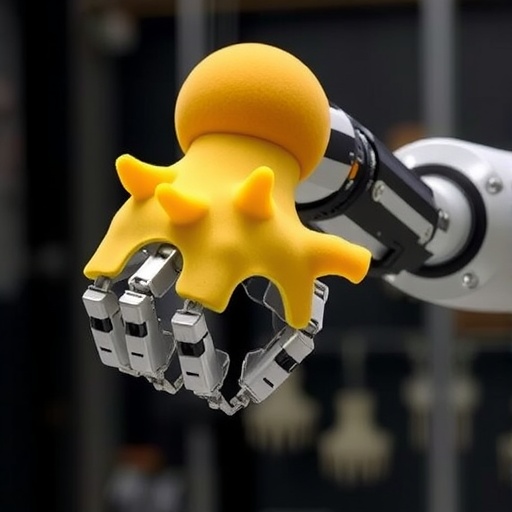
A team of robotics researchers has unveiled a fully open-source, 3D-printable soft robotic gripper that borrows its mechanics from the skeleton of a fish fin and pairs it with embedded force sensing and low-cost control electronics, bringing sophisticated cooperative object manipulation within reach of laboratories, classrooms, and hobbyists for roughly $900. The device, described in a new paper in HardwareX, is purpose-built for multi-robot systems in which several mobile robots enclose and transport an object together rather than gripping it from a single arm. By combining the passive adaptability of the Fin-Ray effect with piezoresistive force feedback and an STM32-based proportional controller, the design demonstrates that useful force-controlled manipulation no longer requires expensive commercial end-effectors or specialized fabrication facilities.
The gripper’s central mechanical principle is the Fin-Ray effect, a structure adapted from the biomechanical geometry of fish fins. Each finger consists of two flexible sidewalls joined by transversal struts; when an object presses against the finger, applied forces are redistributed through the struts, causing the entire structure to curve toward the contact point. This allows the finger to conform passively to irregular shapes without any complex sensing or control. Traditional Fin-Ray designs, however, have often lacked integrated feedback, exhibited limited load capacity, and required laborious empirical tuning of their geometry. Earlier research groups have addressed these shortcomings in various ways—embedding force sensors, adding vision-based tactile skins such as GelSight, leveraging neuromorphic cameras for proprioceptive state estimation, and even building reconfigurable architectures with tactile skins for dexterous in-hand manipulation. But each of these additions increases fabrication complexity and cost, placing sensorized soft grippers out of reach for open-source, low-budget, and educational platforms. The new design deliberately walks a middle path: it adds just enough sensing and computation to close a control loop, while keeping every component printable or off-the-shelf.
The geometry of the finger was not chosen by trial and error. The researchers, led by Santiago Velasquez and colleagues at Universidad EIA and collaborating institutions in Colombia and Mexico, ran a finite element analysis sweep of transversal strut angles from 0° to 60° in 15° increments, simulating fingers made from thermoplastic polyurethane with a Shore hardness of 95A, a material prized in FDM 3D printing for its elasticity. Each model featured 1 mm strut widths at 5 mm spacing, with a 3-newton load applied over a 240 mm² area located 52.5 mm from the base, and a mesh capturing the full three-dimensional solid geometry. The 45° configuration emerged as the clear winner, exhibiting the highest compliance with a maximum displacement of 22.26 mm—the largest of any tested angle. Stress analysis confirmed that this geometry keeps the material within its elastic limits even at peak deformation, while a specific quirk of the design, the internal beam friction that arises between struts under higher loads, provides extra structural rigidity that lets the gripper support heavier objects without sacrificing its soft, conformable character. The two main finger walls are each 100 mm long, forming an isosceles triangle with an 83.3° apex angle.
Manufacturing the fingers demands attention to the peculiarities of printing flexible filament. The team used an Ender 3 V2 printer with 100 percent infill and generic TPU95A filament, recommending a direct-drive modification that repositions the extrusion motor closer to the nozzle. This shortens the path the elastic filament must travel, reducing the risk of jamming or buckling and making retractions more precise since the filament stretches less. The specified print parameters include a 0.2 mm layer height, a 220 °C printing temperature, a 0.4 mm nozzle, a slow 20 mm/s printing speed, a 30 °C bed, and both cooling and retraction disabled. The rigid components—a mounting bracket and two geared arms—are printed in PLA. An HK15138 servomotor rated at 4.3 kg·cm at 6 V actuates the two fingers through a pair of geared arms in a 1:1 transmission, each with 20 teeth, a 20° pressure angle, and a 2.25 mm module. Because both fingers are driven by a single servo through meshed gears, the mechanism closes symmetrically and automatically centers the object, with an intended operating range of cubic objects from roughly 20×20×20 cm up to 30×30×30 cm.
The force feedback that distinguishes this gripper from passive soft fingers comes from a thin-film piezoresistive sensor, 110 mm by 15 mm, mounted on the inner surface of one finger with double-sided tape, its active striped region centered in the expected contact zone. The sensor is rated from 20 to 10,000 grams, but its raw output is noisy and nonlinear, so the team designed a rigorous calibration procedure. Because early tests showed high variability from uneven contact pressure, a dedicated rigid calibration fixture was built to focus known loads precisely on the sensor’s active region. A Fourier transform of idle voltage measurements, gathered through a simple voltage-divider circuit, revealed noise concentrated between 20 and 30 Hz, which motivated a 200-tap moving-average low-pass filter implemented on an STM32F407G-DISC1 development board; with the analog-to-digital converter sampling at 4,000 Hz, the effective cutoff landed at the target 20 Hz. Loads were then applied in 50 g increments up to 500 g, and the resulting voltage–weight pairs were fitted with a third-order polynomial—an empirical calibration curve that captures the sensor’s dual-curvature response without the overfitting risk of higher-order models. The polynomial is embedded in the firmware and evaluated only within the experimentally calibrated range.
Validation of the sensing chain revealed a nuance typical of low-cost piezoresistive films. Accuracy was poor at the bottom of the force range—below roughly 1.5 newtons, small variations in contact area and pressure distribution produce voltage changes comparable to the baseline noise floor—but improved steadily with load, reaching better than 98 percent at the top of the tested range and averaging 70.8 percent across all intervals. Precision, however, was excellent throughout: the coefficient of variation across repeated measurements averaged just 1.0996 percent, with values between 0.82 and 4.32 percent. For the gripper’s intended job, this tradeoff is acceptable by design. In caging-based manipulation, the object is constrained by the geometry and compliance of multiple cooperating grippers rather than held by friction against gravity, so the control system cares more about stable contact, repeatability, and relative force trends than about metrological accuracy in absolute force. The researchers accordingly advise treating readings below 1.5 newtons as contact and trend information, with quantitative force regulation reserved for setpoints above that threshold.
The control system itself is a finite-state machine written in C on the STM32 board, with four states—START, CONTROL, IDLE, and END—selected via USB serial commands. A proportional controller compares the sensed force against a desired setpoint, multiplies the error by an empirically tuned gain of 0.1, and updates the servo’s pulse-width command, which is constrained between 500 and 2,500 microseconds to respect the actuator’s 180° range at a standard 50 Hz PWM frequency. Real-time telemetry—sensed force, setpoint, error, and control action—streams over USB to a Python graphical interface built on PyQtGraph, which plots the signals live and automatically saves the most recent data as a CSV file when closed. A TB6612FNG motor driver, chosen for its dual H-bridge topology, low output on-resistance, and back-EMF protection, safely passes the PWM signal to the servo.
Experimental validation showed the closed-loop system performing reliably. In static tests against a rigid object with a target force of 0.981 newtons—the weight of a 100 g mass, deliberately chosen to sit in the sensor’s reliable region and well below the servo’s torque and thermal limits—the system exhibited an initial contact delay of about 1.12 seconds, a modest overshoot of only 3 to 5 percent, and a settling time of roughly 1.08 seconds measured from the instant of contact, with steady-state error driven close to zero. Dynamic tests were more demanding: researchers manually perturbed the gripper after it reached a stable 1.0-newton setpoint, emulating the sudden load shifts that occur when a caged object rotates or slides during cooperative transport. Disturbances produced force excursions spanning roughly 0.68 to 1.24 newtons, yet the controller recovered to the setpoint within about 0.75 seconds after each major perturbation, its integral action eliminating persistent deviations and its corrective pulse-width changes opening or closing the gripper as needed. Energy measurements showed the servo drawing about 250 mA during active force regulation with peaks up to 1 A under high load, and nearly nothing at idle.
The work builds directly on a previous cooperative manipulation framework by some of the same authors, which paired Fin-Ray-inspired soft grippers with a leader–follower control scheme on two omnidirectional mobile robots and demonstrated the feasibility of caging-based transport. What the new paper adds is the physical realization: a documented, reproducible hardware platform with parametric CAD files, printable STLs, complete firmware, a bill of materials, assembly instructions, and calibration data, all released under a Creative Commons Attribution 4.0 license with design files deposited in a public repository. The gripper is also deliberately framed as more than a single-purpose tool—its modular, parametric construction makes it a flexible research platform for force-based control studies, compliant interaction experiments, and soft robotics education. Looking forward, the team plans to shrink the electronics onto a custom PCB, explore non-back-drivable transmissions to address the mechanism’s tendency toward back-drivability, and expand finger manufacturing beyond FDM printing into resin printing, silicone casting, and injection molding to improve durability and mechanical repeatability for real multi-robot deployments.
Subject of Research: Design, instrumentation, and validation of an open-source Fin-Ray soft robotic gripper with piezoresistive force feedback for cooperative multi-robot object caging and transport
Subject of Research: Technology and Engineering
Article Title: Fin-Ray soft gripper for object manipulation with multi-robot systems
Article References: Velasquez, S., Toro-Ossaba, A., Sanin-Villa, D., Núñez, J. D., Rozo-Osorio, D., Bonet, I., Góngora, M., Giraldo, M. A., & Tejada, J. C. (2026). Fin-Ray soft gripper for object manipulation with multi-robot systems. HardwareX, 27, Article e00806. https://doi.org/10.1016/j.ohx.2026.e00806
Image Credits: AI Generated
DOI: 10.1016/j.ohx.2026.e00806
Keywords: Fin-Ray effect, soft robotics, soft gripper, multi-robot systems, caging strategy, force feedback, piezoresistive sensor, 3D printing, TPU 95A, STM32 controller, open-source hardware, cooperative manipulation
Cite Scienmag News
APA MLA Chicago
Denise Maddox. (September 5, 2026). Fin-Ray-inspired soft gripper enables multi-robot manipulation of diverse objects. Scienmag. https://scienmag.com/fin-ray-inspired-soft-gripper-enables-multi-robot-manipulation-of-diverse-objects/
Copy citation Download RIS
Tags: 3D printable soft robots3D-printed soft roboticsadaptable robotic end-effectorsaffordable robotics for labs and hobbyistsbio-inspired soft robotic designcooperative multi-robot systemscooperative robot manipulationembedded force sensing in soft robotsFin-Ray effect biomechanicsFin-Ray inspired mechanismfish fin biomechanics in roboticsfish fin-inspired robotic gripperforce-controlled soft gripperslow-cost robotic control electronicsmulti-robot object manipulationopen-source robotic gripper designopen-source robotics hardwarepassive adaptability in soft grippingpiezoresistive force feedbacksoft robotic gripper