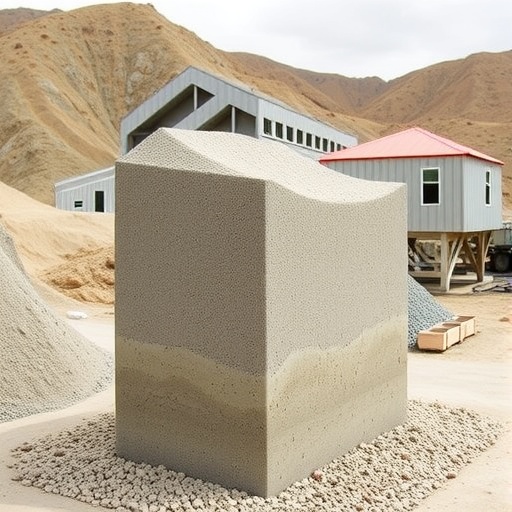
In a development that could reshape how the construction industry handles one of mining’s most stubborn waste streams, researchers in China have shown that lead-zinc tailings—the pulverized residue left over from extracting lead and zinc ores—can replace up to half of the natural sand in self-compacting concrete while actually making it stronger. The study, which combined laboratory testing with advanced X-ray imaging and a three-dimensional computer simulation of the concrete’s internal structure, found a “sweet spot” of tailings substitution at which both strength and durability improve markedly. Beyond that point, performance declines, but even at high replacement levels the material held its own against conventional mixes.
The research addresses two problems at once. Natural river sand, the backbone of the world’s concrete industry, is becoming scarcer as infrastructure booms strain quarrying and dredging operations. Meanwhile, mining operations generate tailings in volumes that far exceed the tonnage of the metal concentrates they accompany. Tailings ponds occupy land, threaten waterways with heavy-metal contamination, and can pose engineering safety hazards if impoundments fail. Turning that waste into a functional construction material would relieve pressure on both fronts.
The team, led by Shiying Liu, Hao Li, Qi Huang, Linchun Qi, and Wei Liang, focused on self-compacting concrete, or SCC, a high-flow formulation that spreads into densely reinforced forms and fills confined spaces under its own weight, without mechanical vibration. Because SCC relies so heavily on the fine aggregate fraction for its flow behavior and packing density, it represents a particularly demanding test case for a substitute sand. The researchers replaced natural river sand with lead-zinc tailings sand at volumetric replacement ratios of 10, 20, 30, 40, and 50 percent, preparing parallel series of self-compacting mortar and self-compacting concrete, each cured and tested at 3, 7, and 28 days.
The workability results revealed a subtle divergence between the two material families. In the mortar, both slump flow and consistency declined steadily as tailings content rose, with the 50 percent mix showing a 14.2 percent drop in slump flow relative to the control. The concrete behaved differently: its slump flow actually peaked at 10 percent replacement, reaching 779.5 millimeters, before falling off at higher dosages. The T500 flow time—a measure of how long the concrete takes to spread to a 500-millimeter diameter—climbed from 4.3 seconds to 12.2 seconds as replacement rose to 50 percent, signaling substantially increased flow resistance. The explanation lies in the physical character of the tailings: angular particle shapes, rough surfaces, and elevated water absorption all increase interparticle friction and consume free water that would otherwise lubricate the flowing mixture. At moderate doses, the fine tailings particles provide a microfilling effect that compensates; beyond a threshold, the frictional penalties dominate.
Strength told an even more compelling story. Self-compacting mortar reached its peak compressive strength at 40 percent tailings replacement, achieving 51.91, 63.29, and 79.51 megapascals at 3, 7, and 28 days respectively—gains of up to 21.6 percent over the control. The concrete’s optimum came at 30 percent replacement, delivering 56.19, 69.79, and 82.84 megapascals at the three ages, an improvement of 18.6 percent at early age. The mechanism is classic particle-packing physics: fine tailings particles slot into voids between cement paste and aggregate, densifying the porous interfacial transition zone that typically acts as concrete’s weakest link. At excessive replacement, however, the surplus of angular, water-absorbing particles disrupts grading, hinders cement hydration, and leaves a more porous, weaker interface.
X-ray computed tomography, or X-CT, provided three-dimensional confirmation. Scanning 30-millimeter cubes before loading, the team extracted porosity, pore-size distributions, and pore morphology metrics. Porosity in the mortar fell from 1.38 percent in the control to just 0.60 percent at the optimal 40 percent replacement—a reduction of 56.5 percent—while the concrete’s porosity dropped from 1.98 percent to 1.09 percent at 30 percent replacement. Pore sphericity remained remarkably stable across all mixes, hovering between 0.97 and 1.00, but the fractal dimension of pore boundaries—a measure of their roughness and tortuosity—fell by 8.9 percent at the optimal dosages, indicating smoother, less defective pore walls. Most pores measured between 250 and 500 micrometers, and the fraction of large macropores was suppressed dramatically at optimal replacement. Past the threshold, at 50 percent substitution, porosity rebounded above control levels in both systems, with macropore fractions climbing sharply as paste became unable to encapsulate and fill the irregular tailings surfaces. X-ray diffraction analysis further showed that moderate tailings addition boosted the quartz peak in the hydration products while weakening portlandite peaks at high dosages—evidence that excessive tailings suppress calcium hydroxide formation and thus slow hydration.
Crucially for environmental safety, a leaching test on the 50 percent replacement specimens measured total concentrations of chromium, copper, zinc, and lead in the extract at 0.052, 0.006, 0.015, and 0.015 milligrams per liter respectively—orders of magnitude below the regulatory limits of 15, 100, 100, and 5 milligrams per liter. The cement matrix physically encapsulates the metal-bearing particles, binds them by surface adsorption, and locks them in chemically, effectively neutralizing the heavy-metal hazard.
The study’s most technically ambitious component was a discrete element method, or DEM, simulation that modeled the concrete as a mesoscopic assembly of individual particles. The team built a three-dimensional model containing cement paste, river sand, tailings sand, coarse aggregate, and pores, explicitly distinguishing six types of interparticle contacts, each with its own calibrated stiffness and bond strength using the Linear Parallel Bond Model. After testing model sizes from 10 to 100 millimeters, they settled on a 15-millimeter cube containing roughly 46,359 particles as the best compromise between representativeness and computational cost. Parameters were tuned stepwise against the experimental stress-strain curves—first the parallel bond modulus to match elastic stiffness, then tensile strength and cohesion to reproduce peak behavior. The simulation proved remarkably accurate: errors in predicted peak stress ranged from just 0.02 to 0.9 percent, and post-peak strain predictions deviated by only 2.0 to 9.5 percent.
The simulation then let the researchers watch cracks form in silico. Damage followed a consistent three-stage choreography. In the elastic stage, microcracks appear preferentially at aggregate-matrix interfaces, accounting for roughly 76 percent of all early cracks—a direct consequence of stiffness mismatch between aggregates and paste, which concentrates stress at their boundaries. In the strain-hardening stage, cracks multiply and begin to link, with the cement matrix joining the fracture network. Finally, in the post-peak softening stage, cracks coalesce into through-going paths dominated by coarse aggregate-matrix contacts and matrix-matrix contacts, producing the shear-dominated failure bands seen in real specimens, oriented near 90 degrees to the loading axis with secondary concentrations at 30 to 60 and 120 to 150 degrees.
The damage index—a dimensionless measure of broken contacts—told the story of why 30 percent replacement is special. It peaked at 14.29 percent for the 30 percent mix, indicating the most extensive interaction between interface and matrix cracking. Before cracks can fully coalesce, they propagate and redistribute stress, allowing the material to absorb more energy before failure. That translates into higher strength, better ductility, and a gentler post-peak stress decline. At 40 and 50 percent replacement, the damage index fell, interfacial embrittlement intensified, and specimens failed earlier and more brittlely.
The implications extend well beyond the laboratory. Self-compacting concrete is widely used in bridges, tunnels, mass concrete placements, and high-rise construction—projects where its vibration-free placement justifies premium cost. If a third of the fine aggregate in such mixes could come from mine waste rather than dredged river sand, the material could simultaneously immobilize hazardous tailings, slow the depletion of natural sand resources, and lower the carbon and ecological footprint of construction. The combined experimental-and-simulation framework also offers a template: by coupling X-CT imaging of real pore structures with DEM models that resolve individual interparticle contacts, engineers can predict not just strength but the full failure mechanism of novel concrete formulations before large-scale trials begin. The researchers note that future work will need to address long-term durability, varied tailings sources, and field-scale application, but the fundamental message stands: one industry’s waste may be another’s building block, provided the dosage is right.
Subject of Research: Partial replacement of natural river sand with lead-zinc tailings sand in self-compacting concrete and mortar, combining mechanical testing, X-CT pore characterization, and three-dimensional discrete element simulation of mesoscale damage evolution.
Subject of Research: Technology and Engineering
Article Title: Mesoscopic analysis of self-compacting concrete incorporating lead-zinc tailings sand based on the discrete element method
Article References: Liu, S., Li, H., Huang, Q., Qi, L., & Liang, W. (2026). Mesoscopic analysis of self-compacting concrete incorporating lead-zinc tailings sand based on the discrete element method. Case Studies in Construction Materials, 25, Article e06472. https://doi.org/10.1016/j.cscm.2026.e06472
Image Credits: AI Generated
DOI: 10.1016/j.cscm.2026.e06472
Keywords: self-compacting concrete, lead-zinc tailings sand, discrete element method, mesoscopic damage evolution, pore structure, X-ray computed tomography, interfacial transition zone, crack propagation, fine aggregate replacement, sustainable construction materials, heavy-metal leaching, compressive strength
Cite Scienmag News
APA MLA Chicago
Denise Maddox. (September 5, 2026). Discrete element study of self-compacting concrete with lead-zinc tailings sand. Scienmag. https://scienmag.com/discrete-element-study-of-self-compacting-concrete-with-lead-zinc-tailings-sand/
Copy citation Download RIS
Tags: 3D computer simulation of concrete internal structure3D computer simulation of concrete microstructureadvanced X-ray imaging in concrete researchchallenges of natural sand scarcity in constructionDisaster waste reuse in constructiondiscrete element analysis of self-compacting concreteenvironmental benefits of tailings reuse in concreteenvironmental impact of mining tailingsheavy-metal contamination mitigation in constructionimpact of tailings substitution on concrete strength and durabilityinnovation in sustainable infrastructure developmentinnovative approaches to reduce mining waste environmental impactlead-zinc tailings as alternative sand in concretelead-zinc tailings sand utilization in constructionnatural sand scarcity in construction industryoptimization ofrecycling mining waste for building materialsrecycling mining waste for concrete productionsafety and environmental risks of tailings pondsself-compacting concrete with industrial wastestrength and durability of tailings concretesustainable concrete materialssustainable construction materials from mining waste