In a groundbreaking advancement for wildlife conservation, researchers at Washington State University partnered with Google to demonstrate that artificial intelligence (AI) can accelerate the analysis of camera trap images without compromising scientific accuracy. Published in the Journal of Applied Ecology, the study reveals that AI-powered systems can reduce data processing time from nearly a year down to just a few days, all while providing occupancy models remarkably similar to those curated by human experts.
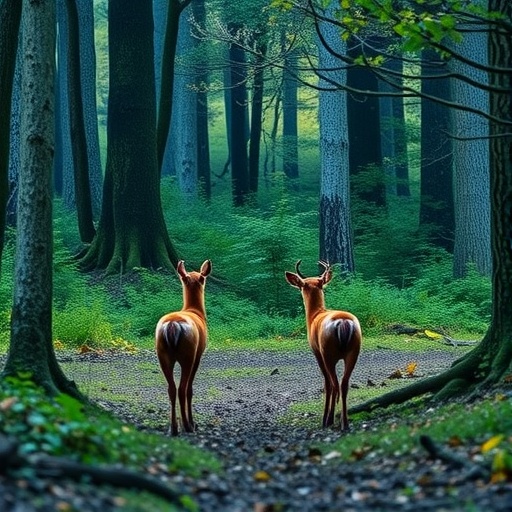
Camera traps are pivotal tools in modern ecological monitoring, capturing images of animals in their natural habitats via motion-activated sensors. These devices generate massive datasets—ranging from hundreds of thousands to millions of photos—that require extensive review by humans to identify the species present. Typically, this review can stretch for six months or longer, causing significant delays in deriving conservation insights from the collected data.
The study centers on SpeciesNet, a sophisticated AI model developed by Google, engineered to autonomously identify species across diverse ecosystems. By processing vast quantities of images from Washington state, Montana’s Glacier National Park, and Guatemala’s Maya Biosphere Reserve, the researchers rigorously tested whether fully automated identification could effectively replace human-led annotation in ecological studies.
Remarkably, for most species under consideration, AI-generated identifications yielded occupancy models almost indistinguishable from those based on human labels. These models determine not only species presence over time and space but also reveal crucial environmental factors influencing species distribution. The congruence between AI-derived data and expert analysis was observed in approximately 85 to 90 percent of cases, underscoring the robustness of the automated approach.
This near equivalence was maintained even though AI systems occasionally misclassified certain species or failed to detect animals in a small fraction of images. Such errors typically exert minimal influence on occupancy modeling due to its reliance on repeated observations across temporal and spatial scales. This inherent redundancy enables the models to absorb occasional misidentifications without distorting overarching ecological conclusions.
The implications for conservation efforts are profound. Accelerating image processing liberates ecologists and wildlife managers from the bottleneck of manual annotation, enabling more immediate responses to emerging threats, better-informed management strategies, and potentially real-time monitoring of elusive species such as jaguars, wolves, and grizzly bears. This efficiency is particularly beneficial for under-resourced organizations seeking to expand monitoring operations without proportionally increasing labor.
Lead author Daniel Thornton, a wildlife ecologist at Washington State University, emphasized that the aim is not to supplant human expertise but to empower researchers to reach analytical results with unprecedented speed. “The goal is to help researchers get to answers faster so they can make better decisions about managing and conserving wildlife,” Thornton explains.
Historically, the labor-intensive workflow mandated teams of students and scientists to painstakingly classify images, a process often spread over months. Early AI applications mitigated the workload moderately by filtering out blank images—those devoid of animals—which commonly constitute 60 to 70 percent of all captures. However, researchers still needed to manually vet the large subset containing actual wildlife, which limited true scalability.
The novel aspect of this study lies in the elimination of the final human review step. By applying SpeciesNet in a fully automated pipeline, the researchers evaluated the efficacy of AI output in generating species occurrence models directly comparable to those established through expert annotations. Dan Morris, a senior research scientist at Google and co-author of the study, underscores this pragmatic focus: “We weren’t trying to invent a new model. We were asking whether, given where the technology is today, people can rely on it for the kinds of analyses they already do.”
Despite these promising advancements, the researchers caution that challenges remain. For very rare species or those with subtle morphological differences, AI detection currently struggles. These cases still demand human intervention to ensure accuracy. Furthermore, specific applications of camera trap data—such as behavioral studies or population density estimates—may require nuanced interpretation beyond binary presence-absence determinations achievable via automated means.
Nonetheless, this research marks an important milestone in the integration of AI into conservation biology workflows. By demonstrating that established ecological models retain their integrity when derived from AI-processed data, the study signals a paradigm shift in wildlife monitoring approaches. The ability to process vast camera trap datasets rapidly and reliably removes a critical bottleneck, enabling conservationists to act with greater agility in the face of environmental challenges.
In addition to advancing practical conservation analytics, the project contributes to the broader AI-for-conservation ecosystem by publicly releasing portions of its dataset. Sharing high-quality camera trap data fosters community-driven improvements to models like SpeciesNet, catalyzing iterative enhancements that will extend AI’s applicability across regions and species.
This collaboration between academic researchers and industry exemplifies how cutting-edge technology can serve ecological science. As AI tools continue to mature, their integration with traditional methods offers a potent combination—leveraging computational efficiency without relinquishing the insightful judgments afforded by human expertise.
In summary, the study reveals that today’s AI capabilities are sufficiently mature to transform wildlife image analysis from a laborious hurdle into a streamlined, scalable operation. This transition not only accelerates research timelines but may also unlock new avenues for monitoring biodiversity at unprecedented resolutions, ultimately aiding global efforts to preserve the world’s most vulnerable species.
Subject of Research:
Application of artificial intelligence in processing camera trap images for wildlife monitoring and occupancy modeling
Article Title:
Identification of camera trap images by artificial intelligence and human experts produce similar multi-species occupancy models
News Publication Date:
7-May-2026
Web References:
http://dx.doi.org/10.1111/1365-2664.70370
Image Credits:
Mammal Spatial Ecology and Conservation Lab
Keywords:
Artificial intelligence, wildlife monitoring, camera traps, SpeciesNet, occupancy models, ecological modeling, conservation technology, automated species identification, biodiversity, ecological data analysis
Tags: accelerating ecological monitoring with AIAI applications in wildlife ecologyAI camera trap image analysisAI in conservation biologyAI vs human accuracy in ecologyAI wildlife tracking technologyautomated species identification systemsecological data automation toolsGoogle AI in environmental researchmachine learning for biodiversity studiesreducing wildlife data processing timeSpeciesNet AI model for species identification