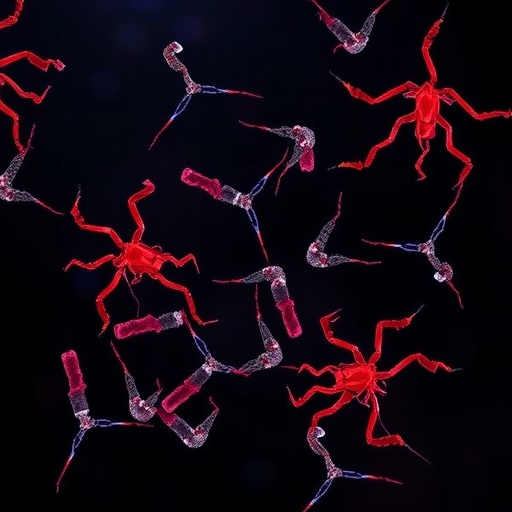
Malaria parasites do not invade red blood cells by force alone. They use a carefully coordinated molecular system that allows the invasive stage of Plasmodium falciparum to recognize, attach to and penetrate an erythrocyte within seconds. A new study by Farrell, Cooper, Butkeviciute and colleagues provides a closer look at one of the proteins at the center of this process, revealing that PfRIPR is not a rigid molecular scaffold but a flexible component capable of hinge-like motion. The findings, reported in Nature Communications, show how invasion-inhibitory antibodies can expose and exploit structural movements in the parasite’s machinery.
The discovery focuses on PfRIPR, short for Plasmodium falciparum Rh5-interacting protein. The molecule belongs to a protein complex that operates on the surface of the merozoite, the short-lived, highly specialized stage of the malaria parasite responsible for entering red blood cells. Merozoites circulate briefly after being released from infected erythrocytes, and their survival depends on rapidly invading new host cells. During this narrow window, proteins on the merozoite surface must function with extraordinary precision. PfRIPR is associated with the invasion complex built around the parasite ligand PfRH5 and other partner proteins, including CyRPA, which together help establish the molecular contacts needed for entry.
For years, researchers have viewed invasion proteins primarily through the static snapshots provided by structural biology. These images are invaluable, but they can obscure the fact that proteins are constantly moving. Their domains may rotate, bend, close or open as they bind to partners and receptors. The new work places this dynamic behavior at the center of PfRIPR biology. Rather than treating the protein as a fixed object, the researchers examined how its architecture changes and how antibodies that block invasion interact with different structural states. Their results indicate that PfRIPR contains a hinge-like region that allows one portion of the molecule to move relative to another.
This type of motion could be essential during parasite invasion. A merozoite must first make contact with the erythrocyte, then strengthen that contact and ultimately form a tightly organized junction through which it can enter. Each stage may require invasion proteins to adopt slightly different conformations. A hinge in PfRIPR could provide the flexibility needed to accommodate these transitions, helping the complex remain connected while adjusting its orientation at the parasite–cell interface. In molecular terms, the hinge may act like a controlled mechanical joint: flexible enough to permit movement, but structured enough to transmit forces and preserve the integrity of the invasion machinery.
The importance of this movement became clearer through the study of antibodies that inhibit malaria invasion. Antibodies are immune proteins capable of recognizing defined surfaces on pathogen proteins. When they bind to a critical region, they may block receptor engagement, prevent the formation of a functional complex or lock a protein into a nonproductive configuration. In the case of PfRIPR, invasion-inhibitory antibodies appear to provide more than simple molecular labels. They help reveal how the protein moves and which conformations are associated with effective parasite entry. By comparing antibody-bound and unbound forms, the researchers were able to connect antibody recognition with the dynamic hinge behavior of the molecule.
That insight has implications for the design of malaria vaccines and antibody-based interventions. A vaccine does not merely need to generate antibodies that bind a parasite protein; it must ideally induce antibodies that interfere with a vulnerable biological function. If a protein changes shape during invasion, an antibody directed against a surface visible in only one state may have limited protective value. Conversely, an antibody that recognizes a conserved hinge, a moving interface or a transition state could potentially disrupt several steps at once. Understanding PfRIPR’s motion therefore offers a framework for identifying epitopes—specific antibody-binding regions—that are functionally important rather than merely exposed.
The study also highlights a broader challenge in targeting malaria. P. falciparum has a complex life cycle and relies on multiple, tightly coordinated proteins to invade human cells. Blocking one interaction may not be sufficient if the parasite can use alternative contacts or if the targeted protein changes its configuration. Structural flexibility can make a pathogen harder to neutralize, but it can also create a weakness. A moving protein must pass through defined conformational states, and those transitions may expose temporary interfaces that are essential for function. Antibodies capable of intercepting those transitions could be particularly effective, especially when combined with antibodies against other invasion components.
PfRIPR is also relevant because the parasite’s invasion machinery is assembled as a multi-protein system rather than a collection of independent molecules. The behavior of one component can influence the orientation, stability and activity of its partners. A hinge movement in PfRIPR may alter how the protein communicates mechanically with PfRH5, CyRPA or other elements of the complex. This does not mean that PfRIPR functions like a motor in the conventional sense, but its controlled flexibility could help the complex respond to the changing physical environment encountered during invasion. The protein must operate at the boundary between a moving parasite and a deformable host cell, where molecular contacts are repeatedly formed, strengthened and rearranged.
The findings arrive as researchers continue to seek alternatives and complements to existing malaria-control tools. Vaccines, antimalarial drugs, insecticide-treated nets and mosquito-control programs have reduced disease in many settings, yet malaria remains a major global health threat, and parasite resistance continues to complicate treatment. Invasion-blocking antibodies offer a strategy that acts at the earliest stage of blood-stage infection, before the parasite can multiply inside red blood cells. By defining the structural motions that support invasion, the new study provides a more detailed map for future therapeutic development. The central message is that PfRIPR should be understood not as a static target, but as a moving molecular machine whose flexibility may determine whether the parasite succeeds or fails.
Farrell, B., Cooper, A.J.R., Butkeviciute, E. et al. Dynamic hinge-motion of PfRIPR revealed by malaria invasion inhibitory antibodies. Nature Communications (2026). The work illustrates how combining structural analysis with functional antibody studies can uncover mechanisms that would remain hidden in a single frozen molecular image. As researchers build on these observations, the next challenge will be to determine exactly when PfRIPR changes shape during invasion, how that movement is coupled to its partners and whether antibodies or vaccine-induced immune responses can reliably stop the transition. For malaria biology, the hinge is more than a structural detail: it may be a critical point of vulnerability in one of the parasite’s most important machines.
Subject of Research: The dynamic structure and hinge-like motion of PfRIPR, a protein involved in Plasmodium falciparum invasion of human red blood cells, and its interaction with malaria invasion-inhibitory antibodies.
Article Title: Dynamic hinge-motion of PfRIPR revealed by malaria invasion inhibitory antibodies
Article References: Farrell, B., Cooper, A.J.R., Butkeviciute, E. et al. Dynamic hinge-motion of PfRIPR revealed by malaria invasion inhibitory antibodies. Nat Commun (2026). https://doi.org/10.1038/s41467-026-77069-z
Image Credits: AI Generated
DOI: 10.1038/s41467-026-77069-z
Keywords: Malaria, Plasmodium falciparum, PfRIPR, malaria invasion, red blood cells, inhibitory antibodies, protein dynamics, hinge motion, vaccine research, parasite biology
Tags: advances in malaria vaccine target researchantibody targeting of malaria invasion machineryhinge motion in parasite invasion proteinsinvasion-inhibitory antibodies against malariamalaria merozoite surface proteinsmalaria parasite invasion mechanismsmolecular mechanisms of malaria parasite invasionPfRIPR protein structure and dynamicsPlasmodium falciparum red blood cell invasionprotein flexibility during malaria parasite entryrole of PfRH5 and CyRPA in malariastructural biology of malaria invasion proteins