In the relentless pursuit of advancing integrated circuit technology, managing heat generation and dissipation has become one of the most formidable challenges. As modern electronic devices continue to shrink in size while exponentially increasing in power density, the efficient evacuation of heat is critical to maintaining performance and reliability. A groundbreaking study now reveals an innovative approach to thermal management by harnessing the peculiar properties of van der Waals heterostructures, opening new avenues for asymmetric thermal transport at the atomic scale.
One of the persistent hurdles in thermal engineering is achieving directional control of heat flow within ultrathin layered materials. Traditional materials tend to exhibit symmetric thermal conductance, meaning that heat transfer efficiency remains similar regardless of the direction of heat flow. However, contemporary applications such as thermoelectric energy harvesting, thermal diodes, and protecting sensitive components necessitate materials that can favor heat flow in one direction while suppressing it in the reverse. Achieving this asymmetric phonon transport, especially in the out-of-plane direction across multilayered interfaces, has remained elusive.
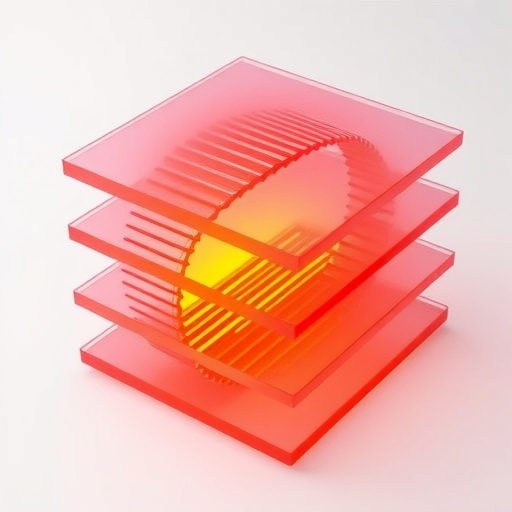
Addressing this frontier, researchers have meticulously constructed a trilayer van der Waals heterostructure composed of molybdenum disulfide (MoS₂), molybdenum sulfide selenide (MoSSe), and tungsten diselenide (WSe₂). This assembly, just under five nanometers in thickness, represents an unprecedented feat of material engineering aimed at harnessing directional heat conduction. By exploiting the unique lattice dynamics and interfacial interactions innate to these two-dimensional materials, this heterostructure acts as a ‘thermal Janus crystal,’ named for the Roman god with two contrasting faces, symbolizing its capability to conduct heat asymmetrically.
Central to the study is the precise manipulation of twist angles at the two critical interfaces: MoS₂/MoSSe and MoSSe/WSe₂. These interfacial twist angles, meticulously controlled during fabrication, serve as tuning knobs for the degree of thermal asymmetry. The twisting alters the phonon dispersion and coupling across the interfaces, which in turn modulates the phonon transmission probabilities and scattering processes. The team demonstrated that by adjusting these angles, the relative change in interfacial thermal conductance under opposing temperature gradients could vary dramatically—from a moderate 23% up to a staggering 104%—a magnitude of asymmetric thermal transport unprecedented in such atomically thin systems.
Delving deeper into the microscopic mechanisms, molecular dynamics simulations reveal the nuanced interplay of in-plane and out-of-plane phonon modes across the relevant interfaces. Phonons, quanta of lattice vibrations responsible for heat conduction, behave differently depending on their polarization and propagation direction. The simulations suggest that the MoS₂/MoSSe interface favors stronger coupling of in-plane phonon modes, while the MoSSe/WSe₂ interface preferentially facilitates out-of-plane modes. This disparity in phonon behavior across interfaces engenders an intrinsic asymmetry that skews thermal transport favorably in one direction over the other.
The impact of this finding extends beyond theoretical fascination. Experimentally, the team integrated this trilayer heterostructure within a functional device setup involving a field-effect transistor (FET) and a 58-milliwatt microwire heater. Thermal tests revealed that the surface temperature dropped by nearly 3.9 Kelvin when heat flowed from the tungsten diselenide side towards molybdenum disulfide, compared to heat flow in the reverse direction. This observable temperature difference underscores the practical viability of the thermal Janus crystal in managing heat dissipation in nanoscale electronic devices, potentially prolonging device lifetimes and enhancing performance stability.
The implications of such a breakthrough ripple across multiple technological sectors. In high-performance computing, asymmetric thermal interfaces could mitigate hotspots by directing heat away from vulnerable regions efficiently. In energy harvesting devices, rectifying heat flow can enable novel thermal diodes and transistors, leading to improved conversion efficiencies. Furthermore, the atomic-scale thickness and van der Waals nature of the heterostructure make it highly compatible with existing semiconductor fabrication processes, signaling a feasible pathway for industrial adoption.
Beyond its practical potential, this work redefines fundamental understanding of heat transport in two-dimensional heterostructures. Previous research typically regarded phonon transport as nearly reciprocal at interfaces, but introducing structural asymmetry via rotational misalignment challenges this dogma. The discovery that controlling twist angles can modulate phonon behavior so significantly adds a versatile tool to the toolkit of thermal engineering at the nanoscale. It also prompts deeper theoretical exploration into the role of symmetry breaking and anisotropic phonon interactions in other van der Waals layered systems.
Fabrication of the thermal Janus crystal required meticulous layer stacking employing advanced mechanical exfoliation and transfer techniques, ensuring atomic-level precision and cleanliness at interfaces. The choice of combining MoS₂, MoSSe, and WSe₂ was strategic, leveraging their varying lattice constants, electronic properties, and phononic spectra to maximize interfacial contrast and thus promote asymmetric transport. Importantly, incorporating the Janus compound MoSSe—an alloyed transition metal dichalcogenide with intrinsic out-of-plane asymmetry—was pivotal to breaking the reciprocity of heat flow.
Molecular dynamics simulations served as a critical complement to the experimental work, enabling visualization and quantification of phonon mode distributions and scattering phenomena at the interfaces. The sophisticated computational approach incorporated realistic potentials and boundary conditions to replicate experimentally relevant scenarios. By dissecting contributions from different phonon polarizations and momenta, the simulations corroborated the observed degree of asymmetry and illuminated the microscopic underpinnings linking twist angles to phonon transmission asymmetry.
The study’s findings propel the development of ultrathin thermal devices that could revolutionize thermal management strategies in electronics and beyond. Thermal diodes, transistors, and logic devices based on asymmetric heat transport have long been theorized but rarely realized at this scale with such dramatic performance. The thermal Janus crystal opens avenues towards active thermal circuitry and smart heat guiding materials, potentially enabling adaptive thermal management systems responsive to operating conditions.
Moreover, integrating such heterostructures into layered stack architectures promises to enable compact thermal interfaces with tailored directional conductance. This capability could fundamentally alter design paradigms in microelectronics cooling, enabling fewer layers with enhanced thermal performance and increased design flexibility. The research further inspires exploration into other multi-component van der Waals systems that might host even richer asymmetry phenomena and tunability.
This pioneering work signals a bold step forward, challenging conventional thinking and expanding the horizons of nanoscale thermal transport engineering. It underscores the potency of atomic-scale control—not just of material composition but also orientation and stacking—in dictating macroscopic functional properties. As demands for efficient, miniaturized, and reliable thermal management solutions escalate, innovations like the thermal Janus crystal will undoubtedly shape the future landscape of semiconductor technology and materials science.
In conclusion, the unveiling of asymmetric thermal transport enabled by trilayer van der Waals heterostructures marks a transformative moment in heat management research. By exploiting rotational alignment and intrinsic material asymmetry in a few-nanometer thin crystal, researchers have demonstrated controllable, directional heat conduction unprecedented in scale and performance. This discovery holds profound implications for both fundamental science and applied technology, promising smarter, more efficient ways to control heat in next-generation electronics and energy devices.
The research community eagerly awaits further exploration and adaptation of this concept, particularly how it can be integrated seamlessly with current semiconductor manufacturing lines and scaled for commercial applications. The continued refinement of fabrication techniques, combined with deeper theoretical insights, may soon unlock a new generation of thermally intelligent materials and devices that manipulate heat as dexterously as electricity or light.
Ultimately, the thermal Janus crystal exemplifies how atomic precision engineering enables emergent properties that transcend the capabilities of individual materials. It marks a critical step in the evolution of van der Waals heterostructures from intriguing scientific curiosities to practical, impactful technologies that reshape the nexus of heat, energy, and information in the modern world.
Subject of Research: Asymmetric thermal transport in nanoscale van der Waals heterostructures.
Article Title: Asymmetric thermal transport in a trilayer van der Waals heterostructure.
Article References:
Wang, H., Zhu, H., Xue, G. et al. Asymmetric thermal transport in a trilayer van der Waals heterostructure. Nat Electron (2026). https://doi.org/10.1038/s41928-026-01620-5
Image Credits: AI Generated
DOI: https://doi.org/10.1038/s41928-026-01620-5
Tags: asymmetric heat flow in van der Waals heterostructuresdirectional heat transport in 2D materialsmolybdenum disulfide MoS2 thermal propertiesout-ofphonon transport in layered semiconductorsthermal diodes using van der Waals heterostructuresthermoelectric energy harvesting in 2D materialstrilayer van der Waals materials thermal managementtungsten diselenide WSe2 heat conductionultrathin layered materials heat dissipation