SAN DIEGO — The U.S. Food and Drug Administration (FDA) is in the middle of a cultural and operational shift that goes beyond leadership changes. U.S.–China biotechnology competition is driving discussions around regulatory reform in the U.S. where traditional paradigms are being reviewed and reconsidered, particularly for rare diseases. And patient perspectives need to be a more integral part of the drug development continuum.
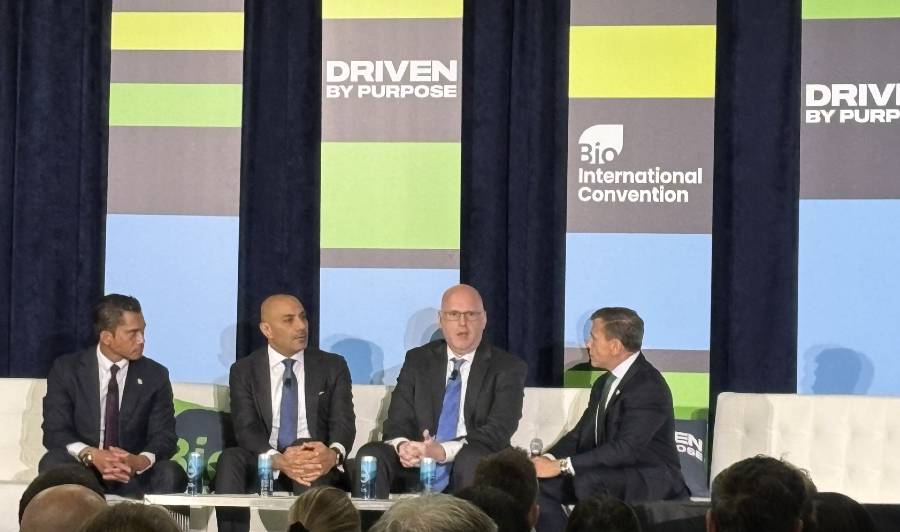
Those were some of the major themes that emerged from a town hall that took place at this year’s Biotechnology Innovation Organization (BIO) meeting in San Diego, which featured members of the current FDA leadership team.
John Crowley, BIO president and CEO, moderated the discussion with the acting directors of Center for Drug Evaluation and Research (CDER) and the Center for Biologics Evaluation and Research (CBER) and the acting chief of staff at the FDA. During the hour-long conversation in a room packed to the hilt with BIO attendees, they spoke about the agency’s current priorities and its plans to increase its headcount, among other initiatives.
Much of the discussion centered on ongoing plans to stabilize the agency’s workforce following the massive reduction in staffing implemented by the Department of Government Efficiency (DOGE) as well as departures of several leaders in rapid succession. The panelists acknowledged the disruptions to operations, the loss of institutional knowledge, and the past unpredictability at the agency, but did not dwell on it.
The consensus seems to be that stabilizing the agency’s workforce is an important prerequisite for successfully launching several planned initiatives. In fact, Michael Davis, MD, PhD, acting director of CDER, noted that this has been one of his top priorities. His initial efforts were aimed at “fortifying the center and specifically the workforce” as well as finding ways to retain staff retention and boost recruitment.
The conversation covered plans to improve overall morale, boost staff numbers, and to refocus on executing the agency’s mission. That includes implementing “some initiatives that were announced” or “have been in discussion for some time” and thinking through what is needed to support those programs, said Lowell Zeta, JD, acting chief of staff at the FDA.
Karim Mikhail, CBER acting director, stated that in addition to working through existing submissions, his team is also planning for future challenges and ways to address them quickly to avoid backlogs.
In terms of recruitment, the agency is looking to fill more than 2,200 authorized positions across the agency, Zeta said. About 600 people are currently being onboarded as part of the hiring push “so we feel like we’re making good progress.” CDER’s Davis said he is open to “bringing back good people” who would be interested in returning, as well as recruiting new candidates interested in public health who have the requisite skills.
The agency is also intentional about its efforts to minimize attrition, including offering opportunities for staff to meet with leadership to discuss challenges and support needs. And those efforts may be working. In CDER, for example, staff attrition has slowed to its historical rate.
Modernizing clinical development
Earlier this week, the FDA announced a slate of early actions aimed at “modernizing” and expediting early and late-stage clinical development. These were unveiled as part of Operation TrailBlazer, a U.S. Department of Health and Human Services initiative. The proposed changes are aimed at streamlining Phase I submission requirements so that drug developers have more clarity about what is necessary at this stage and what can be deferred. The agency is seeking public comments from the scientific community on some of these proposed actions.
The panelists positioned the proposed actions as a fundamental shift from the traditional comprehensive review approach to drug development towards a more adaptive design process. “Everybody understands the challenge we have,” Mikhail said. “We have incredible rigor” but “we need to make sure that we’re also as fast as we are rigorous.”
Importantly, the agency is also seeking to make patient perspectives more central to the drug development process. Asked by Crowley how this will work, Davis shared an anecdote about taking part in a listening session coordinated by the FDA for parents of patients with the rare disorder, Smith-Magenis syndrome. Asking questions like “What is it like to have children with this condition? What effect does that have on the children? What effect does that have on the family dynamic?” makes it “more real when connecting the data to what families and patients are experiencing.”
China crisis
Another major theme here and indeed throughout the conference was maintaining U.S. competitiveness and leadership in biotech. The panelists acknowledged China’s current competitive advantage in terms of the development of its biotech infrastructure and the reality of clinical trials moving overseas due to increasing costs and the regulatory burden in the U.S.
As Crowley put it, “China frankly is eating our lunch” and “we’re forcing so many of our innovators and companies to go to China” for early-stage clinical trials. In this climate, he noted that the FDA has a crucial role to play.
The FDA has traditionally been viewed as the “guardian of public health, which is an important, primary role,” Crowley said, but “this notion of being a beacon of innovation and U.S. competitiveness tied to our national security is a new and important role.” The panelists also highlighted the growing use of artificial intelligence tools, digital health technologies, and wearable sensors as an important source of innovation within the agency
The FDA has recently signaled a willingness to revisit decisions it made over the past several months if those companies whose applications were rejected choose to resubmit them. “I want to make sure that we’re getting the decisions right in a way they have the confidence of the American public,” Davis said. “I think the public really trusts the FDA to make the right decisions” and “doing this closely with the multidisciplinary expert staff that we have.”
To be clear, the agency is not going to approve everything, Mikhail said. But it will make sure that patient safety is prioritized, and that a multidisciplinary group of scientific experts at the FDA provide critical input.
“I think everybody wants what is best for the patients,” he said. So “making sure that safety is paramount” and that “everybody is on the same page with regards to that second chance.”