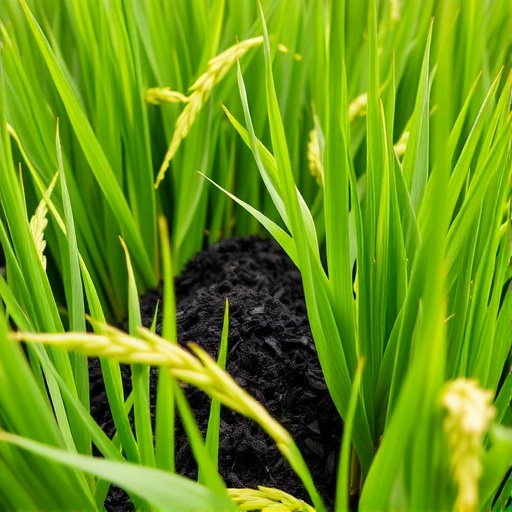
Rice straw is a cornerstone of sustainable rice farming—returned to fields to recycle nutrients and avoid open burning. But a new study suggests that what looks like a “waste-to-resource” practice may also reshape how toxic metals move from contaminated soil into the food chain.
Researchers investigated six rice straw management approaches and measured arsenic, cadmium, copper, nickel, lead, and zinc levels in rice. The work, published in Environmental and Biogeochemical Processes, is notable for treating multiple contaminants at once rather than optimizing for a single metal.
The experiments used greenhouse pots filled with cadmium-contaminated paddy soil collected from Jiangsu Province, China. Treatments included direct incorporation of untreated straw, accelerated straw decomposition, soil pH adjustment, modified water management, and application of biochar produced from rice straw.
Direct straw incorporation produced sharply contrasting outcomes across the metal suite. Arsenic in rice grains rose by 73.1%, while copper and lead dropped by 13.8% and 89.3%, respectively. Meanwhile, cadmium, nickel, and zinc showed no significant change under the conditions tested, highlighting the complexity of straw-driven chemistry.
Alternative mitigation strategies did not reliably prevent unwanted metal accumulation. Adjusting soil pH or changing decomposition timing failed to deliver consistent benefits, and modified water management could worsen risk: grain cadmium increased roughly 30-fold and exceeded China’s national food safety limit.
A key mechanism proposed by the authors involves organic matter released during straw breakdown. That material can strongly bind certain metals (such as copper and lead), yet simultaneously alter soil chemistry and microbial processes in ways that mobilize or transform other elements, including arsenic.
In contrast, applying rice straw–derived biochar at a relatively low dose of about 0.3% did not significantly increase any of the six metals in rice grains. The biochar treatment also reduced copper and lead accumulation, improved several soil properties, and produced the highest grain and whole-plant biomass among the tested options.
Because biochar is produced by heating biomass under oxygen-limited conditions, it is more stable than raw straw. Beyond contaminant control, converting straw to biochar can also reduce air pollution from open burning and limit greenhouse gases associated with decomposition in flooded paddies.
The authors caution that pot results may not translate directly to all field conditions. Further field trials across different soils, climates, and rice varieties are needed, alongside economic assessments of collection, production, transport, and application.
Subject of Research: Environmental and Biogeochemical Processes—rice straw management and heavy metal accumulation
Article Title: Incorporating rice straw in the form of biochar: a sustainable measure to protect humans from heavy metal exposure
News Publication Date: 30-Jun-2026
Web References: https://doi.org/10.48130/ebp-0026-0007
References: Liao J, Ning W, Gong Y, Tang W, Zhong H. 2026. Environmental and Biogeochemical Processes 2: e012. doi:10.48130/ebp-0026-0007
Image Credits: Jiannan Liao, Wenjing Ning, Yu Gong, Wenli Tang, & Huan Zhong
Keywords: rice straw, biochar, heavy metal pollution, arsenic, cadmium, food safety, soil chemistry, greenhouse pot experiment, sustainable agriculture, paddy soil
Tags: arsenic and cadmium uptake in ricebiochar application for soil remediationenvironmentally sustainable rice farming techniquesheavy metal contamination in riceheavy metal transfer from soil to rice grainsimpact of water management on metal levelsmulti-metal contamination in rice cultivationrice straw biocharrice straw decomposition effectsrice straw management strategiessoil pH modification for metal mitigationsustainable rice farming practices