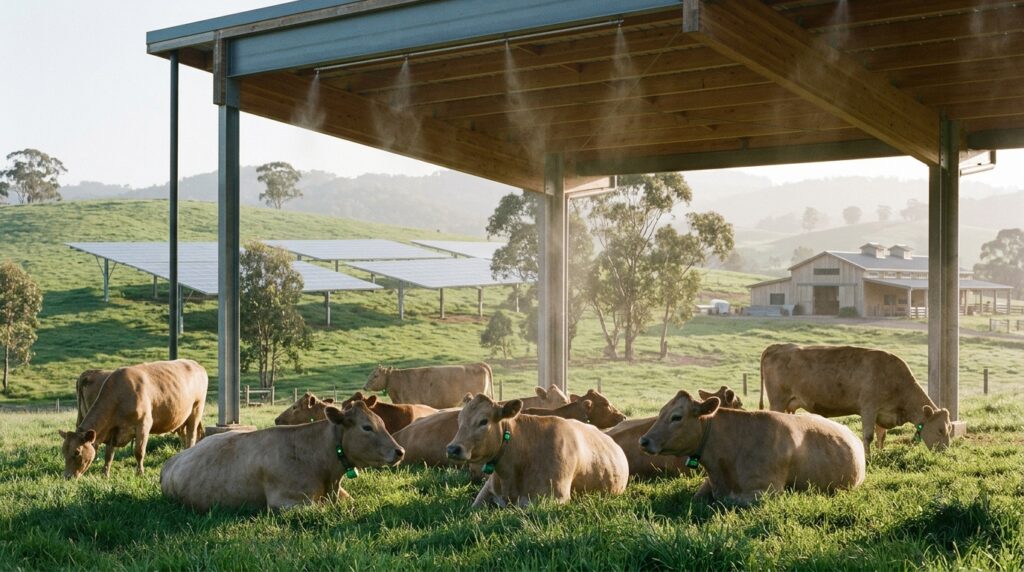
Climate change is reshaping livestock production worldwide, and a new review argues that the response can no longer be piecemeal. Writing in Frontiers in Animal Science, Yavuzkan Paksoy and Nazan Koluman of Cukurova University in Türkiye synthesize biological, environmental, technological and socio-economic evidence to build an integrated framework for climate-resilient livestock systems. Their central claim is that adaptation strategies are too often evaluated through single outcomes such as productivity, emission intensity or physiological response, while their combined effects at the production-system level, including trade-offs, go unmeasured. The review places particular emphasis on Mediterranean and semi-arid systems, where rising temperatures, recurrent drought, declining water availability and land degradation threaten production ranging from extensive sheep and goat grazing to intensive dairy and meat operations.
The physiological stakes are concrete. Heat stress reduces voluntary feed intake, alters metabolic and endocrine functions, compromises immune responses, and negatively affects growth, milk production, reproductive efficiency and welfare. One controlled experiment summarized in the review exposed Holstein dairy cows to heat stress over nine days: dry matter intake fell by more than 35 percent, and milk yield declined 40.5 percent under heat stress compared with 20.9 percent in thermoneutral pair-fed cows that ate the same reduced amount of feed. The comparison matters because it shows heat damages milk production beyond the effect of reduced eating alone. The authors caution, however, that the experimental groups were small and the exposure short, so the result is not a general estimate for all herds.
Water scarcity emerges as one of the most critical climate-related constraints, particularly in arid and semi-arid regions. Declining availability affects livestock through reduced access to drinking water, deterioration of grazing resources, limits on irrigation for forage production, and rising production costs. Global water-footprint accounting across farm animal production attributes roughly 98 percent of the total livestock water footprint to feed production, with drinking water accounting for only about 1.1 percent. The authors stress that these figures refer to global accounting, not direct freshwater withdrawals, and that the footprint includes green, blue and gray water, so it is not a measure of irrigation savings. A separate global comparative assessment finds nearly one-third of agriculture’s total water footprint associated with animal products, a descriptive global estimate rather than a measured adaptation response.
Small ruminants occupy a special position in this picture. Goats and sheep adapted to dry environments often show greater tolerance to limited water availability, thanks to physiological and behavioral mechanisms that enable more efficient water use and greater resistance to dehydration. Yet the review is explicit that such adaptive capacity should not be read as an absence of welfare risk: prolonged or severe water restriction can compromise physiological homeostasis, health, behavior and productivity even in relatively drought-tolerant animals. Adaptation strategies, the authors argue, should therefore combine resilient genotypes with adequate water provision, heat-stress management and continuous monitoring of animal-based welfare indicators rather than relying on breed reputation alone.
Genetic resources form a second pillar. Locally adapted breeds may carry traits related to heat tolerance, disease resistance, efficient use of low-quality feed, and adaptation to harsh or highly variable environments; the review cites Awassi sheep as an example of advantages under hot and dry conditions, and mentions Akkaraman and local Mediterranean goat populations as valuable genetic resources for challenging environments. Maintaining genetic diversity gives populations a broader biological capacity to respond to future climatic and disease challenges, and the authors frame conservation of locally adapted breeds as a long-term climate adaptation strategy, not merely a biodiversity objective. Drought-tolerant forage crops such as sorghum and pearl millet can support feed availability under water-limited conditions. They also warn that intensive selection for a narrow set of economically desirable traits may erode the very variability needed for future adaptation, so breeding programs should balance short-term gains against long-term adaptive capacity.
Technology receives the most forward-looking treatment. Precision livestock farming, wearable sensors, accelerometers, cameras, microphones, rumination sensors, GPS and GNSS devices, computer vision, thermal imaging, satellite observations and automated feeding systems can generate continuous or near-real-time information on animals and their environments. In the heat-stress context, automated systems combining environmental measurements with body temperature, activity, feeding behavior and imaging can help characterize animals’ responses to thermal strain, and machine-learning approaches may improve interpretation of these multidimensional datasets. Recent multimodal monitoring studies have detected behavioral and performance responses of grazing cattle to thermal conditions using integrated sensor systems. Early identification of heat-related changes can let producers adjust feeding schedules, grazing periods, shade, ventilation, cooling and water provision before severe welfare or production consequences develop.
Artificial intelligence extends this analytical reach. AI-based approaches can integrate heterogeneous datasets from sensors, images, production records, environmental monitoring and genomic information, and may support prediction of heat stress, health disorders, changes in feeding and drinking behavior, reproductive events and shifts in resource requirements. Combined with weather forecasts, predictive algorithms could provide early-warning information that allows producers to act before climatic thresholds are exceeded. The authors are careful, however, to distinguish prediction from decision: algorithm performance depends on training-data quality, sensor accuracy, animal population, production environment and external validation, and models developed under intensive dairy conditions may not perform equally well in extensive sheep or goat systems. AI-supported technologies, they write, should complement rather than replace veterinary expertise and farmer observation, with human oversight maintained wherever automated decisions bear directly on animal health and welfare.
The review is equally clear about the barriers and trade-offs. High investment costs, infrastructure requirements, limited internet connectivity, maintenance demands, data-management capacity and lack of technical expertise restrict adoption, particularly among smallholders, and some of the livestock systems most exposed to climate change sit in areas with the least access to advanced technological infrastructure. Digitalization also raises questions of data ownership, privacy, interoperability, algorithm transparency, farmer autonomy and dependence on commercial providers, and unequal access could widen the gap between large commercial enterprises and smaller farms. Sensor-based monitoring does not automatically improve welfare; improvements occur only when information leads to appropriate intervention. Cooling systems illustrate the trade-off problem: they can relieve thermal stress in housed dairy cattle but increase water, electricity and capital demands, limiting suitability for extensive systems. A United States livestock-sector economic simulation cited in the review estimated annual heat-stress losses of approximately 2.36 billion dollars with minimal abatement versus 1.69 billion dollars with optimized abatement, modeled historical estimates rather than observed farm-level savings.
Measurement itself comes under scrutiny. A recent review of 239 European whole-farm cattle life cycle assessment studies published between 2010 and 2024 found that attributional LCA remains dominant and that studies frequently concentrate on a limited set of impact categories, particularly global warming, acidification and eutrophication potentials. Conventional product-based indicators, the authors argue, poorly represent functions of extensive grazing systems such as utilization of marginal land, maintenance of open landscapes, preservation of locally adapted genetic resources and support for rural livelihoods, though they caution these should not automatically be counted as environmental benefits in all grazing systems, since their magnitude depends on stocking density, ecosystem characteristics and management intensity. As climatic variability increases, they propose treating resilience itself as a sustainability outcome: a system that is highly efficient under stable conditions but loses production, health or viability during droughts or heat waves is not necessarily more sustainable than one with moderate average productivity but greater stability under disturbance. They recommend complementing environmental LCA with animal welfare assessments, biodiversity and ecosystem-service indicators, socio-economic evaluations and measures of adaptive capacity.
The strategic framework that emerges is layered across animal, farm, landscape and institutional levels. At the animal level sit locally adapted genetic resources, breeding objectives that include robustness and thermal tolerance, preventive health management and welfare-oriented practices. At the farm level, adaptive and rotational grazing, diversified feed resources, efficient water management, appropriate housing and precision monitoring reduce exposure and sensitivity to climatic stress. Landscape-level measures include sustainable rangeland management, biodiversity conservation, soil protection and crop-livestock integration, while institutional support requires extension services, climate information, financing mechanisms, infrastructure, policy coordination and participatory governance. The authors call for long-term, multi-location studies comparing adaptation outcomes across species, breeds, production systems and climatic environments, and for affordable monitoring and decision-support technologies suitable for smallholders. Their closing argument is that climate resilience should be understood as a dynamic process of continuous monitoring, learning and adaptive management, in which animal welfare, ecological sustainability, technological innovation and socio-economic viability are treated as interconnected rather than separate challenges.
Subject of Research: An integrated review of climate adaptation strategies for livestock systems, covering heat stress, water scarcity, locally adapted breeds, precision farming technologies and sustainability assessment.
Article Title: Future-ready livestock systems: climate resilience, animal welfare and sustainable adaptation
Article References: Paksoy, Y., & Koluman, N. (2026). Future-ready livestock systems: climate resilience, animal welfare and sustainable adaptation. Frontiers in Animal Science, 7, Article 1972520. https://doi.org/10.3389/fanim.2026.1972520
Image Credits: AI Generated
DOI: 10.3389/fanim.2026.1972520
Keywords: climate resilience, livestock, animal welfare, heat stress, precision livestock farming, water scarcity, locally adapted breeds, genomic selection, Mediterranean agriculture, life cycle assessment, adaptive grazing, small ruminants