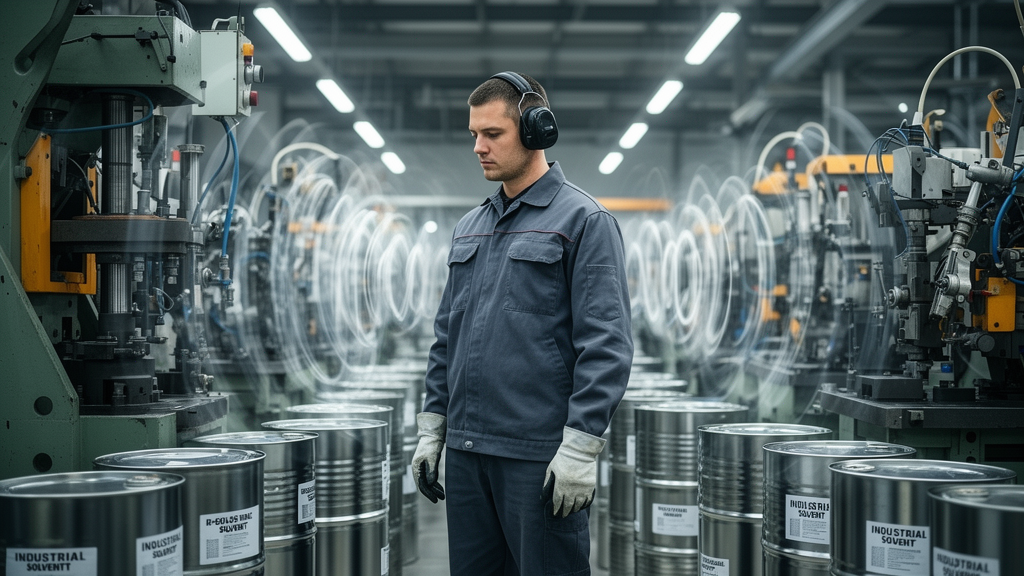
A detailed investigation into occupational health hazards in Chinese manufacturing facilities has revealed that industrial workers subjected simultaneously to industrial noise and airborne benzene compounds show hearing impairment spanning the entire audible testing spectrum. Conducted by researchers from Hebei Medical University alongside municipal and provincial centers for disease control and prevention, the study evaluated auditory thresholds and biological exposure indicators across distinct operational environments. The newly reported findings indicate that while acoustic trauma typically impairs high-frequency perception and chemical solvents disturb mid- to high-frequency hearing, concurrent exposure to both environmental stressors is linked to elevated hearing thresholds across low, middle, and high acoustic frequencies alike.
To investigate the specific auditory consequences of isolated and combined exposures, the research team implemented a judgment sampling design to recruit one hundred and fifty-five workers across four operational manufacturing enterprises in China. Prior to participant selection, comprehensive on-site occupational hygiene surveys evaluated production workflows, enterprise scale, engineering controls, and the availability of personal protective equipment to ensure stable manufacturing conditions and isolate well-defined hazard profiles. Candidate workplaces were screened through ambient sound level measurements and volatile solvent monitoring along primary factory aisles to identify consistent exposure zones while systematically excluding posts involving heavy metals or undefined toxic hazards. Eligible participants were required to have maintained stable job placements for longer than twelve months with no confounding exposures to extraneous ototoxic chemicals. Individuals with a history of military service, diagnosed otological pathologies, documented familial hearing loss, ototoxic pharmaceutical treatments, or hospital-confirmed diabetes mellitus were systematically excluded from the study cohort.
The final research cohort comprised thirty-eight unexposed control employees from a furniture manufacturing facility, thirty-nine workers exposed exclusively to organic solvents in a paint manufacturing enterprise, forty employees exposed solely to industrial noise within a furniture production company, and thirty-eight workers experiencing combined exposure to noise and organic solvents at an automotive components facility. Within the baseline demographic assessment, statistical evaluations across the four groups indicated no significant discrepancies regarding participant age or biological sex. The distribution of educational attainment, smoking habits, alcohol consumption, physical exercise routines, overall length of employment service, daily operational working hours, shift-level noise exposure durations, and the utilization of personal protective equipment were recorded through a structured eleven-item questionnaire.
Full-shift personal noise monitoring was executed using calibrated physical exposure meters fitted with shoulder-mounted microphones positioned four centimeters above the shoulder and ten centimeters from the external auditory canal of the most exposed ear. The monitoring apparatus recorded continuous shift equivalent sound levels alongside noise exposure kurtosis while avoiding mechanical interference from workers’ garments. For ninety-seven employees with complete shift-level dosimetric tracking, eight-hour equivalent noise measurements averaged fifty-eight point three decibels in the control cohort, sixty-seven point one six decibels in the solvent-only group, eighty-five point four four decibels in the noise-only cohort, and seventy-three point one six decibels in the combined-exposure population. Within the noise-only group, thirty-three of thirty-eight monitored employees registered sound exposures reaching or exceeding the eighty-decibel threshold, whereas only seven of thirty-eight individuals in the combined-exposure cohort recorded shift exposures meeting or exceeding that same acoustic benchmark.
Workplace environmental chemistry was systematically evaluated across ninety-four fixed sampling points across the participating paint and automotive components facilities, comprising eighteen ambient stations in the solvent-exposure facility and seventy-six stations in the co-exposure facility. Solid activated-carbon adsorption tubes mounted in pump-free passive samplers captured volatile aromatic compounds throughout representative high-concentration zones, stationary workstations, and mobile transit paths. Chemical desorption using carbon disulfide containing a fluorobenzene internal standard was followed by quantitative analysis through gas chromatography-tandem mass spectrometry operated with electron impact ionization under multiple reaction monitoring. Ambient concentrations of six target volatile compounds—benzene, toluene, ethylbenzene, ortho-xylene, meta-xylene, and para-xylene—were consistently detected in both solvent-exposed environments. Ambient toluene concentrations reached up to zero point one three six milligrams per cubic meter in the solvent facility and one point seven five eight milligrams per cubic meter in the combined-exposure facility, while meta-xylene reached peak levels of zero point two three zero and two point three zero zero milligrams per cubic meter across the respective enterprise environments.
Processed through solid-phase extraction with specialized sorbent columns and analyzed via ultra-performance liquid chromatography-tandem mass spectrometry in electrospray negative ionization mode, the biological specimens were assayed for eight established metabolic indicators: trans,trans-muconic acid, ortho-methylhippuric acid, meta-methylhippuric acid, para-methylhippuric acid, mandelic acid, hippuric acid, phenylglyoxylic acid, and benzene mercapturic acid. At least seven of the target metabolites were detected in one hundred and fifty-four of the one hundred and fifty-five tested samples.
The evaluation of external and internal exposure metrics demonstrated that fixed-site ambient air concentrations failed to reliably correlate with internal biomarker concentrations for several compounds, underscoring the critical necessity of biological monitoring in occupational surveillance. Nonparametric rank correlation evaluations demonstrated statistically significant, weak-to-moderate positive associations between ambient ethylbenzene and urinary phenylglyoxylic acid, ortho-xylene and ortho-methylhippuric acid, meta-xylene and meta-methylhippuric acid, and para-xylene and para-methylhippuric acid. Conversely, no statistically significant associations emerged between ambient benzene and trans,trans-muconic acid or between ambient toluene and hippuric acid.
Auditory health was determined through bilateral pure-tone audiometry conducted prior to the commencement of work shifts following a mandatory noise-free cessation period of at least twelve hours. Following otoscopic inspection of the external auditory canal and tympanic membrane to exclude severe cerumen impaction or structural ear pathology, hearing thresholds were quantified across frequencies of two hundred and fifty, five hundred, one thousand, two thousand, three thousand, four thousand, six thousand, and eight thousand hertz from minus ten to eighty-five decibels of hearing level. Auditory impairment was classified under World Health Organization criteria as any threshold exceeding twenty-five decibels of hearing level. Normal hearing rates exceeded ninety-seven percent across all tested frequencies in both ears among the unexposed control cohort. In contrast, hearing abnormality rates in the solvent-only cohort exceeded thirty-five percent at three, four, and eight kilohertz, while the noise-only group exhibited abnormality rates exceeding sixty percent in the left ear at three kilohertz and across both ears at four kilohertz.
The morphological profile of hearing loss diverged substantially across the experimental groups. While the noise-only group exhibited auditory damage concentrated within high frequencies, the organic solvent cohort demonstrated functional impairments extending into mid-frequency hearing ranges. In the combined-exposure cohort, hearing loss was uniquely distributed across the entire testing range, showing elevated thresholds even at lower frequencies such as two hundred and fifty and five hundred hertz. All three exposed cohorts displayed a distinct audiometric notch at six thousand hertz in both ears, matching the recognized pathophysiological signature of acoustic trauma where sensory outer hair cells of the cochlea sustain localized mechanical and metabolic injury. As duration of employment lengthened, these audiometric notches widened and deepened toward neighboring acoustic bands. Furthermore, rank correlation analyses between urinary benzene metabolites and pure-tone thresholds yielded positive coefficients ranging between zero point two and zero point four, verifying that higher internal chemical burdens are monotonically associated with elevated hearing thresholds.
Multivariate binary logistic regression analyses adjusted for demographic, behavioral, and occupational factors identified several distinct determinants of frequency-specific hearing loss. Lower educational attainment showed significant positive associations with low- and high-frequency loss, and lifestyle factors including alcohol intake and tobacco smoking exhibited positive associations with impairment at specific mid-to-high frequencies. Notably, an employment duration of five to ten years exhibited negative associations with hearing loss at two, four, and six kilohertz in the left ear and six kilohertz in the right ear. The authors attributed this pattern to a healthy worker survivor effect, wherein workers experiencing early auditory decline are reassigned to quieter factory sectors, leaving individuals with resilient hearing in long-term exposure roles.
The regression models additionally revealed that reporting the use of hearing protection equipment was positively associated with hearing loss across multiple frequencies from two thousand through eight thousand hertz in both ears. Rather than reflecting an adverse effect of the protective gear itself, this statistical association was attributed by the investigators to inconsistent or improper usage by workers in intensely noisy environments, as well as the selective provision of hearing protection to employees operating in the highest acoustic hazard zones. Conversely, the omission of respiratory protective equipment designed for organic solvents was positively associated with hearing loss at eight thousand hertz in the left ear and at five hundred, three thousand, four thousand, six thousand, and eight thousand hertz in the right ear. Cross-tabulation analyses combining median-split metabolite concentrations and eighty-decibel noise thresholds confirmed that joint exposure categories exhibited significant associations with hearing loss, particularly at three, four, six, and eight kilohertz.
Despite the broader acoustic spectrum of hearing loss observed in the combined-exposure group, pairwise statistical comparisons between the groups following rigorous Bonferroni correction revealed important interpretive limits. Statistically significant differences in hearing status distributions were confirmed between the unexposed control group and each of the three exposure groups across several frequencies. However, comparisons between the combined-exposure cohort and either the solvent-only or noise-only cohorts yielded adjusted p-values greater than the corrected threshold of zero point zero zero eight three. Consequently, the cross-sectional dataset demonstrates a clear association between combined exposure and widespread auditory impairment, but it does not establish a statistically significant synergistic effect beyond the independent ototoxic contributions of noise and benzene solvents. The authors highlighted that modest subgroup sizes of thirty-eight to forty workers and overlapping noise levels across manufacturing sectors limited statistical power, emphasizing the urgent need for larger prospective cohorts and toxicological investigations to optimize workplace hearing conservation standards.
Subject of Research: Auditory impairment associated with combined occupational exposure to noise and benzene compounds
Article Title: Risk analysis of hearing loss in workplace populations due to combined exposure to benzene compounds and occupational noise
Article References: Lu, Y., Sui, L., Dong, Q., Jiao, B., Shi, J., Ren, Y., Li, Z., Li, S., Bai, G., Chen, X., Shi, H., & Yang, L. (2026). Risk analysis of hearing loss in workplace populations due to combined exposure to benzene compounds and occupational noise. Frontiers in Public Health, 14, Article 2023337. https://doi.org/10.3389/fpubh.2026.2023337
Image Credits: AI Generated
DOI: 10.3389/fpubh.2026.2023337
Keywords: Occupational health, Hearing loss, Benzene compounds, Industrial noise, Toluene, Xylene, Ethylbenzene, Pure-tone audiometry, Biomarkers, Urinary metabolites, Methylhippuric acid, Environmental monitoring, Ototoxicity, Workplace safety, Public health, Audiometric notch