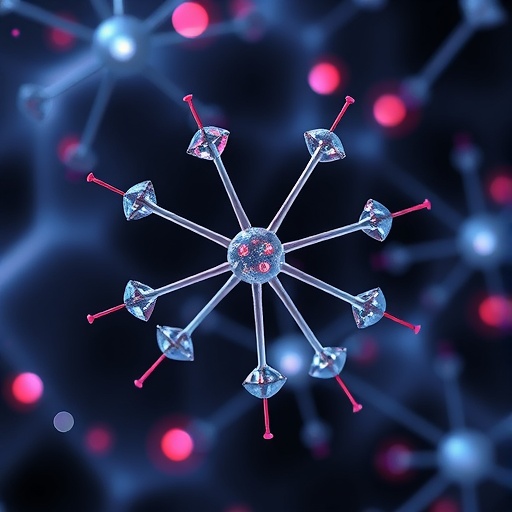
A team of researchers led by Professor Taesung Kim from Sungkyunkwan University has made a groundbreaking advancement in neuromorphic engineering by developing an optoelectronic synaptic device that closely emulates the functional complexities of human neurons and synapses. This novel device is constructed from a designable van der Waals (vdW) crystal synthesized through a single-step sulfurization process involving mixed plasma. Operating under optical stimuli, this innovation provides a transformative structural approach to engineering semiconductor materials tailored for brain-inspired computing paradigms.
In the quest to meet the surging demands of artificial intelligence technologies and hyper-connected digital ecosystems, neuromorphic vision systems have emerged as vital tools capable of sensing and processing vast volumes of visual information with remarkable speed and precision. At the heart of these systems lie optoelectronic synapses, components whose conductance dynamically modulates in response to light signals, thereby serving as fundamental units for information processing. Layered vdW materials have attracted intense research interest for such applications, largely due to their unique optical properties coupled with atomic-scale thinness. However, widespread adoption has been hampered by technical barriers such as uncontrollable grain boundaries, issues of intercalation, polymer residue buildup, mechanical warpage at material interfaces, and inconsistencies in large-area crystalline uniformity.
Addressing these challenges, Professor Kim’s research team drew inspiration from the structural and functional analogy between biological ion channels—integral to light-sensitive neuronal membranes—and the layered lattices of van der Waals crystals. Utilizing an argon and hydrogen sulfide plasma (Ar + H₂S) sulfurization technique applied to bulk van der Waals rhenium selenide (ReSe₂), the researchers engineered a two-tiered material structure. The top layer was converted into a nano-crystalline ReSe₂ consisting of interconnected nano-sized grains, whereas the underlying bulk single-crystalline ReSe₂ was preserved intact without compromising interlayer interfaces. This architectural design mimics the biphasic nature of neuronal membranes, with the nano-crystalline layer corresponding to light-sensitive ion channels and the bulk layer aligning with the intracellular environment. Remarkably, this was achieved without any additional deposition or patterning steps, underscoring the efficiency of the single-step process.
Delving deeper into the material’s operability, the team harnessed scanning probe microscopy (SPM) to meticulously map the pathways of sulfur ion (S²⁻) migration within the nano-crystalline layer. The grain boundaries in this region distinctly confined sulfur ionic transport at an atomic scale, effectively enabling deterministic modulation of synaptic weights. This functionality parallels the gating mechanisms of biological ion channels, wherein ionic flow is tightly regulated to facilitate neural signal transmission. The precision control of ionic migration underscores a critical breakthrough in mimicking synaptic plasticity within artificial devices.
The device demonstrated core synaptic functionalities essential for brain-like operations, such as multi-level conductance modulation and long-term potentiation/depression (LTP/LTD), which are fundamental to learning and memory processes. Additionally, it exhibited paired-pulse facilitation (PPF) and a tunable transition from short-term to long-term memory (STM-LTM), both indicative of complex temporal neural dynamics. Compared to its bulk ReSe₂ counterpart, the nano-crystalline device showed a substantial 34.7% enhancement in retention efficiency amidst learning-forgetting-relearning cycles, highlighting its robust memory endurance.
The practical promise of this optoelectronic synapse was further reinforced through system-level evaluations. When implemented in image processing tasks, the device effectively performed edge detection on natural images, a critical operation in visual perception systems. Moreover, it achieved an impressive classification accuracy of 96.24% on the CIFAR-10 benchmark dataset, which is a standard testbed for advanced image recognition algorithms. These outcomes position the technology as a highly competitive candidate for next-generation neuromorphic semiconductor devices and AI hardware platforms.
Professor Taesung Kim elaborated on the significance of this research, emphasizing the breakthrough single-step fabrication that allows intentional design of van der Waals crystal structures for optoelectronic synaptic applications. By isolating and controlling the randomness typically associated with ionic migration and interface irregularities in conventional devices, this work sets a new foundation for brain-inspired electronics. The unique architecture opens avenues not only for enhanced device stability but also for scalable manufacturing of neuromorphic components.
This research represents a concerted collaboration across multiple leading institutions, including Sungkyunkwan University, the Center for Quantum Nanoscience at the Institute for Basic Science (IBS), and the Korea Institute of Machinery and Materials (KIMM). The interdisciplinary approach, combining expertise in mechanical engineering, quantum nanoscience, and materials science, was crucial in overcoming long-standing materials challenges and pioneering this innovative device architecture.
The project garnered substantial funding from prominent Korean institutions such as the National Research Foundation of Korea (NRF) Leader Research Program, the Institute for Basic Science, and the Semiconductor-Track Graduate School Program supported by the Ministry of Trade, Industry and Energy (MOTIE). The financial and institutional support was instrumental in facilitating advanced materials synthesis techniques, comprehensive characterization, and device prototyping efforts that culminated in this milestone achievement.
The findings of this study were recently published in the prestigious journal Advanced Materials, highlighting the technical depth and high impact of the work within the scientific community. The article underscores the potential of vdW materials in revolutionizing optoelectronic synaptic devices and provides a clear pathway for integrating such devices into emerging AI computational frameworks.
As the world increasingly relies on neuromorphic technologies for efficient, biologically inspired computing, innovations like the designable vdW crystal optoelectronic synapse represent critical steps toward the realization of adaptive, energy-efficient artificial neural systems. The ability to finely tune ionic migration pathways and synaptic weight updates at the atomic level heralds a new era in hardware capable of truly emulating the complex dynamics of the human brain using light-responsive, scalable materials systems.
Subject of Research: Optoelectronic Synaptic Devices / Neuromorphic Computing / Van der Waals Crystals
Article Title: Designable Van der Waals Crystal for Artificial Neuronal Cell Mimicking
News Publication Date: June 3, 2026
Web References: DOI: 10.1002/adma.73595
References: J. Lee, G. Kim, D. Lee, et al. “Designable van der Waals Crystal for Artificial Neuronal Cell Mimicking.” Advanced Materials (2026): e73595.
Image Credits: J. Lee, G. Kim, D. Lee, et al., Advanced Materials (2026)
Keywords
van der Waals crystals, optoelectronic synapse, neuromorphic computing, brain-inspired computing, rhenium selenide, sulfurization, plasma processing, ionic migration, synaptic plasticity, long-term potentiation, artificial neurons, image recognition, AI hardware, layered materials
Tags: artificial neuron-like cells in neuromorphic engineeringbrain-inspired computing with semiconductor materialschallenges in large-area vdW crystal synthesisdynamic conductance modulation in optoelectronic synapseslayered vdW materials for optoelectronicsneuromorphic vision systems for AI applicationsoptical stimuli inoptoelectronic synaptic devices controlled by lightplasma-assisted synthesis of vdW crystalssingle-step sulfurization process in vdW materialsvan der Waals crystals for neuromorphic devices