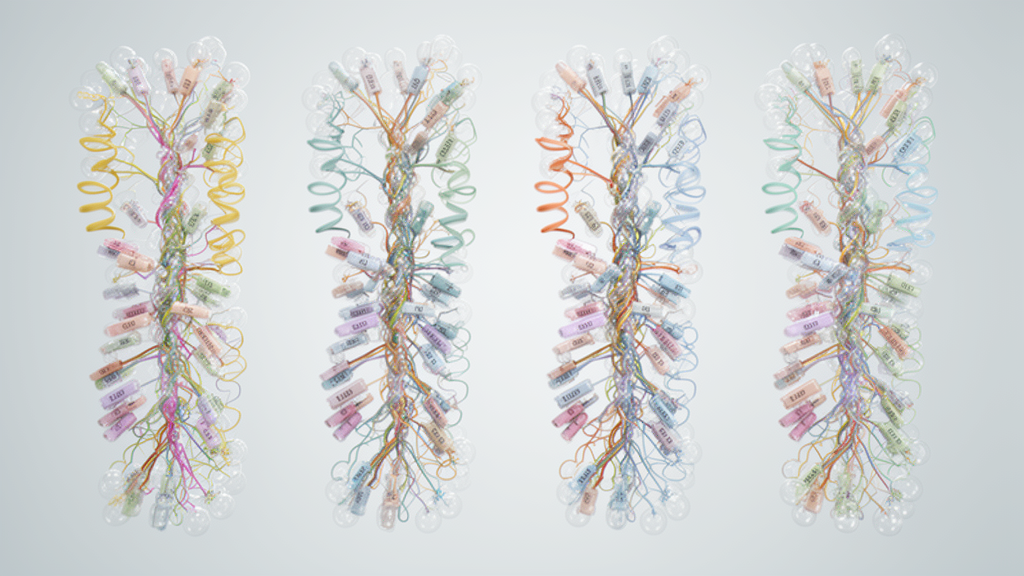
A comparative analysis of human, mouse, fly and zebrafish genomes found that genes producing more transcript isoforms consistently tend to have longer introns, shorter exons and more complex exon–intron organization. The study also identified differences among species and gene biotypes, indicating that conserved structural features shape transcript diversity while regulatory architecture can modify the pattern in particular evolutionary lineages.
Alternative splicing allows a single gene to generate multiple transcript isoforms, but the genomic features associated with isoform-rich genes have remained incompletely defined. Researchers examined curated transcript annotations alongside structural, regulatory, sequence-derived and functional gene-level features. The analysis covered four eukaryotic genomes, providing a cross-species test of whether relationships observed in humans are conserved elsewhere.
The results showed that isoform diversity was widespread in all four species, although its extent varied by genome and biotype. Longer introns, shorter exons and increased exon–intron organization were the clearest recurring associations with higher isoform counts. Relationships involving untranslated regions were less consistent, although 3′ UTR length had stronger positive associations in humans and Drosophila. In human genes, isoform count was negatively associated with GC content and CpG-island density but positively associated with the size of the gene’s protein–protein interaction network.
Machine-learning models predicted human isoform counts with strong performance, and the predictive signal was retained in mouse data, suggesting that some relationships may transfer between mammalian genomes. Principal component analysis and uniform manifold approximation and projection placed the isoform-associated features on a continuous, structured manifold rather than in clearly separated gene classes. Taken together, the findings support a model in which conserved gene structure provides a broad basis for transcript complexity, while lineage- and biotype-specific regulatory features help account for variation in how extensively that complexity is expressed.
The study is observational at the genome level, so its associations do not establish that particular structural features cause a gene to produce more isoforms. Its cross-species design nevertheless demonstrates that the central relationship is not confined to one genome. By combining predictive modeling, feature attribution and dimensionality reduction, the researchers offer a framework for understanding how the organization of eukaryotic genes is connected to the diversity of their transcript products.
Subject of Research: Comparative genomic analysis of the gene-structure features associated with transcript isoform diversity in four eukaryotic species.
Article Title: Gene body architecture predicts isoform diversity across eukaryotic genomes
Article References: Brohart, Q., & Mer, A. (2026). Gene body architecture predicts isoform diversity across eukaryotic genomes. BMC Genomics. https://doi.org/10.1186/s12864-026-13421-3
Image Credits: AI Generated
DOI: 10.1186/s12864-026-13421-3
Keywords: alternative splicing, isoform diversity, gene architecture, eukaryotic genomes, human genomics, comparative genomics, machine learning, exon–intron structure, transcriptomics, regulatory architecture, Gene, body