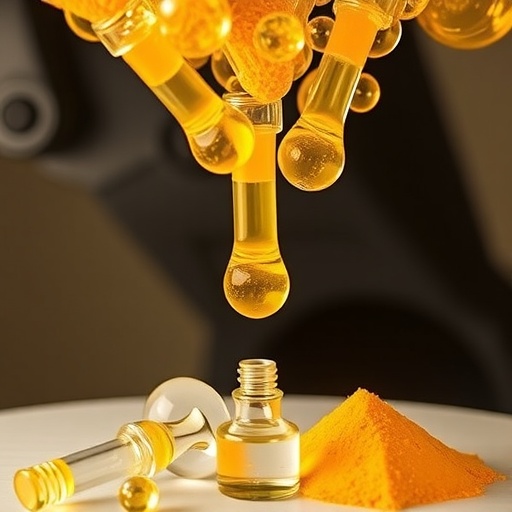
In a groundbreaking stride within the realm of nanomedicine and cancer therapy, researchers have unveiled a compelling advancement harnessing the synergy of nanotechnology and biochemical engineering to combat tumor growth more effectively. This pioneering work focuses on the comparative in vitro antitumor efficacy of innovative nanocomposites designed to deliver curcumin, a natural compound renowned for its anticancer properties, encapsulated within zeolitic imidazole frameworks-8 (ZIF-8). The study meticulously contrasts the efficiency of hyaluronic acid-coated curcumin-loaded ZIF-8 nanocomposites with their uncoated counterparts, unveiling potentially transformative implications for targeted cancer treatment modalities.
Curcumin, derived from the turmeric plant, holds considerable promise in oncology due to its multifaceted pharmacological effects, including anti-inflammatory, antioxidant, and antiproliferative activities. However, its clinical application has been impeded by poor solubility, rapid metabolism, and limited bioavailability. Addressing these limitations, scientists have engineered ZIF-8, a subclass of metal-organic frameworks characterized by high porosity and favorable biocompatibility, as a nanocarrier to encapsulate curcumin, thereby stabilizing it and facilitating controlled release within the tumor microenvironment.
The incorporation of hyaluronic acid (HA) as a coating material further elevates this platform’s therapeutic potential. Hyaluronic acid, a naturally occurring glycosaminoglycan with high affinity for CD44 receptors frequently overexpressed on cancer cell surfaces, offers a strategic mechanism for targeted drug delivery. By functionalizing curcumin-loaded ZIF-8 nanoparticles with HA, the researchers aimed to exploit receptor-mediated endocytosis to enhance cellular uptake selectively in tumor cells, minimizing off-target effects and maximizing antitumor efficacy.
Extensive characterization of the nanocomposites was conducted, including physicochemical analyses to understand particle size distribution, surface charge, morphological features, and curcumin encapsulation efficiency. Transmission electron microscopy illustrated a uniform nanoscale architecture, with HA coating imparting additional stability and favorable interaction profiles under physiological conditions. Notably, the HA-coated nanocomposites exhibited enhanced dispersibility and colloidal stability in aqueous media, crucial for intravenous administration.
In vitro cytotoxicity assays using various human cancer cell lines revealed that HA-coated curcumin-loaded ZIF-8 significantly outperformed the uncoated versions in reducing tumor cell viability. This superior performance was attributed to enhanced receptor-specific internalization facilitated by HA interaction with CD44, corroborated by flow cytometry and confocal microscopy analyses demonstrating increased nanoparticle uptake. Additionally, apoptosis assays indicated a higher incidence of programmed cell death triggered by the HA-coated nanoformulation, underlining its potent antitumor activity.
The drug release kinetics from these nanocomposites underscored a pH-responsive behavior, with faster curcumin release occurring under acidic conditions that mimic the tumor microenvironment. This pH sensitivity ensures that drug discharge is localized predominantly within tumor sites, further reducing systemic toxicity. Moreover, the HA coating was found to modulate the release profile, providing a fine-tuned balance between stability in circulation and efficient payload liberation upon reaching cancerous tissues.
Mechanistically, the study elaborated on how the synergistic effects of the HA coating and the ZIF-8 framework potentiate curcumin’s ability to disrupt multiple signaling pathways involved in cancer cell proliferation, migration, and survival. The nanocomposite formulation was shown to interfere with nuclear factor-kappa B (NF-κB) signaling, a key regulator of inflammation and tumor progression, as well as modulate reactive oxygen species (ROS) levels, leading to oxidative stress-induced apoptosis in malignant cells.
This novel nanotherapeutic system also demonstrated reduced cytotoxicity toward normal, healthy cells, emphasizing the safety and selectivity conferred by HA targeting. Such selective action is paramount in developing treatments that minimize damage to noncancerous tissues and reduce adverse side effects typically associated with chemotherapy. Importantly, these findings position HA-coated curcumin-loaded ZIF-8 nanocomposites as a promising candidate for further preclinical investigations.
The implications of this research extend beyond fundamental nanomedicine, offering potential applications in personalized cancer therapy, where treatments can be tailored based on receptor expression profiles and tumor microenvironment characteristics. The modularity of the ZIF-8 framework allows for versatile loading of diverse therapeutic agents, suggesting that this platform could be adapted for combination therapies or co-delivery of drugs and imaging agents for theranostic purposes.
Moreover, the study addresses challenges concerning nanotoxicology and immunogenicity by demonstrating biocompatibility and negligible induction of inflammatory responses in relevant cellular models. The biodegradability of the ZIF-8 framework and the natural origin of HA contribute positively to the clinical feasibility of this approach, mitigating long-term accumulation risks associated with some inorganic nanoparticles.
Although these findings are derived from in vitro studies, they lay a robust foundation for subsequent in vivo evaluations in animal models to assess pharmacokinetics, biodistribution, therapeutic efficacy, and safety profiles under physiological conditions. Success in these stages could accelerate the translation of HA-coated curcumin-loaded ZIF-8 nanocomposites into clinical trials, marking a significant leap toward more effective and less toxic cancer therapeutics.
The study’s innovative fusion of material science, molecular biology, and pharmacology exemplifies the multidisciplinary efforts necessary to overcome conventional barriers in oncology. As the field advances, such nanoplatforms may herald a new era of precision medicine, where nanoscale interventions not only inhibit tumor growth but also actively reshape the tumor microenvironment to thwart metastasis and recurrence.
In summary, this research elucidates a compelling strategy to amplify the therapeutic impact of curcumin through sophisticated nanoengineering. The HA-coated curcumin-loaded ZIF-8 nanocomposites exemplify how targeted delivery platforms can elevate natural compounds into viable clinical candidates by enhancing bioavailability, specificity, and efficacy. As the global burden of cancer continues to rise, innovations like these offer hope for safer, smarter, and more personalized treatments in the fight against this devastating disease.
Subject of Research: Development and comparative evaluation of hyaluronic acid-coated versus uncoated curcumin-loaded zeolitic imidazole frameworks-8 (ZIF-8) nanocomposites for enhanced in vitro antitumor efficacy.
Article Title: In vitro antitumor efficacy of hyaluronic acid coating for curcumin-loaded zeolitic imidazole frameworks-8 (ZIF-8) versus that of uncoated curcumin-loaded ZIF-8 nanocomposites.
Article References:
Oransa, W.W., Zahran, R.F., El Sadda, R.R. et al. In vitro antitumor efficacy of hyaluronic acid coating for curcumin-loaded zeolitic imidazole frameworks-8 (ZIF-8) versus that of uncoated curcumin-loaded ZIF-8 nanocomposites. Sci Rep (2026). https://doi.org/10.1038/s41598-026-48707-9
Image Credits: AI Generated
Tags: anti-inflammatory natural compounds in oncologyantioxidant anticancer agentsbiocompatible nanocarriers for chemotherapyCD44 receptor targetingcontrolled release drug carrierscurcumin delivery systemsenhanced curcumin bioavailabilityhyaluronic acid coated nanocompositesnanomedicine for cancer treatmenttargeted cancer therapy nanotechnologytumor microenvironment drug releaseZIF-8 metal-organic frameworks