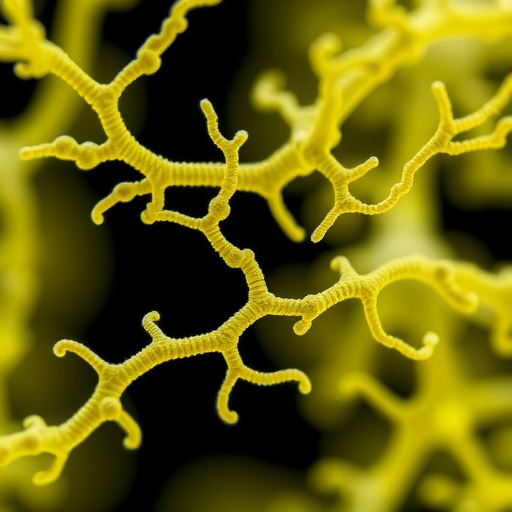
In the relentless pursuit of replicating the human body’s complex vascular systems, researchers have long grappled with a formidable barrier: fabricating blood vessel networks at the microscopic scale of capillaries. This level of precision is essential for engineering fully functional organs capable of integration within living systems. A groundbreaking advancement now emerges from the convergence of bioprinting technology and artificial intelligence—a hybrid approach that orchestrates the production of hierarchical vascular networks with capillary-scale resolution, promising a quantum leap in organ fabrication.
Traditional methods of fabricating vascular networks have been constrained by the limitations of resolution and scalability. While extrusion bioprinting excels in rapid deposition of cellular matrices, it falls short on the sub-10-micron precision necessary to emulate capillaries, which are pivotal for nutrient exchange and waste removal in tissues. Conversely, high-resolution techniques often suffer from slow throughput and lack real-time adaptability. Addressing these challenges, the new study introduces a dual-modality bioprinting strategy that melds aerosol jet printing of sacrificial materials with conventional extrusion printing, unlocking unprecedented control over microvascular architecture.
The crux of this innovation lies in utilizing aerosol jet printing to deposit sacrificial inks with remarkable spatial fidelity. These inks form the blueprint for complex vascular channels once they are removed, creating void spaces that mimic capillary networks. Aerosol jet printing achieves channel dimensions below 10 microns, a resolution hitherto unattained in tissue engineering. Complementing this, the robust extrusion printing deposits cellular and extracellular matrix components around these sacrificial templates, providing structural integrity and biological functionality.
Yet, such technical prowess alone cannot guarantee replicability. Recognizing this, the researchers integrated constrained Bayesian optimization, an intelligent algorithmic approach, to dynamically fine-tune critical printing parameters. This machine learning-driven process expedites the identification of optimal print settings to achieve precise channel diameters without exhaustive trial and error. Real-time feedback loops empower the system to adjust on the fly, enabling bespoke modulation of vessel dimensions tuned to specific biological or regenerative requirements.
The result is a versatile printing platform capable of synthesizing vascular conduits that scale from one-dimensional channels to three-dimensional, multibranched hierarchical networks mirroring native tissue complexity. This architectural fidelity is not merely aesthetic but functional. The engineered vessels are subsequently seeded with endothelial cells—the natural lining of blood vessels—which form continuous, confluent monolayers integral to vascular health and selective permeability.
Crucially, the endothelialization process within these microchannels yields a dramatic reduction in permeability compared to non-optimized vasculature models. This hallmark indicates the formation of a stable, quasi-native barrier that modulates molecular transport, an essential property for sustaining tissue homeostasis and preventing leakage. Additionally, the cells exhibit robust viability and proliferation, underscoring the biocompatibility and physiological relevance of the hybrid-printed constructs.
Transcending conventional bioprinting limits, this methodology pioneers a new pathway for fabricating intricately branched vasculature capable of supporting living tissues in vitro and, potentially, in vivo. The implications are expansive: beyond regenerating complex organs for transplantation, these engineered vascular networks serve as vital platforms for drug testing and disease modeling, where microvascular behavior profoundly influences therapeutic outcomes.
The integration of adaptive machine learning algorithms within the bioprinting workflow heralds a paradigm shift, transforming a traditionally static process into a dynamic, precision-engineered practice. By harnessing rapid optimization and real-time modulation, researchers can now customize vascular geometries and dimensions tailored to specific research or clinical applications, fostering personalized medicine approaches.
Moreover, the scalable nature of this approach addresses the pressing need for manufacturing complexity without sacrificing throughput. The capacity to generate hierarchically organized vascular networks—spanning from major conduits to capillary beds—enables the fabrication of tissue constructs with native-like perfusion capabilities, critical for maintaining cell viability in thicker tissues.
The research aligns with the broader vision of biomimetic tissue engineering: constructing living structures that not only mirror the form but also the function of natural organs. By capturing the vascular intricacies down to the capillary scale, this technology closes a crucial gap in organ fabrication, facilitating enhanced nutrient delivery, waste removal, and cell signaling pathways necessary for organ development and function.
Equally notable is the demonstration that this hybrid printing method supports endothelial cell cultures over an extended period, maintaining monolayer integrity and proliferative capacity. This stability suggests potential for long-term studies and implantation scenarios, where vascular integrity and adaptability are paramount.
Looking forward, the synergy of aerosol jet printing and extrusion-based bioprinting augmented by artificial intelligence offers limitless possibilities. The strategy can potentially be extended to incorporate multiple cell types, extracellular matrix components, and growth factors, crafting fully vascularized tissue models tailored to specific organ systems.
In the context of regenerative medicine, these advances could revolutionize approaches to repairing or replacing damaged tissues, offering patient-specific grafts engineered to exact specifications. Similarly, the platform’s utility in pharmacological research provides a nuanced environment for assessing drug delivery and vascular responses at a granular level, accelerating drug discovery pipelines.
In summation, this hybrid bioprinting technique marks a pivotal milestone in vascular tissue engineering, deftly merging high-resolution fabrication with computational intelligence to overcome previous scalability and precision roadblocks. By ushering in capillary-scale vascular networks with hierarchical complexity, it not only elevates the state-of-the-art but also lays a foundational framework for the next generation of organ fabrication technologies.
As this technology matures and integrates with other biofabrication innovations, it portends an era where the fabrication of intricate, functional human tissues transitions from aspiration to routine practice. The seamless blending of adaptive machine learning with advanced printing heralds a future where the minute architecture of life itself can be recreated with fidelity, ushering transformative impacts on healthcare and biomedical research.
Subject of Research: Fabrication of hierarchical vascular networks using hybrid bioprinting methods enhanced by machine learning algorithms.
Article Title: Hybrid bioprinting of hierarchical vascular networks at capillary-scale resolution.
Article References:
Liao, Y., Gallegos-Martínez, S., Kuang, X. et al. Hybrid bioprinting of hierarchical vascular networks at capillary-scale resolution. Nat Chem Eng (2026). https://doi.org/10.1038/s44286-026-00396-x
Image Credits: AI Generated
DOI: https://doi.org/10.1038/s44286-026-00396-x
Tags: aerosol jet printing sacrificial inksAI-driven bioprinting controlcapillary-scale blood vessel fabricationdual-modality bioprinting strategyextrusion bioprinting limitationshierarchical vascular system engineeringhigh-resolution bioprinting techniqueshybrid bioprinting vascular networksnutrient exchange in engineered tissuesorgan fabrication with bioprintingreal-time adaptable bioprinting methodsscalable microvascular architecture