Sponsored content brought to you by

ATTCGA ➜ ATTCCA
That’s gene editing. On paper, it is merely the rearrangement of letters. However, the road to editing genes in hopes of a therapeutic benefit is difficult to travel. Additionally, researchers want the ability to make any change to the genome, not just a single-nucleotide change, as in the example above. They want the ability to delete portions of the genome and insert new genetic material.
Gene editing expanded researchers’ ability to make specific modifications to genetic material and probe protein expression, opening the door for new therapeutic approaches to many diseases. Recent advancements have resulted in therapies for sickle cell disease, acute lymphoblastic leukemia (ALL), and spinal muscular atrophy (SMA), which are all the result of gene-editing therapies.
But to provide a new therapy to patients, scientists must first develop and test the approach in a research lab. For example, a lab may be interested in using a CRISPR/Cas9 approach to replace a mutated gene with a functional gene that makes a cancer-attacking protein. There are two main methods to introduce genetic material (like the functional gene and Cas9) into the cells of interest—transduction and transfection.
Transduction or transfection? That is the question
Transduction involves using a non-replicating virus, like a modified lentivirus, to bring genetic material into the cell; transfection involves introducing genetic material using a non-viral method. This could be via cationic lipids, calcium phosphate, electroporation, or microinjection. Transduction is typically favored over transfection because it benefits from high efficiency, even in hard-to-transfect cells, and is generally less toxic to cells.
Lentiviral transduction is quickly becoming a more popular method among scientists for introducing genetic material into cells for stable, long-term gene expression in hard-to-transfect cells, like primary cells, stem cells, and neurons. Although every viral vector comes with its own pros and cons, researchers are more frequently selecting lentiviral transduction because (1) it provides long-lasting gene expression, (2) it is compatible with knock-in, knock-out, and knock-down CRISPR approaches, giving researchers a lot of flexibility, (3) it can infect both dividing and non-dividing cells, and (4) it can introduce a relatively large insertion (up to 5 kb).
Though lentiviral transduction is a reliable option, this method still has its pitfalls—mainly low transduction efficiency. Transduction efficiency (i.e., how much of the genetic material from the packaged lentivirus is transferred and incorporated into the cell) can vary widely.
Microfluidics-driven solution

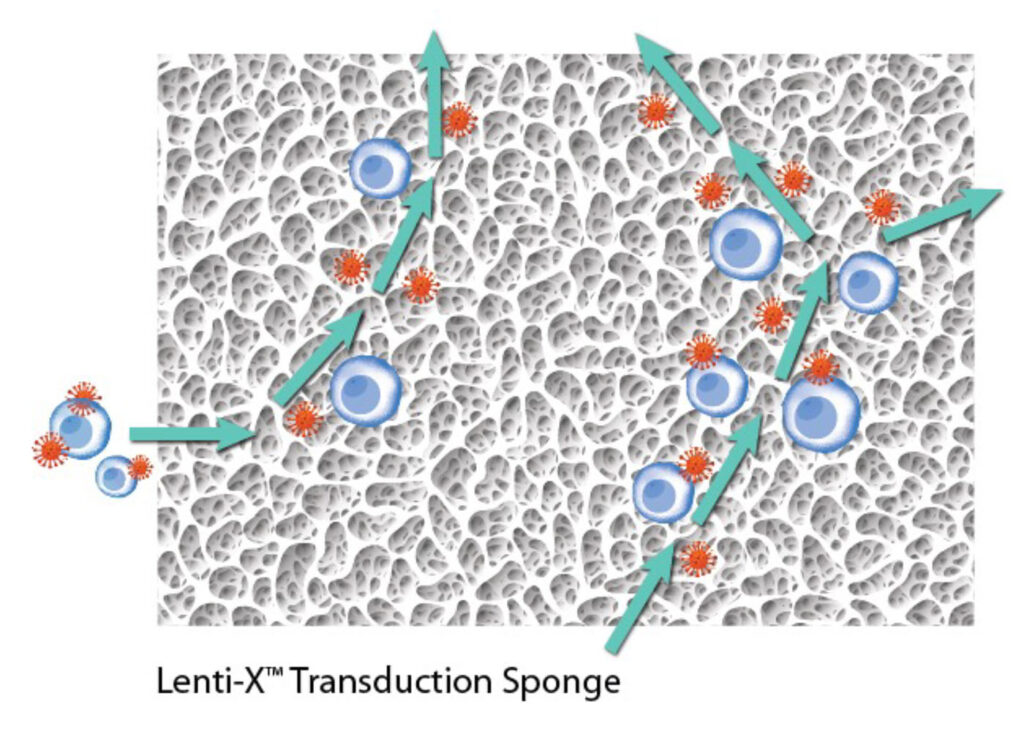
Perhaps the most effective and efficient way to increase transduction is by using the Lenti-X Transduction Sponge. Inspired by microfluidics approaches, like flow cells, which increase transduction efficiency but often result in lower overall yield due to the harsh conditions for cells, Takara Bio developed the Lenti-X Transduction Sponge to simplify and optimize the lentiviral transduction workflow. The sponge is made of a porous material that provides many locations for the viral vector and cell of interest to co-localize (see image) without the need to apply external factors, like chemical enhancers, which can be detrimental to the cells. By designing a simple solution that eliminates laborious steps that are required in the traditional transduction workflow and still provides exceptionally high titers, the sponge helps researchers accelerate gene delivery discoveries.
The sponge is gentler on cells, avoids spinoculation, eliminates optimization steps, and works for many different cell types, providing scientists with an easy-to-use solution to increase transduction efficiency and further their gene-editing research projects. Additionally, the sponge works well on primary cells that have been historically difficult to transduce, like T cells (which require further activation), NK cells, and CD34+ human stem cells.
Streamlining transduction with the Lenti-X Transduction Sponge supports research in many areas, including CRISPR/Cas9-based therapeutic approaches.

Learn how to increase viral titers at takarabio.com/lenti-x.