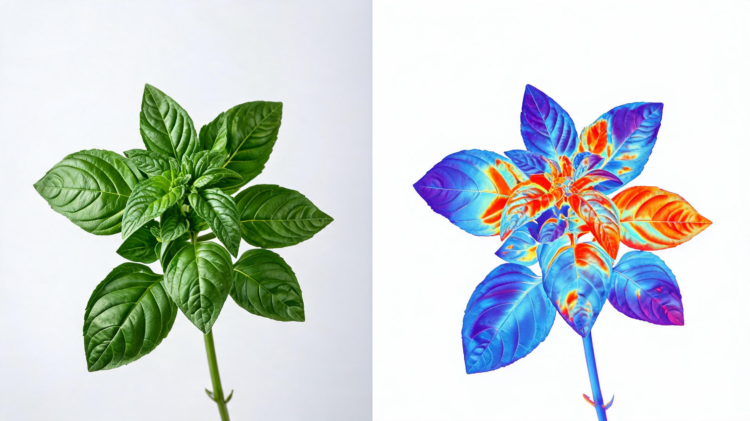
When a plant runs out of water, the first signs of trouble are often invisible. Long before leaves wilt or turn yellow, the plant has already begun to shut down its internal plumbing, closing the microscopic pores on its leaves and sacrificing photosynthesis to conserve moisture. A new study from researchers in Kerala, India, suggests that this hidden crisis can be caught early simply by measuring how hot the leaves become, offering a rapid, non-destructive way to detect water stress in some of the world’s most valuable medicinal crops.
The research, led by Ashish K. Chaturvedi and colleagues at the Centre for Water Resources Development and Management in Kozhikode, examined selected high-value medicinal plants grown under both irrigated and non-irrigated conditions. The team’s goal was to determine whether leaf temperature and the Crop Water Stress Index, a widely used thermal metric known as CWSI, could serve as reliable indicators of physiological responses and irrigation requirements in these crops. The findings, published in the journal Plant Biosystems, demonstrate that the approach works remarkably well, and could form the basis of a practical framework for precision irrigation scheduling in medicinal plant cultivation.
The underlying physics is elegant. Plants cool themselves through transpiration, the process by which water evaporates from leaf surfaces through stomata, the adjustable pores that also admit carbon dioxide for photosynthesis. When water is plentiful, stomata stay open, transpiration runs at full capacity, and leaf temperatures remain below the temperature of the surrounding air. When water becomes scarce, plants close their stomata to prevent hydraulic failure. Transpiration slows, evaporative cooling diminishes, and the foliage warms relative to the air. That canopy-to-air temperature differential is, in effect, a physiological signal written in heat, and it can be read with nothing more sophisticated than an infrared thermometer.
To decode that signal, the researchers measured a suite of key physiological parameters, including stomatal conductance, transpiration rate, photosynthesis rate, foliage temperature, and CWSI under irrigated and non-irrigated treatments. Infrared thermometry was employed to quantify the canopy-air temperature differentials associated with transpiration dynamics and plant water status. The results revealed clear diurnal variations in foliage temperature that tracked changes in transpiration and atmospheric conditions throughout the day, exactly as the theory of leaf energy balance predicts. As vapor pressure and solar radiation shifted during the day, so did the thermal signature of the canopy, underscoring the importance of timing when thermal measurements are used for stress diagnosis.
The contrast between water regimes was striking. Non-irrigated plants exhibited substantially higher CWSI values, ranging from 0.6 to 0.8, compared with irrigated plants, which registered values between 0.3 and 0.5. In the language of the index, the unwatered plants were experiencing severe water stress while their irrigated counterparts remained comparatively comfortable. The CWSI, first developed in the early 1980s by researchers seeking to normalize canopy temperature measurements for environmental variability, works by comparing the observed canopy temperature against theoretical lower and upper bounds representing fully transpiring and completely non-transpiring canopies. A value near zero indicates a well-watered, actively transpiring crop, while values approaching one signal acute stress.
What makes the new study particularly compelling is the strength of the statistical relationships between the thermal index and direct physiological measurements. The researchers observed significant correlations between CWSI and leaf photosynthetic rate, with coefficients of determination ranging from 0.49 to 0.79 at a significance level of P less than 0.001. Even more impressive, the stomatal conductance-based index showed strong agreement with measured stomatal conductance, with r-squared values between 0.52 and 0.87, also at P less than 0.001. In practical terms, this means that a handheld infrared reading can stand in for a porometer measurement, delivering in seconds what conventional gas-exchange instruments require minutes and considerable expertise to obtain.
The physiological story behind these numbers is well understood but worth spelling out. Water deficit induced stomatal closure in the study plants, which reduced transpiration and photosynthetic activity, increased leaf temperature, and altered plant water relations. Stomata are the gatekeepers of the carbon-water tradeoff: every molecule of carbon dioxide gained through an open stoma costs water lost to the atmosphere. Under drought, the plant tightens its gates, protecting its hydraulic system at the expense of carbon gain. Because photosynthesis depends on a continuous supply of carbon dioxide, sustained stomatal closure directly suppresses growth and, in medicinal plants, potentially the accumulation of the bioactive compounds that give these species their market value.
Medicinal plants represent a particularly important testing ground for this technology. Many of the species cultivated for pharmaceutical and traditional medicine markets are high-value but water-sensitive, and several, such as the endemic South Indian aromatic plant Plectranthus vettiveroides and the endangered Western Ghats species Nilgirianthus ciliatus, face both commercial demand and conservation pressure. Over-irrigation wastes scarce water and can leach nutrients, while under-irrigation quietly erodes yield and quality before any visible symptom appears. A tool that detects stress at the moment stomata begin to close, rather than when leaves droop, gives growers a critical window for intervention.
The implications extend well beyond a single field trial. The authors argue that integrating thermal sensing with physiological monitoring can improve irrigation efficiency, optimize water use, and enhance climate-resilient management of medicinal crops. Infrared thermometry is inexpensive, portable, and fast, which makes it suitable for routine field scouting, while the same physical principles scale upward to drone-mounted thermal cameras and satellite-based sensors that survey entire landscapes. Recent reviews of crop water stress assessment highlight a growing pipeline of remote sensing platforms and machine learning methods designed to automate exactly this kind of thermal diagnosis, suggesting that the framework validated in Kerala could soon be deployed at scales ranging from a single medicinal plant bed to an entire watershed.
There are, of course, caveats that practitioners should keep in mind. Canopy temperature is influenced not only by soil moisture but also by air temperature, humidity, wind, and radiation, which is why the CWSI incorporates reference temperatures to normalize for environmental variability. Diurnal variation means that measurements taken at different times of day are not directly comparable, and the study’s demonstration of clear diurnal patterns in foliage temperature reinforces the need for standardized sampling protocols. Nevertheless, the strong correlations reported here, spanning multiple species and water regimes, indicate that with proper calibration, leaf temperature and CWSI are robust, rapid, and non-destructive indicators of plant water status. As climate change intensifies drought pressure across the tropics and freshwater resources grow ever more contested, the ability to read a plant’s stress in degrees Celsius rather than days of wilting may prove one of the most practical advances in precision agriculture for high-value crops.
The intellectual lineage of thermal plant monitoring stretches back several decades. Early work in the 1980s established that canopy temperature could serve as a crop water stress indicator, and subsequent refinements introduced infrared thermometry as a practical tool for estimating stomatal conductance in the field. What has changed in recent years is accessibility: thermal sensors that once required specialized laboratory equipment are now compact, affordable, and increasingly integrated into smartphones, drones, and automated weather stations. This democratization of the technology means that the kind of validation work performed in Kerala arrives at a moment when growers worldwide can realistically adopt it.
The stomatal behavior underlying these measurements is itself a rich area of plant science. Stomata do not simply open and close like valves; they respond dynamically to a combination of soil moisture signals arriving from the roots, hormonal cues such as abscisic acid, and atmospheric conditions, particularly vapor pressure deficit, the gradient that drives water loss from leaf to air. As the air dries, plants face a dilemma: keeping stomata open maintains carbon uptake but accelerates dehydration, while closing them conserves water at the cost of photosynthesis. Different species and even different cultivars resolve this tradeoff in distinct ways, which is why physiological monitoring alongside thermal readings adds valuable interpretive depth.
For medicinal crops specifically, the stakes of water management extend beyond biomass. The concentration of secondary metabolites, the alkaloids, essential oils, and phenolic compounds that constitute the active ingredients in many herbal medicines, can be sensitive to water availability during particular growth stages. Moderate stress sometimes enhances the synthesis of certain compounds, while severe or prolonged stress degrades both yield and quality. This complexity makes precise, timely indicators of plant water status especially valuable, allowing growers to navigate the narrow band between the stress that diminishes productivity and the abundance that dilutes potency.
The Kerala setting also lends the work broader relevance. Humid tropical environments pose particular challenges for thermal sensing because high atmospheric humidity suppresses the evaporative cooling that creates measurable temperature differentials in the first place. Demonstrating that CWSI discriminates clearly between irrigation treatments under such conditions strengthens confidence that the approach can generalize across climates, not only to the arid and semi-arid regions where much of the classic validation work was done. For smallholder farmers who cultivate the majority of the world’s medicinal plants, often with limited access to irrigation infrastructure, an inexpensive diagnostic that guides when and how much to water could translate directly into improved livelihoods and more sustainable extraction pressure on wild plant populations, an outcome with benefits for both agriculture and conservation.
Subject of Research: Leaf temperature and the Crop Water Stress Index as indicators of water stress and irrigation needs in medicinal plants
Article Title: Leaf temperature and Crop Water Stress Index as indicators of physiological responses and irrigation needs in medicinal plants
Article References: Chaturvedi, A. K., K, N., U, S., M, A., P, S., & Mohanan, A. (2026). Leaf temperature and Crop Water Stress Index as indicators of physiological responses and irrigation needs in medicinal plants. Plant Biosystems, 160(5), Article 258. https://doi.org/10.1007/s44473-026-00251-0
Image Credits: AI Generated
DOI: 10.1007/s44473-026-00251-0
Keywords: leaf temperature, Crop Water Stress Index, medicinal plants, infrared thermometry, water stress, stomatal conductance, photosynthesis, transpiration, precision irrigation, drought stress, plant physiology, Kerala India
Cite Scienmag News
APA
MLA
Chicago
Copy citation
Download RIS
Tags: Crop Water Stress Indexcrop water stress index in medicinal plant irrigation managementdrought stressearly signs of water deficiency in plants revealed by thermal imagingimpact of water stress on photosynthesis in medicinal plantsinfrared thermometryinfrared thermometry applications in plant physiologyKerala Indialeaf temperatureMedicinal plant water stress detection using infrared thermometryMedicinal plantsmonitoring leaf temperature to assess plant hydration statusnon-destructive plant water stress measurement methodsphotosynthesisphysiological responses of medicinal plants to water scarcityplant physiologyprecision irrigationprecision irrigation scheduling for medicinal cropsstomatal conductancethermal imaging for early detection of plant drought stressthermal techniques for nontranspirationwater stress