
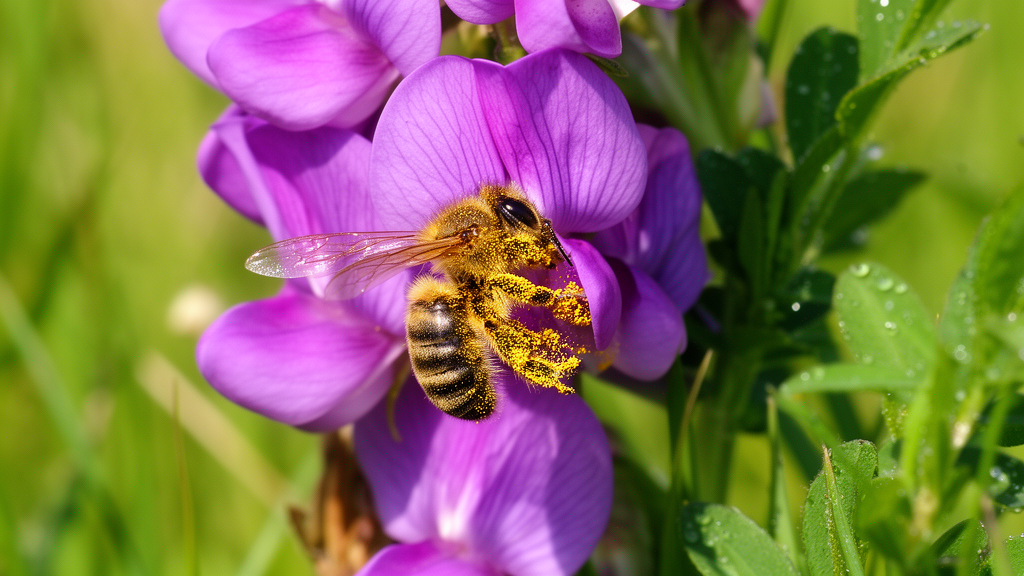
Agricultural intensification, landscape simplification, and widespread pesticide use have driven extensive declines in global pollinator assemblages, threatening ecosystem stability and crop yields worldwide. As wild bees and other insect pollinators support the reproductive cycles of more than eighty percent of wild plant species and nearly seventy-five percent of cultivated food crops, identifying resilient botanical resources has become a critical ecological priority. A comprehensive scientific synthesis published in Frontiers in Ecology and Evolution by researcher Deniz Aygören Uluer evaluates how keel-flowered legumes function as vital reservoirs of nectar and pollen within modern farming landscapes. With the global human population projected to surpass nine billion by 2050 and climate-driven drought increasingly stressing agricultural systems, the review synthesizes current empirical research to demonstrate how specialized legume floral structures filter floral visitors, sustain functionally adapted wild bee populations, and reinforce multiple biodiversity-mediated ecosystem services.
Leguminosae, or Fabaceae, represents the third-largest angiosperm family on Earth, encompassing over 22,500 species across 765 genera distributed across all continents except Antarctica. Although the family underwent rapid evolutionary radiation during the early Cenozoic, producing weakly to strongly zygomorphic blooms across six recognized subfamilies, specialized keel flowers reach their highest concentration within the Papilionoideae, an economically and ecologically pivotal clade of approximately 14,000 species. Keel flowers represent a remarkable case of convergent floral evolution, having evolved independently at least sixteen times across ten distinct angiosperm orders. The classic pentamerous architecture consists of an upright standard petal that serves as a visual guide, two lateral wing petals that act as landing platforms, and an enclosed keel formed by two partially fused petals protecting the reproductive organs. This morphological configuration conceals pollen and nectar behind mechanical tripping barriers that demand specific operative strength and morphological compatibility from foraging insects.
The physical tripping mechanisms of keel blossoms operate as selective mechanical filters, restricting legitimate floral access primarily to medium- and large-bodied bees equipped with sufficient physical strength and appropriate proboscis lengths. In most keel-flowered legumes, pollen is secondarily presented on stylar trichomes or the style itself prior to anthesis, enabling precise pollen placement onto protected anatomical areas of visiting bees, such as the head or leg insertions, where grooming cannot readily dislodge it. The review categorizes four primary pollination mechanisms across the family: valvular systems where wing-keel complexes depress temporarily; pump mechanisms that dispense pollen incrementally over repeated visits; brush mechanisms utilizing stylar hairs; and explosive mechanisms that discharge pollen and reproductive organs in a single forceful event. Consequently, specialized wild taxa, including bumblebees in the genus Bombus as well as solitary bees in Anthophora, Eucera, Megachile, Osmia, and Xylocopa, serve as primary, functionally adapted pollinators capable of operating these complex mechanical structures.
A critical analytical contribution of the synthesis is the necessity to decouple three distinct tiers of empirical evidence when evaluating legume-pollinator relationships: flower visitation frequency, individual-level pollination effectiveness, and measurable population-level conservation outcomes. While global syntheses document over two hundred insect visitor species across eight orders visiting legume crops, high visitation rates frequently fail to correlate with effective pollination or fruit set. For example, honeybees and short-tongued bumblebees frequently act as nectar robbers, biting perforations into the base of deep corolla tubes to extract nectar without depressing the keel or contacting reproductive organs. Field observations in faba bean fields reveal that while honeybees and short-tongued Bombus terrestris accounted for fifty-six percent and thirty-seven percent of floral visits, respectively, their contribution to pollination was largely ineffective due to rampant nectar robbing, whereas the less abundant long-tongued Bombus hortorum, representing only four percent of visits, delivered the most effective cross-pollination.
Examining model agricultural legumes reveals stark differences in floral traits, visitation dynamics, and breeding biology across staple crops. Faba bean, widely cultivated as an arable break crop for human food and animal feed, relies substantially on insect visitation despite possessing self-pollinating capabilities, with pollination trials demonstrating insect-mediated seed yield increases ranging from 40% to 185%. Similarly, perennial alfalfa is predominantly cross-pollinated and exhibits an explosive floral tripping mechanism that deters honeybees, which learn to avoid the forceful blow of the staminal column by foraging laterally. Consequently, commercial alfalfa seed production depends heavily on managed solitary species, specifically the alfalfa leafcutting bee Megachile rotundata and the ground-nesting alkali bee Nomia melanderi. Nevertheless, experimental field studies confirm that native wild bee assemblages substantially alleviate pollen limitation in alfalfa even when present at modest densities, underscoring the functional value of conserving indigenous pollinator communities rather than relying solely on introduced managed stocks.
Clovers within the genus Trifolium, particularly white clover and red clover, provide indispensable nectar and pollen reservoirs that bridge critical seasonal forage deficits in temperate agricultural matrices. Field surveys show that white clover supplies nearly three-quarters of the available nectar volume in improved agricultural grasslands, with white clover, wild garlic, and creeping thistle together accounting for nearly half of total landscape-scale nectar provision. Red clover, distinguished by its elongated corolla tube, provides late-season floral forage that directly fuels the reproductive development of bumblebee queens and males during late summer. Landscape-level evaluations demonstrate that even when red clover fields occupied less than 0.2% of the surrounding agricultural land area, nearby landscapes exhibited five-fold higher queen bumblebee densities and a 71% increase in male densities. However, cultivar selection remains paramount, as trials indicate that red clover cultivars can vary by as much as 50-fold in their capacity to attract bumblebees.
Beyond supporting dedicated single-species stands, integrating legumes into diverse agricultural cropping configurations substantially enhances floral resource continuity and habitat heterogeneity across production landscapes. Establishing legume-rich mass-flowering habitats and flower strips in species-poor grasslands can increase total blossom abundance by up to 25-fold and elevate local bumblebee abundance by 50-fold, providing critical forage for declining medium- and long-tongued species such as Bombus pascuorum and Bombus hortorum. Combining legume species with staggered flowering phenologies directly alleviates severe seasonal resource collapses, including the European June gap as well as early spring and late summer hunger periods. However, because specialized legume corollas restrict nectar extraction for short-tongued beneficial insects such as hoverflies, multi-species conservation plantings must incorporate complementary botanical families, such as Brassicaceae and Apiaceae, while avoiding competitive or agronomically detrimental weeds.
Intercropping cash crops with grain or forage legumes represents another highly promising diversification strategy that combines pollinator support with notable agronomic gains. Traditional polycultures, such as the historical Three Sisters system combining common bean, maize, and squash, illustrate how multi-species plant architecture improves soil nutrient capture, suppresses weeds, elevates parasitism rates, and reduces herbivore pressure. Because staple cereals like maize offer virtually no nectar rewards and display low initial competitive vigor, they serve as ideal companion crops for climbing or bush legumes. Field experiments show that intercropping legumes with cereals increases total grain output per unit area compared to monocultures, enhances the nutritional amino acid profile of human diets, and supplies steady nectar and pollen over extended intervals. Furthermore, legume-cereal combinations like faba bean intercropped with wheat sustain pollinator visitation rates identical to faba bean sole crops while delivering elevated grain yields per legume plant.
The review also highlights that legumes provide vital, under-researched contributions to biological pest regulation by providing floral nectar, extrafloral nectaries located on stipules, alternative prey, and overwintering structural cover. These resources support robust populations of predatory bugs, spiders, ladybird beetles, lacewings, carabid ground beetles, hoverfly larvae, and parasitoid wasps that suppress destructive crop pests. However, the author emphasizes an acute research imbalance: a recent global review identified an average of only 11 scientific publications per legume species evaluating biological pest control, compared to approximately 173 publications per species focusing on plant nutrition and soil fertility. In addition to harboring beneficial entomofauna, leguminous covers, living mulches, and undersown clover leys significantly suppress problematic weed communities without penalizing main crop yields, while perennial stands like alfalfa establish biological breaks that reduce root-feeding nematodes and soil-borne fungal pathogens.
Nevertheless, the agronomic adoption of legumes faces notable operational constraints, and their ecological outcomes remain strongly conditioned by environmental context. In water-limited arid and semi-arid regions, dense legume intercrops can trigger severe moisture competition with companion crops, necessitating the breeding and selection of drought-tolerant cultivars. Furthermore, highly concentrated mass-flowering legume monocultures can occasionally trigger local pollinator dilution effects or create hump-shaped visitation responses, where available pollinator pools become saturated. Agronomic barriers also persist across industrialized regions, where low and volatile seed yields, complex management logistics, and entrenched economic specialization toward cereal monocultures continue to suppress farmer adoption, as evidenced by the stubbornly low acreage devoted to grain legumes across Europe despite international policy campaigns such as the International Year of Pulses.
A critical limitation underscored in the synthesis is that the overwhelming majority of empirical literature on legume-pollinator dynamics originates from temperate European agroecosystems and focuses almost exclusively on bumblebees. In tropical, subtropical, and arid agricultural regions where Bombus species are naturally absent or scarce, functionally distinct pollinator groups, including carpenter bees and stingless Meliponini bees, execute essential flower-tripping roles. The review concludes by calling for comprehensive, multi-regional meta-analyses and interdisciplinary field trials that integrate plant genetics, landscape ecology, and agronomy. Tailoring site-specific legume combinations, selecting cultivars with superior nectar traits, and implementing protective farm management practices—such as rotational grazing, reduced mowing during peak flowering, and minimized pesticide exposure—will be essential to fully harness the multifunctional agroecological potential of keel-flowered legumes.
Subject of Research: Keel-flowered legumes as specialized pollinator resources and ecosystem service providers in agricultural landscapes
Article Title: Keel-flowered legumes as pollinator resources and providers of ecosystem services in agricultural landscapes
Article References: Aygören Uluer, D. (2026). Keel-flowered legumes as pollinator resources and providers of ecosystem services in agricultural landscapes. Frontiers in Ecology and Evolution, 14, Article 1974258. https://doi.org/10.3389/fevo.2026.1974258
Image Credits: AI Generated
DOI: 10.3389/fevo.2026.1974258
Keywords: keel flowers, Leguminosae, Papilionoideae, wild bees, Bombus, pollination ecology, floral tripping, faba bean, alfalfa, red clover, intercropping, cover cropping, biological pest control, agricultural landscapes, ecosystem services, nectar robbing, semi-natural habitats

