
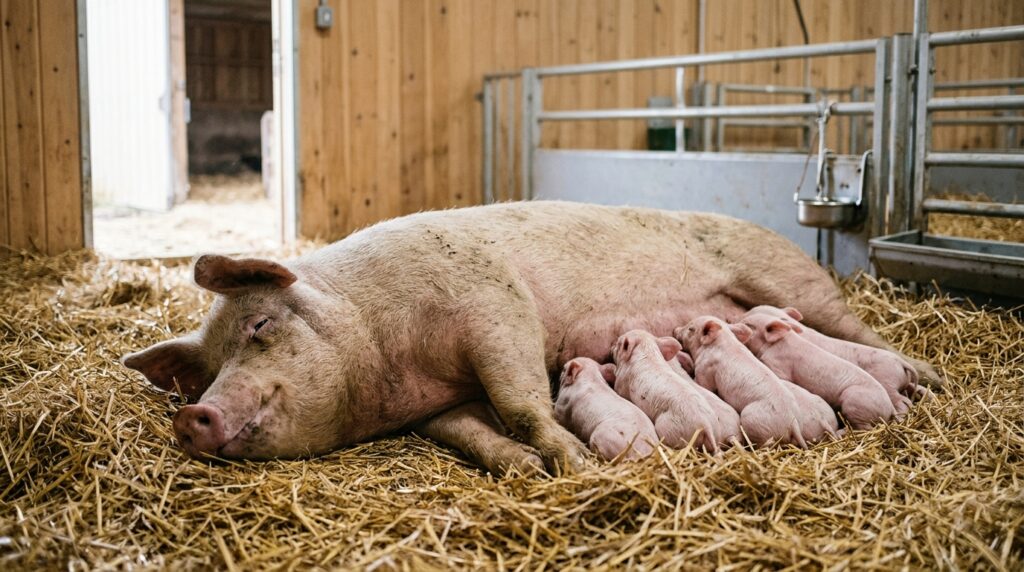
A large-scale field investigation in Japan has revealed that maternal fecal microbiota composition is associated with milk immunoglobulin A (IgA) concentrations in lactating pigs, though herd environment exerts a substantially stronger influence. The research, led by Mutsumi Furukawa, Tomonori Nochi, and collaborators, evaluated paired biological samples from commercial herds to examine how gut microbial communities correlate with antibodies supplied during lactation.
In mammals, maternal milk is essential for transferring both vital nutrients and critical immunological factors from mother to offspring. Secreted antibodies, particularly IgA, play an indispensable role in promoting the functional development of intestinal mucosal barriers that defend neonates against harmful infections. Previous experimental investigations in murine models demonstrated that maternal intestinal microbiota can stimulate Peyer’s patch-dependent secretion of IgA directly into milk, underscoring the biological importance of identifying maternal factors that influence milk antibody production to enhance mammary gland immunity.
Despite these established mechanisms in rodent models, the relationship between maternal fecal microbial communities and milk antibody concentrations has remained poorly characterized in commercial livestock populations. In particular, previous research had not sufficiently determined how milk IgA levels vary across diverse regional facilities or how those variations correlate with the fecal microbiota of lactating sows managed under distinct production environments.
To address this gap, the researchers conducted a cross-sectional field study utilizing paired milk and fecal samples collected from 409 lactating pigs located across 19 individual farms in Japan. This multi-farm design permitted an assessment of inter-animal biological relationships while simultaneously accounting for overarching environmental and management differences present between distinct agricultural sites.
The study utilized standard molecular and immunological profiling techniques to analyze the collected specimens. Fecal samples underwent 16S rRNA amplicon sequencing to determine the community composition and taxonomic structure of each sow’s intestinal microbiota, while paired milk samples were evaluated by enzyme-linked immunosorbent assays (ELISA) to quantify exact milk IgA concentrations.
Statistical evaluation using permutational multivariate analysis of variance (PERMANOVA) showed that the farm of origin accounted for the vast majority of variation observed in fecal microbial community structure. In single-factor PERMANOVA models, farm origin explained 27.20 percent of fecal microbial variation, compared to only 1.99 percent explained by the milk-IgA grouping. Similarly, in marginal multivariable PERMANOVA models, farm origin accounted for 24.71 percent of the variation, whereas the milk-IgA group accounted for 0.73 percent, reaching statistical significance at p = 0.029.
The research team reinforced these statistical tests by applying two complementary microbiota-based analytical strategies. The first strategy implemented comparative microbiota profiling categorized directly according to milk IgA concentration tiers, while the second approach grouped animals into bacterial community structures known as enterotypes before evaluating differences in milk IgA concentration across those classifications.
The authors noted important epidemiological and experimental limitations regarding these observations. Specifically, within the enterotype-based framework, 33 of the 35 animals classified into Enterotype 3 originated from a single farm, demonstrating strong confounding between microbial clustering and individual facility settings. Furthermore, because the study relied strictly on a cross-sectional design and the observed microbial contribution was modest relative to farm-level variation, the investigators emphasized that these findings represent statistical associations and preclude direct causal inference.
Subject of Research: Association between maternal fecal microbiota composition and milk IgA concentration in lactating pigs
Article Title: Association between maternal fecal microbiota composition and milk IgA concentration in lactating sows
Article References: Furukawa, M., Okada, T., Ohta, M., Kakuzen, A., Kurita, M., Tsukio, M., Kato, T., Kounoe, S., Shuto, Y., Akiyama, M., Matsuo, A., Okano, K., Hirakawa, R., Islam, J., & Nochi, T. (2026). Association between maternal fecal microbiota composition and milk IgA concentration in lactating sows. Animal Microbiome. https://doi.org/10.1186/s42523-026-00656-4
Image Credits: AI Generated
DOI: 10.1186/s42523-026-00656-4
Keywords: lactating sows, milk IgA concentration, maternal fecal microbiota, immunoglobulin A, swine gut microbiome, 16S rRNA amplicon sequencing, enzyme-linked immunosorbent assay, PERMANOVA, enterotype classification, Peyer’s patches, mammary gland immunity, cross-sectional study, intestinal barrier development, maternal antibody transfer, farm-associated variation, Japan swine farms, Enterotype 3

