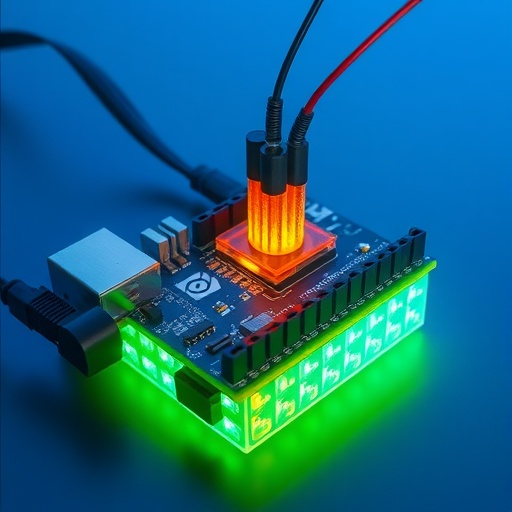
A $30 Arduino Machine That Grows Silver Nanostructures Could Put Nanofabrication on Every Lab Bench
For decades, sculpting matter at the nanoscale with precise electrical control has meant equipment that costs as much as a car. A team of researchers in Mexico has now released complete construction plans for a device that performs one of electrochemistry’s most demanding tasks — depositing metal nanostructures under millisecond-timed current pulses — using parts totaling less than thirty dollars. Writing in the open-access journal HardwareX, the group led by Marcos Luna Cervantes describes an Arduino-based pulsed constant-current platform that regulates currents from 0.50 to 40.00 milliamperes with a linearity of 0.9998, executes pulse trains with sub-millisecond fidelity, and has already fabricated silver nanoparticles and three-dimensional silver dendrites on titanium dioxide scaffolds for ultrasensitive molecular detection. Every element — schematic, firmware, wiring tables, bill of materials, and 3D-printed enclosure — is freely available, opening reproducible electrochemical nanofabrication to laboratories, classrooms, and independent scientists who could never justify a commercial galvanostat.
The technique at the heart of the device, pulsed current electrodeposition, exploits a subtlety that steady currents cannot. During each ON interval, metal ions such as Ag+ are reduced at the electrode surface and growth proceeds; during the OFF interval, the current stops and the diffusion layer depleted of ions partially recovers as fresh electroactive species redistribute toward the surface. By adjusting the current, ON time, OFF time, duty cycle, and cycle number, an experimenter can steer nucleation and growth independently, coaxing the same chemistry into dispersed nanoparticles, dense films, aggregates, or branched dendritic architectures. That control matters because applications from photoelectrochemical systems and energy electrodes to catalytically active surfaces and surface-enhanced Raman scattering (SERS) substrates depend critically on particle size, spacing, and shape. Residual current leaking through the relaxation period can quietly rewrite the ionic landscape near the electrode and shift where the next pulse nucleates, which is why the team treated a genuine zero-current OFF state as a core design requirement rather than an afterthought.
Commercial galvanostats and potentiostats deliver superb waveform control and accuracy, but a single instrument can cost thousands of dollars, which usually means one workstation per laboratory and experiments run sequentially rather than in parallel. Open-source projects such as PassStat and MYSTAT have lowered the entry barrier for general electrochemical measurements, yet the team spotted an unfilled niche: a dedicated, standalone instrument purpose-built for low-voltage pulsed constant-current electrodeposition, one that can sit beside several beakers at once and sweep systematically varied protocols without a computer in the loop. The published bill of materials reads like a hobbyist shopping list: an eight-dollar Arduino Nano, a three-dollar MCP4725 digital-to-analog converter, a 67-cent MCP602 operational amplifier, a 72-cent IRLZ34N logic-level MOSFET, a four-cent 2N2222 transistor, and a 20 × 4 liquid-crystal display, for a total under thirty dollars. Because the design is assembled on solderless breadboards with coordinate-by-coordinate wiring instructions, a first-time builder can reproduce it, although a dedicated printed circuit board heads the team’s improvement list.
Electrically, the platform is a closed-loop current regulator of classical elegance. The Arduino Nano runs a four-state firmware machine — configuration, processing, completion, cancellation — that lets users set ON time, OFF time, cycle count, and current through three push-buttons and the LCD, then converts the selected current into an analog command voltage with the 12-bit MCP4725. An MCP602 operational amplifier compares that command against the voltage dropped across a 10-ohm shunt resistor in series with the cell and continuously trims the gate of the IRLZ34N MOSFET, the low-side pass element, until the two match; because I = V/R, the delivered current is fixed by the DAC command and the shunt value alone. With a 5-volt reference, each DAC step is about 1.22 millivolts, corresponding to roughly 0.12 milliamperes — finer than the 0.50-milliampere menu increment. The 10-ohm shunt was a deliberate compromise: 1 ohm would yield sub-millivolt feedback signals vulnerable to offset and noise at low currents, while 50 to 100 ohms would consume too much of the 5-volt compliance budget that must still cover the cell, which needs only 1 to 3 volts for typical silver deposition. The cell runs in a two-electrode configuration, with a platinum anode tied to the 5-volt rail and the substrate cathode at the MOSFET drain.
The most consequential trick hides in the OFF state. Rather than simply commanding zero current and hoping the transistor complies, the firmware drives the DAC output to zero and simultaneously switches on the 2N2222, which yanks the IRLZ34N gate hard to ground, forcibly discharging any residual charge that might otherwise let the pass element whisper current into the cell. Oscilloscope traces show the gate returning cleanly low at the end of every pulse, a condition the authors verified repeatedly across switching cycles. During ON phases an indicator LED blinks in synchrony with the pulses; a buzzer announces completion or cancellation; and long presses of buttons B and C accelerate parameter adjustment across wide ranges. The whole assembly sits inside a 3D-printed PETG enclosure printed in about two and a half hours, shielding the breadboard electronics from the wet-chemical environment. The safety protocol is unambiguous: keep the cell beside the instrument, never above it; disconnect USB power before touching electrolyte or electrodes; and never run the first electrical test on a real cell.
Validation began with the most fundamental question: does the instrument deliver the current it promises? Using a UNI-T UT117C multimeter in series with a test LED load, the team measured every programmed setpoint from 0.50 to 40.00 milliamperes, five readings each, and found a strikingly linear response with a coefficient of determination of 0.9998. The mean absolute difference between programmed and indicated current was 0.22 milliamperes, the root-mean-square difference 0.29, and the largest single deviation 0.80 milliamperes at the 35.00-milliampere setpoint. All five repetitions were identical at the displayed resolution for every setpoint. Crucially, those deviations fall below the multimeter’s own manufacturer-specified accuracy of roughly ±1.00 to ±1.20 milliamperes on the range used, so the numbers demonstrate agreement within the measurement capability rather than an independent accuracy certification — a distinction the authors draw carefully, noting that a direct waveform comparison against a commercial electrochemical workstation remains a necessary future step because no such instrument was available in their laboratory.
Timing proved equally disciplined. Oscilloscope monitoring of programmed ON/OFF intervals from 5 to 500 milliseconds showed ON-time errors never exceeding 0.10 milliseconds and OFF-time deviations capped at 0.45 milliseconds. The ON-time data fit a straight line with a slope of 1.0001 and a coefficient of determination indistinguishable from one, and for intervals of 50 milliseconds and beyond the relative errors shrank to 0.2 percent for ON phases and 0.6 percent for OFF phases. The 50-millisecond figure is not arbitrary: it is the pulse duration in the group’s representative silver protocol, which pairs 400 cycles of 50 milliseconds ON and 250 milliseconds OFF at 5 milliamperes per square centimeter in 10 millimolar silver nitrate with 100 millimolar sodium nitrate supporting electrolyte and a platinum-sheet anode. Users simply enter the absolute current computed from their target current density and exposed electrode area, since the device regulates milliamperes, not milliamperes per square centimeter.
The decisive test was whether clean pulses translate into controlled nanostructures. The team electrodeposited silver onto bamboo-like titanium dioxide nanotube arrays grown in ethylene glycol containing 0.33 weight percent ammonium fluoride under an alternating 60/20-volt sequence. Holding the cycle count at 400 and sweeping current density from 4 to 7 milliamperes per square centimeter produced a textbook progression in field-emission scanning electron micrographs: sparse silver particles averaging 58 nanometers at 18 percent surface coverage at the lowest current; dense, well-distributed 63-nanometer particles at 5; larger 71-nanometer particles with partial coalescence at 6; and, at 7, pronounced agglomeration into 800-nanometer aggregates. Changing the anodization recipe to 80/10 volts cracked the oxide surface, and the silver answered by growing preferential dendrites along those cracks while nanoparticles decorated the intact nanotubes nearby — self-formed defects concentrate the local electric field and seed nucleation. A galvanostatically grown nanograss scaffold, by contrast, yielded a mixed nanoparticle-and-aggregate morphology across its high-surface-area network, confirming that scaffold geometry and pulse program jointly dictate the final architecture.
Those morphologies were not merely decorative; they functioned. In the team’s peer-reviewed companion studies, dendrite-decorated substrates reached analytical enhancement factors of 3 × 10⁷ and 7 × 10⁷ for methylene blue, with detection down to 10⁻¹¹ molar, while the nanoparticle-on-nanotube substrate achieved an enhancement factor of 10⁶ with detection at 10⁻⁹ molar. Benchmarked against a literature table spanning sputtered, evaporated, hydrothermal, laser-ablated, and ion-plated substrates, the pulsed-electrodeposited dendrites outperform several nanoparticle-based titanium dioxide systems yet trail the most extreme architectures such as silver nanowires, which climb to enhancement factors of 10¹² — a gap the authors attribute to hotspot density, interparticle spacing, and scaffold geometry rather than deposition method alone. Dendrites earn their performance from sharp tips and interbranch junctions that concentrate electromagnetic fields, and the data expose an instructive trade-off: too little silver leaves too few nanogaps, while too much merges particles and destroys the very junctions that make surface-enhanced Raman spectroscopy work.
Beyond sensing, the researchers point to protocol screening, parallel and distributed experimentation, and teaching as the natural habitats for a thirty-dollar instrument: multiple units can run comparative parameter studies simultaneously, and the open breadboard architecture makes closed-loop current regulation and pulse generation visible to students in a way a sealed black box never can. The limitations are stated plainly — a single 5-volt supply, no potentiostatic control, no real-time current logging, and thermal reassessment required before scaling the linear-mode MOSFET beyond 40 milliamperes. Near-term plans include a dedicated circuit board, onboard current sensing, data logging, and Bluetooth or USB communication. But the deeper significance lies in what the work removes: the budget barrier between an idea and a nanofabrication experiment. With firmware under an MIT license, hardware under CERN-OHL-P-2.0, documentation under CC BY 4.0, and all files posted on Zenodo, growing a silver dendrite at a precisely chosen pulse rate is no longer something a laboratory must buy the right to do.
Subject of Research: A low-cost, open-source Arduino-based pulsed constant-current electrodeposition platform (0.50–40.00 mA) with active hard-OFF gate clamping, electrically validated and demonstrated through silver nanoparticle and dendrite synthesis on anodized TiO2 scaffolds for surface-enhanced Raman spectroscopy substrates.
Article Title: A low-cost arduino-based pulsed constant-current platform for electrochemical nanostructure synthesis
Article References: Luna Cervantes, M., García González, L., Hernández Torres, J., Santos Santiago, E. O., Zamora Navarro, J. L., Jiménez Girón, D., Araujo Pérez, D. de J., Santaella González, J. B., Díaz Solís, M. A., Dupont, P. T., Izaguirre Hernández, I. Y., & García Chávez, A. de J. (2026). A low-cost arduino-based pulsed constant-current platform for electrochemical nanostructure synthesis. HardwareX, 27, e00831. https://doi.org/10.1016/j.ohx.2026.e00831
Image Credits: AI Generated
DOI: 10.1016/j.ohx.2026.e00831
Keywords: pulsed current electrodeposition, Arduino, open-source hardware, electrochemical synthesis, silver nanostructures, titanium dioxide nanotubes, surface-enhanced Raman spectroscopy, digital-to-analog converter, galvanostat, nanoparticle deposition, low-cost instrumentation, dendritic growth
Subject of Research: Technology and Engineering
Subject of Research: Technology and Engineering
Article Title: Low-cost Arduino platform enables pulsed-current synthesis of electrochemical nanostructures
Article References: Luna Cervantes, M., García González, L., Hernández Torres, J., Santos Santiago, E. O., Zamora Navarro, J. L., Jiménez Girón, D., Araujo Pérez, D. D. J., Santaella González, J. B., Díaz Solís, M. A., Thomas Dupont, P., Izaguirre Hernández, I. Y., & García Chávez, A. D. J. (2026). A low-cost arduino-based pulsed constant-current platform for electrochemical nanostructure synthesis. HardwareX, 27, Article e00831. https://doi.org/10.1016/j.ohx.2026.e00831
Image Credits: AI Generated
DOI: 10.1016/j.ohx.2026.e00831
Keywords: affordable laboratory nanofabrication tools, DIY nanostructure growth, electrochemical nanostructure synthesis, Low-cost Arduino nanofabrication, low-cost electrochemical device, nanostructure synthesis on titanium dioxide, open-access hardware for nanotechnology, open-source nanofabrication equipment, pulsed current control in electrochemistry, pulsed current electrodeposition, silver nanoparticle fabrication, sub-millisecond pulse precision in electrochemical processes
Cite Scienmag News
APA
MLA
Chicago
Denise Maddox. (August 30, 2026). Low-cost Arduino platform enables pulsed-current synthesis of electrochemical nanostructures. Scienmag. https://scienmag.com/low-cost-arduino-platform-enables-pulsed-current-synthesis-of-electrochemical-nanostructures/
Copy citation
Download RIS
Tags: accessible scientific instrumentationaffordable laboratory nanofabrication toolsArduino-based electrochemical synthesiscost-effective research methodsDIY nanofabrication platformsDIY nanostructure growthelectrochemical nanostructure synthesiselectrochemistry for nanotechnologyinexpensive nanomanufacturing toolsLow-cost Arduino nanofabricationlow-cost electrochemical devicelow-cost nanostructure fabricationnanofabricationnanoparticle and dendrite growthnanostructure synthesis on titanium dioxideopen-access hardware for nanotechnologyopen-source lab equipmentopen-source nanofabrication equipmentpulsed current control in electrochemistrypulsed current electrodepositionsilver nanoparticle fabricationsilver nanostructuressub-millisecond pulse precision in electrochemical processes