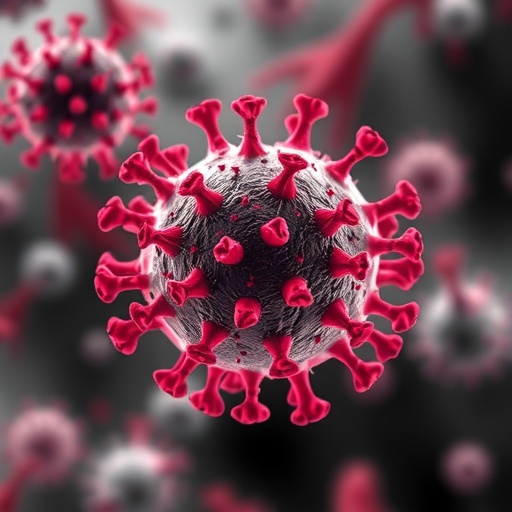
In groundbreaking research conducted at Umeå University, scientists have uncovered a new dimension in the ongoing battle against the spread of flaviviruses, such as tick-borne encephalitis virus (TBEV), West Nile virus, and dengue virus. These viruses, responsible for severe illness and significant mortality worldwide, exploit human cells in ways that have eluded comprehensive understanding until now. The study, led by Professor Anna Överby Wernstedt from the Department of Clinical Microbiology, reveals that two human proteins, NUP98 and NUP153—components of the nuclear pore complex—play critical and previously unrecognized roles in the replication of these viruses.
Flaviviruses replicate within the cytosol of infected cells, a site distant from the nucleus where the nuclear pore complex typically operates. Historically, NUP98 and NUP153 were known for their roles as gatekeepers regulating molecular traffic between the nucleus and cytoplasm, not for involvement in cytosolic viral processes. This new research challenges that notion, demonstrating that both nucleoporins relocate to viral replication sites within the cytosol during infection, directly binding viral RNA. Moreover, NUP153 uniquely binds viral proteins, implicating it as a multifaceted facilitator of viral propagation.
Viruses, due to their limited genomes, rely extensively on hijacking host cell machinery for replication and protein synthesis. Understanding host factors that are co-opted during infection presents a promising avenue for therapeutic intervention, particularly as antiviral drug development has lagged behind for many flaviviruses. These pathogens cause millions of infections annually without approved targeted antiviral treatments, underscoring the urgent need for novel strategies that go beyond traditional antiviral modalities.
The researchers employed a combination of molecular biology techniques, including RNA-protein interaction assays and cellular imaging, to analyze the recruitment and binding dynamics of NUP98 and NUP153 during flavivirus infection. Their findings elucidate distinct roles for each nucleoporin: NUP98 is essential for efficient viral RNA replication, while NUP153 regulates the relative abundance of viral structural and non-structural proteins. This balance is crucial for successful viral assembly and infection progression.
Of particular interest is the discovery that NUP153 interacts with a specific segment of the viral RNA located at the junction between sequences encoding structural proteins and those encoding non-structural proteins. This selective binding modulates the translation of viral proteins, ensuring proper stoichiometric ratios, a mechanism that contradicts the previous assumption that viral protein synthesis proceeds at uniform rates. The ability of the virus to fine-tune protein production via host cell factors highlights a sophisticated level of host-pathogen interplay that has not been appreciated before.
An innovative aspect of this research comes from collaborative efforts with Uppsala University, where a synthetic peptide was identified that can block the binding of NUP98 to viral RNA. By disrupting this critical interaction, viral replication was significantly impaired, demonstrating that targeting host-virus protein interfaces can yield potent antiviral effects. This finding opens the door to therapeutic designs that focus on host factors, potentially circumventing issues of viral mutation and drug resistance commonly seen with direct-acting antivirals.
The recruitment of nucleoporins to cytosolic replication platforms signifies a paradigm shift in our understanding of flavivirus biology. Rather than being confined to nuclear pore functions, these proteins moonlight as integral components of the viral replication machinery. This dual role adds complexity to the nuclear pore proteins but also offers new targets for precision antivirals. Therapeutics that inhibit nucleoporin-virus interactions could present a broad-spectrum strategy against diverse flaviviruses.
Targeting stable host proteins presents an attractive alternative to conventional antivirals that often lose efficacy due to rapid viral evolution. Host proteins are less prone to mutation-driven resistance, lending durability to treatment strategies that exploit this aspect. Furthermore, because NUP98 and NUP153 are implicated across related orthoflaviviruses, drugs designed against these host factors could tackle multiple diseases simultaneously, amplifying their clinical utility.
This research underscores the importance of interdisciplinary approaches that blend virology, molecular biology, and structural biology to decode complex infection processes. Advancing our knowledge of how human proteins facilitate viral lifecycles helps identify vulnerabilities in the pathogen that were previously concealed. Continued exploration of nucleoporin functions may also reveal broader implications for cell biology and host defense mechanisms.
Professor Anna Överby Wernstedt and her team’s work represents a significant step forward in antiviral drug discovery. Their studies not only deepen the molecular understanding of flavivirus replication but also provide proof-of-concept for targeting host-virus interactions with synthetic molecules. As flavivirus-related diseases continue to pose global health threats, innovative solutions such as these are critical for developing next-generation therapeutics.
In sum, by redefining the roles of nuclear pore proteins NUP98 and NUP153 in flavivirus infection, this research dismantles old paradigms and charts new paths for antiviral intervention. The dual functionality of these nucleoporins—transitioning from nuclear gatekeepers to viral facilitators—demonstrates the virus’s ability to repurpose cellular machinery with remarkable precision. These insights set the stage for transformative antiviral strategies that focus on host factors, potentially revolutionizing how we confront viral diseases in the future.
Subject of Research: Cells
Article Title: Proviral NUP153 binding to viral proteins and RNA regulates structural–nonstructural protein ratios in orthoflavivirus infection.
News Publication Date: 8-Apr-2026
Image Credits: Mattias Pettersson
Keywords: Viral infections, West Nile virus, Cell biology, Life sciences, Health and medicine
Tags: cytosolic viral replication sitesdengue virus cell protein interactionsflavivirus replication mechanismshuman proteins facilitating severe viral infectionsmolecular virology of flavivirusesnucleoporins in viral propagationNUP153 protein binding viral RNANUP98 protein in virus replicationrole of nuclear pore complex in viral infectionstick-borne encephalitis virus researchviral hijacking of host cell machineryWest Nile virus host interactions