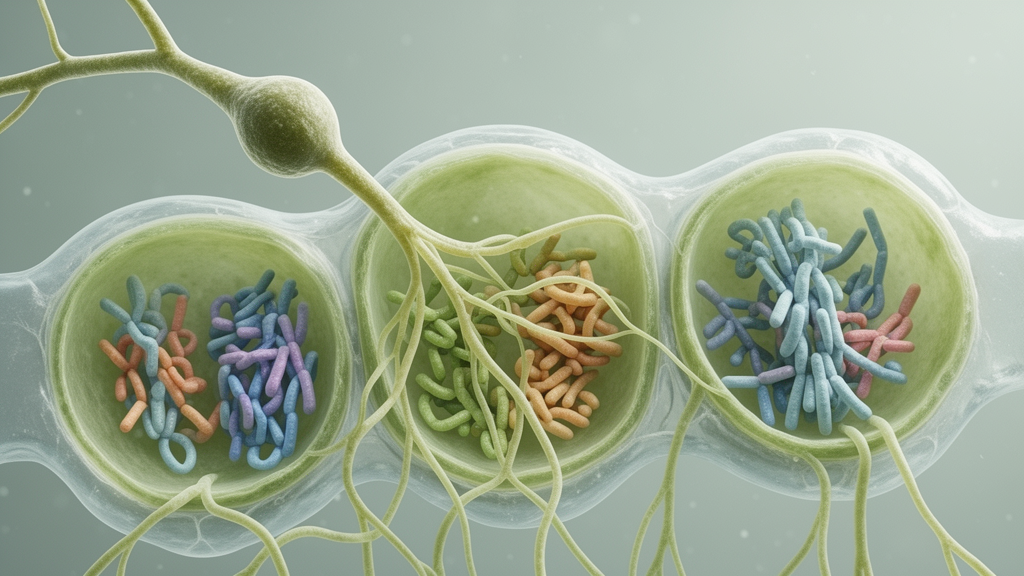
A single haploid strain of the endophytic fungus Epichloë festucae can colonize three polyploid cytotypes of the Iberian endemic grass Festuca rothmaleri, according to a multi-method study that combined chromosome counts, flow cytometry, microscopy, fungal culture, mating-type screening and multilocus phylogenetic analysis. The tetraploid, hexaploid and octoploid plants occurred across three mountainous localities in Salamanca province, northwestern Spain, but their fungal partners showed no corresponding increase in genome size. Instead, isolates from every host cytotype had uninucleate conidia, nearly identical haploid DNA measurements and sequence profiles placing them within E. festucae. The finding establishes an unusual ploidy asymmetry in which the plant genome varies substantially while the apparent fungal genome remains stable, and it provides a natural system for investigating how one endophyte genotype is tolerated by hosts with different numbers of chromosome sets.
The researchers collected F. rothmaleri during the flowering seasons of 2022 and 2023 from Montemayor del Río, Candelario and El Cabaco, three sites separated by approximately 20–50 kilometres and mountain ranges. Between 20 and 35 plants were examined per site, with individuals sampled at least three metres apart to reduce the chance of collecting rhizomatous clones. Morpho-anatomical examination identified the plants as F. rothmaleri, including a characteristic V-shaped leaf cross-section with square ribs and a non-scalloped abaxial surface. Flow cytometry of leaf tissue and counts of metaphase chromosomes from root-tip meristems confirmed the presence of tetraploid plants with 2n = 28, hexaploids with 2n = 42 and octoploids with 2n = 56. Their nuclear DNA contents were estimated as 7.54 ± 0.21 pg/2C, 12.81 ± 0.16 pg/2C and 15.58 ± 0.28 pg/2C, respectively.
The three cytotypes did not have identical geographic distributions. Montemayor del Río contained only tetraploids, El Cabaco contained only hexaploids, and Candelario held both tetraploid and octoploid individuals. Tetraploids from the two sites did not differ significantly in genome size, indicating that the apparent cytotype difference was not simply a geographic effect in the measurements. The authors also noted that the high-polyploid F. rothmaleri populations did not display the strong monoploid-genome reduction reported in some members of the Aulaxyper lineage. These features make the locality arrangement useful because the same host species and apparently the same fungal strain occur in distinct cytological contexts, including tetraploids and octoploids at one site.
Endophyte presence was detected independently by aniline blue staining of aerial tissues and by culturing disinfected stem or tiller material on potato dextrose agar. The two methods agreed for every tested plant. Infection was common at all localities, reaching 77.1% at Montemayor del Río, 82.4% at Candelario and 90.9% at El Cabaco. Rates were also similar among cytotypes: 81.5% for pooled tetraploids, 90.9% for hexaploids and 80.0% for octoploids. These measurements indicate that the association is widespread within the sampled populations and that host chromosome-set number did not appear to impose an obvious barrier to colonization. The observations do not, however, establish whether the fungus provides measurable benefits to the grasses or how infection affects their performance under stress.
No Epichloë stromata—the reproductive structures associated with sexual reproduction and horizontal transmission—were observed in the field collections. Exploratory PCR nevertheless detected both MAT1-1 and MAT1-2 mating-type idiomorphs at each of the three sites. This combination indicates that mating types capable of sexual reproduction are present among the sampled endophytes, but it does not demonstrate that sexual reproduction is occurring. The authors suggest that the endophyte may persist mainly through vertical transmission within seeds, while noting that asexual conidia might also permit water-mediated dispersal. Determining whether epiphytic conidia are produced on F. rothmaleri and how often stromata arise would be necessary to distinguish these possibilities. The mating-type result also does not rule out occasional hybridization involving other Epichloë species, although the study found no direct evidence for such events in this system.
Cultured isolates formed white, fluffy mycelium with variable appearance, but their growth rates did not differ significantly according to source population, host ploidy or the interaction between those factors. The mean growth rate across all isolates was 1.69 ± 0.21 millimetres per day. Fine-scale measurements of asexual structures did reveal variation, particularly among conidia, although individual identity accounted for the largest share of morphological variation in the permutation analysis. Average conidial length, width and area differed only marginally between two broad groups, while conidiophore width remained essentially unchanged. Conidia from isolates associated with hexaploid and some tetraploid hosts were generally smaller than those from the mixed Candelario population, and the smallest conidia and conidiophores occurred among the hexaploid-host isolates.
Multivariate analyses separated isolates more clearly by source population than by host ploidy in principal component analysis, and the first two components explained 86.6% of variation at the individual level. By contrast, linear discriminant models classified groups most successfully according to host ploidy, reaching a cross-validated accuracy of 68.8% with a kappa value of 0.459. Neither result indicates that morphology is a definitive marker of the host cytotype, because variation within groups was substantial and models based on the combined effects of population and ploidy had the weakest discriminatory power. The researchers also developed image-analysis software to measure conidial area automatically, reporting an overall mean area of 7.1 ± 1.0 micrometres squared. This digital morphometric approach was designed to make measurements more scalable and consistent, although the biological meaning of the observed host-associated patterns remains unresolved.
The fungal genome-size assay provided the strongest evidence that the isolates belonged to a common ploidy state. DAPI staining showed that every evaluated conidium contained a single nucleus, and flow cytometry produced reliable results only during the first 6–10 days of culture. Mean DNA content was 0.044 ± 0.002 pg/1C in isolates from Montemayor del Río tetraploids, 0.045 ± 0.002 pg/1C from Candelario tetraploids, 0.045 ± 0.003 pg/1C from El Cabaco hexaploids and 0.046 ± 0.002 pg/1C from Candelario octoploids. No significant differences were detected among populations or host cytotypes. The authors describe this as the first flow-cytometry estimate of Epichloë genome size and converted the common mean of about 0.045 pg/1C to approximately 42.8 megabases. That value is larger than some published E. festucae assemblies but remains within the range reported for haploid Epichloë genomes; comparisons across genera should nevertheless account for differences among sequencing and flow-cytometry methods.
Phylogenetic evidence supported the morphological and cytological identification of the fungus. Eight newly sequenced isolates were analyzed at five nuclear loci—actG, calmodulin, ITS, tefA and tubB—alongside reference Epichloë specimens and two Claviceps purpurea outgroups. Single-locus trees placed all new samples within a strongly supported E. festucae clade. Calmodulin and tubB also grouped the F. rothmaleri isolates into a subclade, with bootstrap support of 98% for calmodulin and 74% for tubB. Two polymorphic positions in the calmodulin alignment were specific to the new samples, suggesting that they could serve as candidate barcodes for this lineage. A concatenated maximum-likelihood tree and a multispecies-coalescent tree constructed with ASTRAL-III produced broadly congruent topologies. Support for the finer placement of the new lineage ranged from high in the coalescent analysis to moderate in the concatenated tree, while the broader E. festucae clade received strong support in both analyses. The authors note that the modest number of loci requires caution when interpreting some gene-tree and site-concordance values.
Taken together, the results document a polyploid host paired with a haploid endophyte across tetraploid, hexaploid and octoploid F. rothmaleri. This contrasts with other Festuca–Epichloë systems in which increased genomic complexity has been reported in both partners. The study establishes a baseline for future work rather than a complete account of the association: it did not test alkaloid profiles, fungal gene expression, plant fitness, drought tolerance, pathogen resistance or grazing responses, and it did not observe the long-term transmission of a single clonal fungal genotype through host generations. Nonetheless, its cytogenetic, morphological and molecular results show that the same E. festucae lineage can persist across markedly different host genome sizes. The system therefore offers a useful framework for asking whether polyploidy alters the endophyte’s metabolism or ecological effects without requiring a corresponding change in fungal ploidy, while the new conidial image-analysis and flow-cytometry methods may help investigators compare these traits more efficiently in other grass–endophyte associations.
Subject of Research: Characterization of a haploid Epichloë festucae strain associated with three polyploid Festuca rothmaleri cytotypes.
Article Title: Unveiling an asymmetric plant–fungal symbiosis: morphological, cytogenetic, and molecular characterization of a haploid Epichloë festucae strain associated with three polyploid cytotypes of the Iberian endemic grass Festuca rothmaleri
Article References: Sotomayor-Alge, A., Inda, L. A., Ángel-Beamonte, E., Zabalgogeazcoa, Í., & Catalán, P. (2025). Unveiling an asymmetric plant–fungal symbiosis: morphological, cytogenetic, and molecular characterization of a haploid Epichloë festucae strain associated with three polyploid cytotypes of the Iberian endemic grass Festuca rothmaleri. IMA Fungus, 16, Article e162692. https://doi.org/10.3897/imafungus.16.162692
Image Credits: AI Generated
DOI: 10.3897/imafungus.16.162692
Keywords: Epichloë festucae, Festuca rothmaleri, plant–fungal symbiosis, polyploidy, ploidy asymmetry, endophyte, flow cytometry, genome size, phylogenetics, Iberian endemic grass, Unveiling, asymmetric