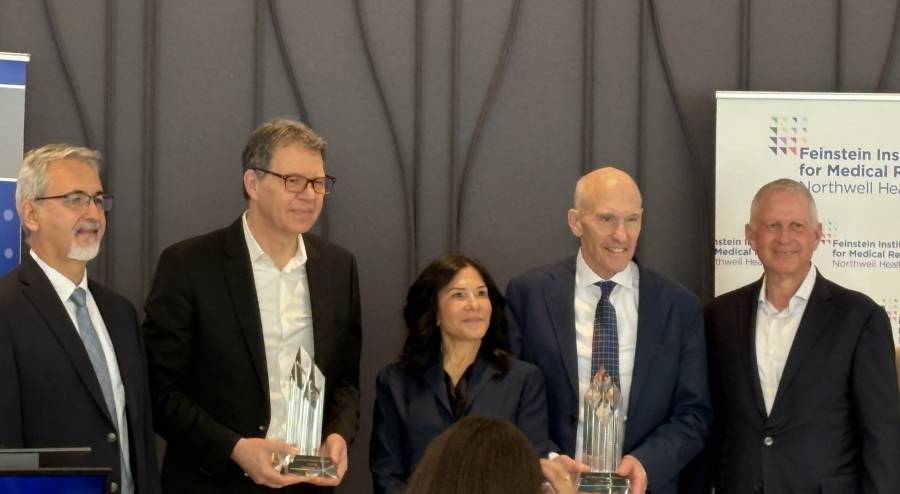
![An image showing the two honorees receiving their awards at an event to celebrate the 13th annual Ross Prize in Molecular Medicine [Uduak Thomas].](https://www.genengnews.com/wp-content/uploads/2026/06/Ross-prize-honorees.jpg "Ross prize honorees")
NEW YORK CITY — Patients, colleagues and peers gathered in midtown Manhattan last week to celebrate Carl June, MD, and Michel Sadelain, MD, PhD, who shared the 13th annual Ross Prize in Molecular Medicine.
The prize, which is made possible by the generosity of Feinstein Institutes board vice chairman Jack Ross and his wife, Robin, assistant vice president of principal gifts at the Northwell Foundation, recognizes biomedical scientists whose discoveries have transformed how medicine is practiced. Established in 2013, it is awarded annually through the Feinstein Institutes’ peer-reviewed, open-access journal Molecular Medicine.
June and Sadelain are both well-known in immunotherapy circles but could not disguise their delight at being recognized for their pioneering work in developing CAR T-cell therapy for cancer treatment.
June is an immunologist and cancer researcher at the University of Pennsylvania’s Perelman School of Medicine. He serves as the director of both the Center for Cellular Immunotherapies and the Parker Institute for Cancer Immunotherapy at Penn. Sadelain, who holds dual French and Canadian citizenship, is a professor of medicine at Columbia University’s Vagelos College of Physicians and Surgeons, where he directs the Columbia Initiative in Cell Engineering and Therapy.
With so many people wanting a chance to congratulate and interact with June and Sadelain—some even requesting autographs—it was hard to get more than a few minutes of their time to chat. June told me the award was a “huge honor” personally as well as a great way to recognize the efforts of those who have worked with him over the past three decades. “It’s a great way for the public to learn more about the value of what was initially basic research and how it can actually affect lives,” June said.
Sadelain expressed similar sentiments. ”I’m so fortunate that somebody looked at our work and thought that it warranted such recognition,” he told me. Additionally, the presence of both patients and students “who are curious and have a sense that there is something that that would like to get involved with” at the award ceremony reinforced both the human impact and educational value of his work.
That kind of curiosity coupled with persistence certainly served Sadelain and June well in their careers. An important theme that both honorees acknowledged is that scientific breakthroughs often require decades of dedicated work despite repeated setbacks.
As June noted, prior to 2011, when the first checkpoint inhibitor therapy was approved, and then in 2017, when the first CAR T-cell therapy was approved “there were many decades when cancer immunotherapy was tried and failed.” Multiple disappointing results can make science review boards nervous and cause federal funding sources to dry up. For the CAR T field, things changed once regulators and scientists realized that immunotherapies could work but “that initial paradigm shift” was needed for acceptance, June said.
Sadelain concurred. Scientists entering the field today are far less likely to face the same challenges that he and June and their teams had to contend with. “When we opened the first clinical trials, we couldn’t find patients,” he told me. “Today, there are waiting lists.”
A brief history of CAR T
The first CAR T trial was not in cancer but in HIV. In the 1990s, June’s lab explored the possibility of using T cells to treat the disease which at the time lacked treatments. “My first clinical protocol began when I was in the Navy in Bethesda and it was called RV 100,” he said in his award lecture. The work was done as part of a joint navy/army effort and marked “the first time we gave T cells to patients.”
![Carl June, MD, director of the Center for Cellular Immunotherapies and the Parker Institute for Cancer Immunotherapy at University of Pennsylvania, giving his lecture at the 13th annual Ross Prize Awards [Uduak Thomas]](https://www.genengnews.com/wp-content/uploads/2026/06/Carl-June-300x228.jpg)
For that first protocol, June’s team took patients with late-stage AIDS and expanded their T cells in the lab, without making any genetic modifications. They then infused those cells back into the patients to determine whether they could restore their immune systems.
“We thought it would be pouring fuel on fire” in the sense that “adding T cells back to the patients would cause more HIV replication.” But that did not happen because the scientists expanded the cells in a way that made them resist reinfection by downregulating the HIV co-receptor. The first clinical trial, published in 2002, showed a dose-dependent increase in T-cell counts following the infusions without a corresponding increase in viral load. June and his colleagues conducted three additional trials, which showed that the infused cells survived on average more than 10 years in patients.
Following those trials, June and his team engineered T cells with a receptor composed of the CD4 molecule fused to the CD3 zeta signaling chain of the T-cell receptor. Over the next five years, June’s group ran trials using these first-generation CAR T cells, demonstrating that they were safe and persisted in the body. Those findings provided important safety data as CAR T technology began moving towards oncology applications.
There were of course disappointments along the way. Several studies using the first-generation CARs did not demonstrate clinical benefit in cancer patients (in contrast to HIV patients). Enthusiasm for the technology waned and skepticism about its potential grew. Still June and his collaborators persisted. The second-generation CAR design incorporated a co-stimulatory domain rather than relying solely on CD3 zeta signaling. Specifically, they used 4-1BB in combination with CD3 zeta to target CD19-positive leukemia cells.
And that’s when the tide turned. The first patient treated with this new generation of cells, a 67-year-old man with end-stage leukemia, achieved a complete response. In total, three of the first patients that were treated responded. “We didn’t know if we were really lucky at that time or not, but it was a striking result,” June said.
Today, there are seven FDA-approved CAR T-cell therapies, and more than 60,000 patients have been treated. Several additional products are in development with many different designs being tested in thousands of labs. June closed by presenting some new, unpublished studies including a program in glioblastoma. It’s clear that June’s work is far from done.
Sadelain’s milestones
Sadelain said there were four major milestones that marked efforts to bring CAR T cells to the clinic. First was the development of methods for introducing genes into primary T cells. Before these techniques were available, scientists largely studied genes in leukemia cell lines as a surrogate for normal T cells. As such, critical aspects of T-cell biology remained poorly understood, including how they respond to antigen, when they proliferate, and when they undergo cell death.
![Michel Sadelain, MD, PhD. professor of medicine at Columbia University’s Vagelos College of Physicians and Surgeons and director of the Columbia Initiative in Cell Engineering and Therapy, giving his lecture at the 13th Ross Prize Awards [Uduak Thomas].](https://www.genengnews.com/wp-content/uploads/2026/06/Michel-Sadelain-300x248.jpg)
Sadelain’s second milestone was the identification of the gene encoding the CD3 zeta chain, which sparked efforts to engineer fusion receptors that enabled T cells to recognize and kill target cells in a sustained way. Third was identifying a target that could be studied in the lab. Sadelain’s lab settled on CD19, which was known to be expressed in lymphomas and leukemias.
The fourth milestone was less a scientific discovery and more of a realization. If scientists wanted to bring T cells into clinical use, “you had to do it yourself,” Sadelain said. “There was no industry interested in developing or manufacturing cells as medicines.”
While CAR T-cell therapies today are spreading beyond cancer to other disease areas, there are still challenges to solve in oncology. CAR T cells do not yet work well in solid tumors, Sadelain said. Despite some promising clinical results, “it’s clear that what had been designed for these blood cancers cannot be applied exactly as is to solid tumors,” Sadelain said. “They can be applied exactly as is to autoimmunity perhaps but not solid tumors.”
Sadelain said the first challenge is the T cell itself. Once the engineered cells are released into the patient’s bloodstream, they have to reach the tumor and penetrate its defenses, which is not easy. Even if they are able to penetrate the tumor, they may not work because tumors have evolved mechanisms to shut off the immune response in order to survive. “The good news is that many of these mechanisms are understood today,” so the next step is to figure out how to engineer T cells that can overcome these mechanisms.
Other challenges include identifying suitable targets and developing ways to support the CAR T cells to ensure they persist. Lastly, scientists need a way to manufacture these cells at sufficient scale to make treatments more affordable and accessible. It may be possible to lower the cost to patients through better reimbursement or policy changes “but some of that can be improved through biology.”
Sadelain went on to describe three CAR designs that go beyond the foundation models and could be the treatments of the future. These designs aim to improve on some previous shortcomings, including a longer lifespan and requiring orders of magnitude lower doses than their predecessors. Sadelain closed by noting that it took nearly four decades for the field to get from “the very first ideas to where we are today,” but “it’s not static by any means.”
“These molecules keep getting better and better, and that’s why we are optimistic,” he said. Moving forward, “we need persistence combined with potency. We need greater sensitivity. I think many of these beautiful receptors are on the way to deliver these results.”
From discovery to deployment
Following the awards, I spoke with Kevin Tracey, MD, president and CEO of the Feinstein Institutes. He told me that the Ross Prize celebrates the complete scientific journey from discovery to deployment. “We live in a time where we benefit from all the work that came before us by brilliant people who used science and medicine and technology to eradicate diseases that some people have never even heard of and will never see,” he said. “But somehow, some of that of the importance and the optimism of that gets lost in the modern era we’re living in.”
Established in 2013, Tracey said the Ross Prize is unique because it celebrates that “rare individual who sets out to solve a problem, to cure a disease” and “stays with the entire process from discovery to development to deployment.” Sadelain and June “have lived that for decades,” Tracey said. Tens of thousands of people “are alive because of what these two men did and all of their colleagues.”
But the Ross Prize is also important at a time of rising anti-science sentiments, amplified by some news media and social media platforms. “What we’re losing is the tradition of storytelling and the creation of stories and themes that bind us all together for a common good. Stories have to be told or they are lost,” he said. The Ross Prize is “an opportunity to tell those stories and to celebrate that excellence.”
While the prize has always focused on rewarding excellence in science that forms the basis of new therapies, Tracey told me that over the past five years or so, the focus has expanded from basic research to include research that has made it into clinical use. There are many worthy science prizes that recognize “very elegant science,” Tracey said. But much of the downstream utility of that early science is “maybe decades in the making, and we decided to focus on the small number of times it actually does go the whole way. Those people deserve a prize too!”
Decisions about the awardees each year are made by committee, with representatives from multiple institutions. It has always been a tough decision selecting a few winners from the hundreds of nominations, Tracey acknowledged, “but we always come to a consensus.”
The next transformative therapy
The transformation from risky experimental therapy to standard of care for some cancers demonstrates how scientific consensus can completely reverse. These days, the future is certainly bright for immunotherapies far beyond its original oncology focus.
Both honorees expressed excitement about the possibilities while maintaining an awareness of practical limitations and reiterating the need for continued research. “I think basically all blood cancers will be treated with some kind of cell therapy,” June predicted. “That’s more of an engineering problem now.” Where advances are still needed, he said, is in similar therapies for solid cancers, something that both he and Sadelain are working on with their respective teams.
Asked whether in vivo CAR T-cell therapy could be the next transformative therapy, June said: “It’s very early. Just two months ago, the first in vivo CAR T cells were reported, and they had a mixture of toxicity and efficacy in myeloma, so that’s great.” But “it’s too early now to know how long [they] will last and how safe” they will prove. He also noted the cost savings that in vivo CAR T therapies could offer, not just for cancer. “There are 10 times more people that have autoimmune disease than cancer. If we have a way to make it cheaper and more readily available, that’s what we really need.”
Looking ahead, Sadelain said “there are many new potential directions that are really tantalizing.” There are, of course, many more cancers that need effective treatments, but researchers are starting to look to other areas as well including organ transplantation, neurodegenerative diseases, and infectious diseases.
Among the important questions left to answer is how to produce these cells? “If this starts working for some more common diseases… we’re going to hit a bottleneck,” Sadelain noted. Could allogeneic cells from healthy volunteers be adapted to work for some recipients? Or could we use T-cells made from pluripotent stem cells? “That’s a very interesting direction.” Another “exciting new frontier” is emerging from in vivo studies, although there is still much to learn about their efficacy and toxicity, especially in cases where multiple doses are required.
The Ross Prize committee is already thinking about next year’s honorees. In a few weeks, Tracey said a new batch of emails will be sent to solicit nominations for next year’s awards. The awardees for the 14th Ross Prize will be selected in January 2027.