Copper oxide nanoparticles have become one of the most talked-about tools in agricultural nanotechnology. They combine strong antimicrobial action with the fact that copper is an essential plant micronutrient, needed for enzymatic activity, photosynthesis, and pathogen resistance. But a growing body of evidence has raised an uncomfortable question: the same particles that could protect crops and deliver nutrients efficiently may also damage the very plants they are meant to help. A new study from researchers at the Central University of Himachal Pradesh in India now offers a promising answer to that dilemma, showing that a simple polymer coating can substantially soften the toxic blow of copper oxide nanoparticles on crop seeds.
The research, published in Discover Chemistry, focused on mixed-phase copper oxide nanoparticles containing both CuO and Cu2O crystalline phases. Rather than applying the bare particles directly, the team wrapped them in polyethyleneimine, or PEI, a cationic polymer densely studded with amine groups. The idea rests on a straightforward but powerful principle: the toxicity of copper oxide nanoparticles is largely driven by the redox-active release of copper ions, which catalyze the production of reactive oxygen species inside plant tissues. These reactive molecules attack DNA, damage proteins, and overwhelm the plant’s antioxidant defenses. If a coating can act as a barrier that limits copper ion release and keeps particles from clumping together, much of that damage could be prevented before it begins.
Synthesis was carried out by chemical reduction. The researchers dissolved copper sulfate pentahydrate and treated it with EDTA and potassium hydroxide before adding sodium borohydride dropwise in an ice bath, then stabilized the resulting particles with polyvinylpyrrolidone. For the coated version, PEI was introduced before the reducing agent, so the polymer both helped reduce the copper and formed a protective shell around the growing particles in a single step. The solution shifted from light blue to navy blue as the PEI bound the copper, then changed color again as reduction proceeded, a visual hint of the chemistry unfolding in the beaker.
Confirming that the coating was really there required an arsenal of characterization techniques. Ultraviolet-visible spectroscopy showed a shift in the absorption peak from 230 nanometers for the bare particles to 268 nanometers after modification, a red-shift consistent with surface functionalization. Fourier transform infrared spectroscopy told a complementary story: the sharp Cu-O stretching vibration at 607 wavenumbers moved to 630 after coating, and new peaks corresponding to N-H stretching, N-H bending, and C-N stretching appeared, the fingerprints of the PEI layer.
Perhaps the most striking evidence came from dynamic light scattering and zeta potential measurements. Bare copper oxide nanoparticles formed large, unstable aggregates with a hydrodynamic diameter of roughly 700 nanometers and a slightly negative zeta potential of minus 8.20 millivolts, conditions that favor clumping. After PEI coating, the hydrodynamic size dropped dramatically to about 160.5 nanometers and the surface charge swung positive to plus 24.8 millivolts. That positive charge comes from the forest of amine groups on the polymer, which push particles apart through electrostatic repulsion. In other words, the coating did not just decorate the surface; it fundamentally changed how the particles behave in suspension, keeping them small, dispersed, and less likely to form the large agglomerates that can smother seed tissues.
X-ray diffraction revealed a cubic crystalline structure matching reference cards for both CuO and Cu2O, with Cu2O as the dominant phase, and the pattern was essentially unchanged by coating, except for reduced peak intensities due to the amorphous polymer. High-resolution transmission electron microscopy showed cubic-shaped particles with clear crystalline ordering in both versions. X-ray photoelectron spectroscopy sealed the case: bare particles showed only copper and oxygen signals, while the coated particles displayed nitrogen and carbon peaks from the PEI chain, with nitrogen signatures corresponding to primary, secondary, and tertiary amines.
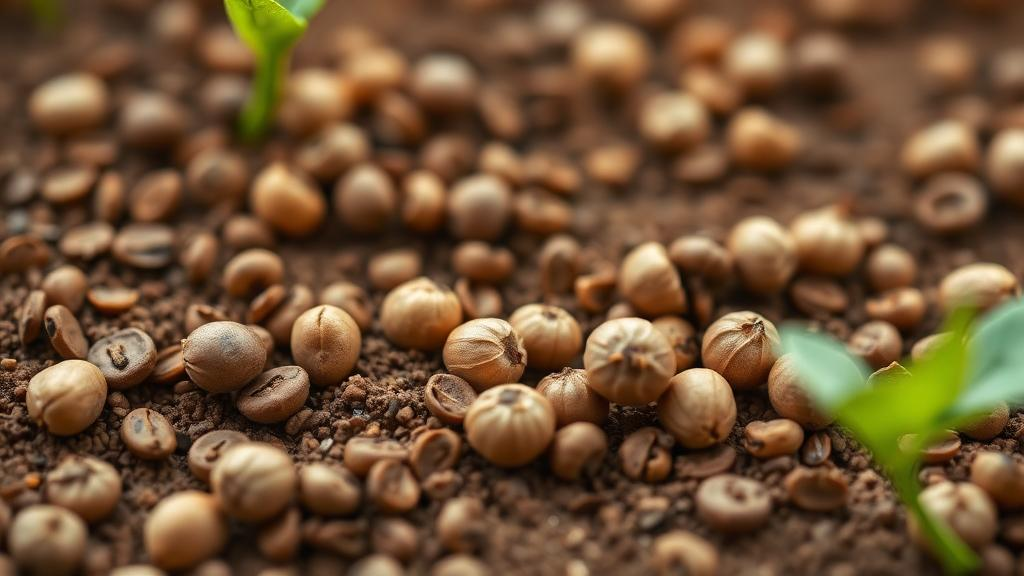
With the materials fully characterized, the team turned to the biological question. Seeds of two agriculturally important crops were tested: Brassica juncea, Indian mustard, a dicot, and Zea mays, maize, a monocot. Twenty seeds of each species were exposed to concentrations ranging from 100 to 2000 milligrams per liter of either bare or coated nanoparticles, with germination percentage and germination index measured after 48 and 72 hours. Germination is a critical early checkpoint for agriculture, since the eventual yield of a crop depends on how successfully its seeds sprout, making it a sensitive sentinel for nanoparticle toxicity.
The results revealed a clear concentration-dependent pattern, and a clear benefit from the coating. In Indian mustard, bare nanoparticles inhibited germination even at 100 milligrams per liter, and at the maximum concentration of 2000 milligrams per liter the germination index fell to just 16.6 after 72 hours. With the PEI-coated particles, germination performance improved markedly at 100 and 500 milligrams per liter, and even at the highest dose the germination index remained better than with the bare particles, indicating reduced nanoparticle-induced stress. The authors attribute this to the polymer acting as a protective barrier, limiting copper ion release and dampening the formation of reactive oxygen species that would otherwise damage cellular structures in the germinating seed.
Maize told a similar but more dramatic story. The monocot seeds proved notably more sensitive to bare copper oxide nanoparticles: at 100 milligrams per liter they still germinated with a germination index of 86 after 72 hours, but at 1000 and 2000 milligrams per liter, germination was completely suppressed to zero. The PEI coating produced a marked reduction in toxicity at low to moderate concentrations, outperforming the bare particles up to 500 milligrams per liter, though even the coated nanoparticles could not rescue germination at the highest doses. The difference between the two species likely reflects physiological and biochemical distinctions between monocots and dicots, a reminder that nanotoxicity is not one-size-fits-all.
The study’s authors are careful about its limits. All experiments were run in duplicate as a preliminary screening, no PEI-only or free copper ion controls were included, and later growth stages were not assessed. Reactive oxygen species measurements and mechanistic studies remain for future work. Still, the central finding stands: surface modification with polyethyleneimine can partially mitigate the phytotoxic effects of copper oxide nanoparticles, particularly at the moderate concentrations most relevant to field applications. As nanotechnology continues to infiltrate agriculture, from targeted agrochemical delivery to disease management, studies like this one suggest that the path to safer nano-enabled farming may lie not in abandoning engineered nanoparticles but in dressing them appropriately before they meet the soil.
Subject of Research: Phytotoxicity of PEI-coated mixed-phase copper oxide nanoparticles in crop seed germination
Article Title: Phytotoxicity assessment of PEI-modified mixed phase copper oxide (CuO/Cu2O) nanoparticles in agricultural plants
Article References: Saini, I., Sharma, H., Devi, K., Sharma, M., Sharma, M., Kumar, M., & Kumar, R. (2026). Phytotoxicity assessment of PEI-modified mixed phase copper oxide (CuO/Cu2O) nanoparticles in agricultural plants. Discover Chemistry, 3(1), Article 449. https://doi.org/10.1007/s44371-026-00890-4
Image Credits: AI Generated
DOI: 10.1007/s44371-026-00890-4
Keywords: copper oxide nanoparticles, polyethyleneimine, phytotoxicity, seed germination, nanotechnology, agriculture, Brassica juncea, Zea mays, reactive oxygen species, surface functionalization, nanotoxicology, agro-nanotechnology