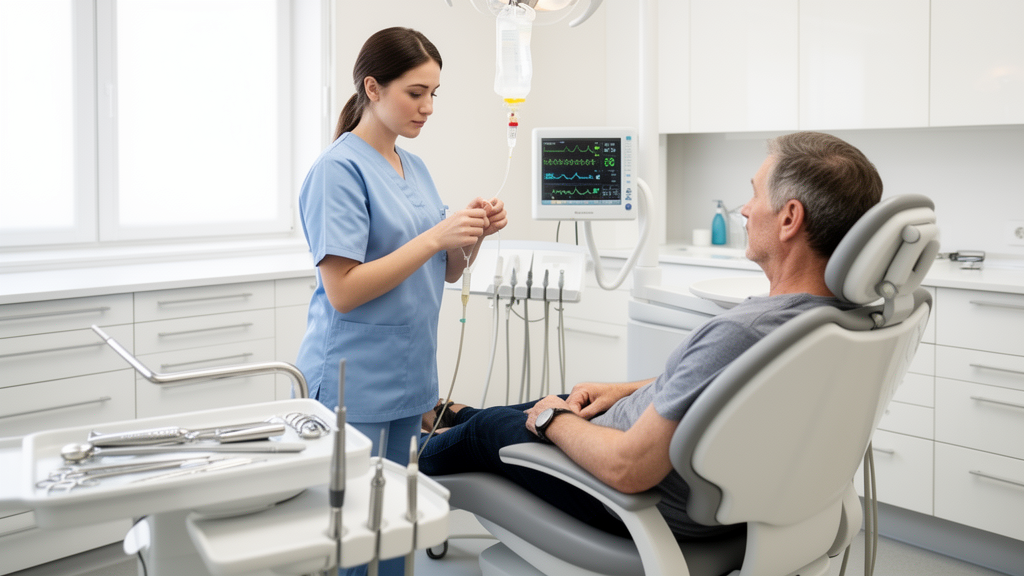
In a multicenter randomized clinical trial evaluating intravenous sedation for outpatient dental extractions, the ultra-short-acting sedative remimazolam matched the clinical efficacy of midazolam while providing faster recovery and fewer postoperative adverse reactions. The trial was conducted across thirteen clinical centers in China from September 2021 to July 2023 and evaluated 612 adult patients undergoing outpatient dental extraction procedures. Sedation success reached 99.0 percent in the remimazolam group compared to 96.1 percent in the midazolam group, confirming non-inferiority under a prespecified non-inferiority margin of six percentage points. In addition to meeting its primary efficacy endpoint, remimazolam led to a faster return to full alertness and significantly reduced adverse reactions documented during twenty-four-hour follow-up. These findings demonstrate that titrated remimazolam provides an effective sedative option for outpatient dental procedures requiring conscious sedation and rapid patient turnover.
Intravenous sedation has expanded substantially over the past decade as a routine component of dental practice, primarily serving to relieve patient anxiety and enhance cooperation during potentially stressful procedures. However, sedation in outpatient dental clinics introduces distinct safety challenges, including airway obstruction, respiratory depression, and compromised airway reflexes, which can be exacerbated by procedural irrigation water and oral residue. Furthermore, dental sedation aims to maintain conscious sedation where patients remain capable of opening their mouths and cooperating with clinicians, rather than deeper sedation levels utilized during gastrointestinal endoscopy. Midazolam has long represented the clinical mainstay for dental conscious sedation due to its established efficacy and safety profile. Nevertheless, midazolam possesses a relatively long half-life that frequently results in prolonged recovery times, which can delay discharge and constrain scheduling in busy outpatient dental extraction practices.
Remimazolam is an ultra-short-acting benzodiazepine that offers rapid onset and offset of sedative effects, making it an attractive candidate for ambulatory dental procedures. Earlier clinical trials in bronchoscopy and colonoscopy indicated that remimazolam achieved higher procedural success rates than midazolam, where success rates ranged from 80 to 90 percent for remimazolam compared to 20 to 30 percent for midazolam. However, the application of remimazolam within outpatient dentistry remained underexplored, particularly regarding its safety profile during incremental titration and the absence of well-defined dosing protocols. Because dental sedation is administered by healthcare professionals with diverse medical backgrounds, including dentists and anesthesiologists, an ideal sedative must rapidly reach intended depth, facilitate straightforward titration, maintain a wide margin of safety, and minimally inhibit respiratory and cardiovascular reflexes. The current trial was designed to evaluate whether a weight-adjusted titration regimen of remimazolam is non-inferior to midazolam while improving recovery and safety.
The investigation was organized as a randomized, single-blind, parallel-controlled, non-inferiority study registered with the Chinese Clinical Trial Registry under identifier ChiCTR2100050822. Originally designed to include fourteen clinical centers, the protocol was revised to encompass thirteen centers following recruitment challenges at one site. Across these thirteen centers, 732 patients scheduled for dental extractions met eligibility requirements, and 614 were formally randomized between September 20, 2021, and July 31, 2023. Eligible participants were adults aged 18 to 60 years with a body mass index between 18 and 30 kilograms per square meter and an American Society of Anesthesiologists physical status of I or II. Individuals with nervous system diseases, serious systemic disorders, allergies to benzodiazepines or local anesthetics, pregnancy, lactation, suspected or confirmed substance abuse, acute pericoronitis of the wisdom teeth, or clinical trial participation within the past three months were excluded.
Randomization followed a centralized system with a block size of fourteen, stratifying participants by clinical center in a one-to-one ratio using sequences generated by an independent statistician in R software. Allocations were concealed in sequentially numbered, sealed opaque envelopes opened at enrollment. Both medications were prepared at concentrations of one milligram per milliliter with masked labels. While attending anesthesiologists who administered the sedatives knew drug assignments to perform titration, patients and outcome assessors were blinded throughout the trial. Two patients randomized to midazolam refused participation before receiving medication, leaving a Full Analysis Set of 612 patients analyzed according to the intention-to-treat principle. Baseline demographics were balanced between the 307 patients in the remimazolam group and the 305 patients in the midazolam group, with mean ages of 31.07 and 32.02 years, male proportions of 33.6 and 35.7 percent, and balanced preexisting medical conditions.
All participants completed routine dental examinations, radiography, and anxiety assessments via the Modified Dental Anxiety Scale before undergoing sedation. Patients fasted for at least six hours, with clear liquids permitted up to two hours prior to the procedure, and received supplemental oxygen via nasal cannula at two to four liters per minute until reaching full alertness. Intravenous access was established with normal saline infusion, and vital signs were recorded automatically every five minutes. The remimazolam cohort received an initial intravenous dose of 0.1 milligrams per kilogram administered over sixty seconds, followed by a one-minute observation period, with additional top-up doses of two milligrams as needed. The midazolam cohort received an initial dose of 0.05 milligrams per kilogram over sixty seconds, followed by a one-minute observation, with top-up doses of one milligram. Titration aimed to achieve an alertness score of four or lower on the observer assessment scale, followed by local anesthesia.
Sedation success, the study’s primary endpoint, was evaluated according to criteria established in Phase III clinical trials of remimazolam. Success required fulfilling three conditions: successful completion of the dental extraction procedure without local anesthetic failure, administration of no more than five doses of remimazolam within any fifteen-minute interval or no more than three doses of midazolam within any twelve-minute interval, and no requirement for an alternative rescue sedative agent. If sedation remained inadequate, anesthesiologists could discontinue sedation or administer 0.5 milligrams per kilogram of propofol as rescue sedation. Sample size calculations assumed a common 95 percent success rate based on feasibility data and specified a 6 percent non-inferiority margin with a one-sided significance level of 0.025 and 90 percent power. Primary efficacy analysis utilized a mixed-effects logistic regression model adjusting for center and baseline covariates, with average risk differences estimated using the marginaleffects package in R.
In the primary efficacy analysis, remimazolam demonstrated non-inferiority to midazolam, achieving a success rate of 99.0 percent (304 of 307 patients) compared to 96.1 percent (293 of 305 patients) in the midazolam group. The adjusted risk difference was estimated at 2.78 percentage points with a 95 percent confidence interval ranging from negative 1.29 to positive 6.91 percentage points. Because the lower bound of negative 1.29 percent remained above the prespecified non-inferiority threshold of negative six percent, non-inferiority was confirmed. Sedation failure occurred in three patients receiving remimazolam, including one patient who could not complete extraction due to excessive movement and two who required propofol rescue. Among twelve sedation failures in the midazolam arm, four patients displayed excessive movement, and seven received more top-up doses than permitted, with three requiring propofol rescue. Subgroup analyses by age, sex, and dental anxiety revealed no significant differences in sedation success.
Secondary outcomes revealed notable recovery advantages for remimazolam over midazolam, even though procedural duration did not differ significantly between cohorts, averaging 13 minutes in both groups. Patients in the remimazolam group achieved peak sedation faster and demonstrated deeper initial sedation within the first three minutes of administration. Following procedure completion, patients receiving remimazolam recovered full alertness significantly faster, requiring a median of 5 minutes compared to 7 minutes for midazolam. Time from the final dose until discharge readiness was likewise shorter in the remimazolam arm, with a median of 46 minutes compared to 52 minutes for midazolam. The median cumulative dose administered was 7.8 milligrams for remimazolam and 3.8 milligrams for midazolam. Pain scores during local anesthesia and extraction stimulus were comparable between groups, but remimazolam produced higher Frankl compliance scores among patients with dental anxiety.
Safety evaluations demonstrated comparable intraoperative tolerance between the two sedative regimens. No statistically significant differences were observed between groups in systolic blood pressure, diastolic blood pressure, respiratory rate, or heart rate across procedural time points, with blood oxygen saturation remaining above 95 percent at all measurements under supplemental oxygen. The incidence of intraoperative adverse events, including bradycardia, hypotension, and cough reflexes, showed no significant differences between cohorts. Four patients in each group received intravenous flumazenil in the recovery unit after remaining unresponsive for more than fifteen minutes post-procedure, and none experienced re-sedation or required a second flumazenil dose. The authors noted that the low rates of intraoperative hypotension in both groups contrasted with earlier endoscopy studies where sedatives were combined with opioids; in the present trial, omitting opioids and utilizing local anesthetics containing adrenaline likely helped counteract sedative-induced vasodilation and maintain hemodynamic stability.
In contrast to intraoperative metrics, twenty-four-hour telephone follow-up revealed a notable safety divergence favoring remimazolam. The incidence of postoperative adverse reactions within twenty-four hours was significantly lower among remimazolam patients at 4.6 percent compared to 12.1 percent in the midazolam group, with dizziness and drowsiness representing predominant postoperative complaints following midazolam administration. The researchers outlined several study limitations, highlighting that participants were restricted to adults aged 18 to 60 years undergoing dental extractions with American Society of Anesthesiologists status I or II, meaning results may not directly apply to children, elderly patients over 60, higher-risk patients, or more complex oral operations. In addition, the single-blind design permitted unblinded operators to administer drugs, introducing potential performance bias despite blinded outcome assessors, and uniform bispectral index monitoring was absent across centers. Finally, the authors noted that remimazolam carries a slightly higher purchase price than midazolam, meaning operational time savings may not automatically translate into lower overall treatment costs.
Subject of Research: Efficacy and safety of remimazolam versus midazolam for dental extraction sedation
Article Title: Efficacy of remimazolam versus midazolam for outpatient dental sedation: a multicenter, randomized, controlled, non-inferiority trial
Article References: Liu, B., Wang, P., Zhu, W., Yu, C., Jia, L., Shi, X., Wang, Z., Xu, T., Li, Q., Yang, X., Zhao, J., Zheng, Z., Li, Y., Xing, N., Zhang, T., Zhao, N., Shan, W., Chen, Q., Zhang, L., … Zhang, H. (2026). Efficacy of remimazolam versus midazolam for outpatient dental sedation: a multicenter, randomized, controlled, non-inferiority trial. Anesthesiology and Perioperative Science, 4(1), Article 15. https://doi.org/10.1007/s44254-025-00160-z
Image Credits: AI Generated
DOI: 10.1007/s44254-025-00160-z
Keywords: remimazolam, midazolam, dental sedation, clinical trial, anesthesiology, outpatient surgery, postoperative recovery, pharmacology, Efficacy, versus, outpatient, dental