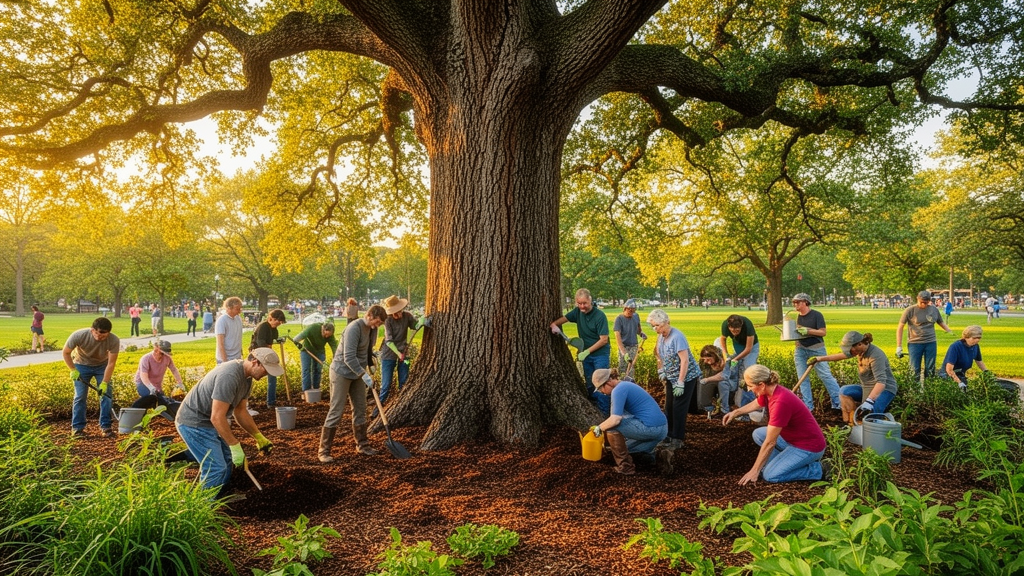
Centuries-long survival among the world’s heritage trees depends fundamentally on the durability of the social arrangements that encircle them rather than on technical arboriculture or statutory protection alone, according to an extensive evidence synthesis published in Frontiers in Forests and Global Change. Conducted by researchers across institutions in China, including Qiongtai Normal University, the Nanjing Institute of Environmental Sciences, and the Sichuan Academy of Forestry, the investigation introduces the conceptual framework of the Social Matrix to explain why ancient specimens and sacred groves endure across generations in certain cultural settings while rapidly deteriorating in others. Conventional conservation approaches traditionally assess individual trees as isolated biological organisms, focusing almost exclusively on physiological health, physical dimensions, or legislative classification. However, the study demonstrates that ancient tree survival across multi-generational horizons requires continuous forbearance against land conversion, deliberate felling, and resource extraction, a behavioral consistency that is sustained primarily by community-level cultural commitments, institutional rules, local knowledge systems, economic incentives, affective attachments, and organizational coordination operating together as an integrated system.
The conceptual limitation of standard arboricultural and ecological perspectives becomes apparent when examining pairs of comparable trees across different jurisdictions. As the authors highlight, specimens of identical species, comparable age, and equivalent biological vitality that are subject to the same statutory protections frequently follow starkly divergent historical paths. One individual tree may thrive across multiple centuries through consistent community stewardship, while another undergoes steady neglect, physical encroachment, or complete clearance within a few decades despite formal legal designation and professional maintenance. Similar resilience patterns emerge across geographically isolated cultural landscapes that share no shared traditions, including sacred groves within the Western Ghats of India, church forests maintained by the Orthodox Tewahedo Church in the Ethiopian highlands, and village fengshui forests in southern China. These disparate forest patches survive as primary remnants of native vegetation within heavily deforested agricultural surroundings, demonstrating that their persistence is not an ecological accident but an outcome governed by the resilience of localized social institutions.
To investigate these protective dynamics, the research team assembled a broad comparative corpus of documented community-managed conservation systems across different continents and institutional contexts. Their case selection incorporated well-documented regional traditions from South Asia, Ethiopia, and southern China, alongside European heritage tree registration registries, the contested management history of Poland and Belarus’s Białowieża Forest, and agricultural landscapes recognized under the Food and Agriculture Organization’s Globally Important Agricultural Heritage Systems initiative. Within the Ethiopian highlands, research documented how native Afromontane biodiversity survives predominantly within walled church boundaries, operating through hybrid ecclesiastical and customary community enforcement outside formal national reserve systems. In southern China, quantitative reviews spanning fifty-seven lineage villages across five provinces demonstrated that customary clan governance rooted in geomantic cosmology consistently preserved higher species diversity than adjacent secondary woodlands. Supplementing these cross-sectional records, the authors evaluated three multi-decadal and multi-generational trajectories from South India, West Bengal, and southwestern Nigeria to trace changes in conservation conditions across time.
The synthesis builds upon and reconciles six distinct bodies of social-ecological theory that previously developed along separate scholarly paths. Biocultural diversity scholarship contributes the core premise that biological variety and cultural traditions co-evolve, while social-ecological systems theory and resilience thinking supply structural models explaining how user communities self-organize around environmental disturbance without suffering functional collapse. Commons governance frameworks and institutional political ecology explain how decentralized communities formulate self-enforcing rules matched to ecological realities, while warning that local communities possess internal heterogeneities that demand careful coordination. Cultural ecosystem service scholarship and place attachment research furnish the affective and symbolic foundation explaining why people protect meaningful sites in the absence of external monitoring or monetary incentives. Finally, traditional ecological knowledge frameworks supply the intergenerational mechanism through which non-codified management practices, such as ritual calendars and microhabitat interventions, pass continuously across generations. The authors argue that these six bodies of scholarship describe complementary dimensions of a single social structure.
From this theoretical convergence, the study establishes that the Social Matrix comprises six interdependent functional dimensions arranged in an operational sequence extending from shared meaning to practical mobilization. Culture serves as the initial anchor by providing origin myths, cosmological narratives, and symbolic significance that establish why an organism is sacred or intrinsically valuable. Institutions convert that cultural justification into enforceable boundaries and taboos that govern physical access, resource extraction, and social sanctions. Knowledge provides the technical and arboricultural capacity required to sustain the specimen, relying on traditional diagnostic methods, microhabitat manipulation, and customary pruning cycles. Economics aligns community livelihoods with preservation, ensuring that conservation acts as an asset yielding sustainable non-timber products or revenue rather than an uncompensated burden. Emotion contributes felt devotion, communal awe, and place attachment that motivate voluntary defensive action without external compulsion. Finally, organizational capacity provides the decisive coordinating apparatus, such as a village temple committee, elder council, or monastic body, capable of enforcing rules, mobilizing collective labor, and resolving disputes.
The six structural dimensions influence human behavior through four functional pathways: cultural, institutional, economic, and organizational, with knowledge and emotional attachment operating as cross-cutting enablers across the entire matrix. The cultural pathway relies on internalized taboos, operating as the most cost-effective protective mechanism because social sanctions do not require formal courts or state inspectors. However, it remains uniquely vulnerable if generational turnover dissolves underlying spiritual beliefs. The institutional pathway relies on codified rules and monitored compliance, as illustrated by Ethiopian church forests where physical perimeter walls and active clerical patrols preserve significantly higher ecological integrity than unwalled religious sites. The economic pathway secures ongoing cooperation by distributing tangible material returns, but it can collapse if commercial land-use alternatives offer superior financial gains or if benefit sharing becomes inequitable. Meanwhile, the organizational pathway acts as the collective engine, converting diffuse beliefs and economic interests into organized monitoring routines that overcome common collective action failures.
A critical analytical finding is that resilience under socio-economic shocks is strongly associated with the functional integration of multiple pathways rather than the isolated strength of any single mechanism. When a conservation framework depends exclusively on a single protective lever, such as statutory designation, it remains fragile against social disruptions, including administrative turnover, demographic shifts, or land valuation increases. By contrast, multi-pathway configurations create structural redundancy, enabling community-managed systems to absorb disturbances without undergoing systemic collapse. The authors observe that statutory registration programs layered onto communities lacking local organizational structures, traditional ecological knowledge, and livelihood incentives do not constitute a stable conservation strategy. Imposing legal mandates in the absence of internal community cohesion often results in paper compliance while failing to halt quiet encroachment on the ground, underscoring the structural limits of purely administrative interventions that overlook customary local stewardship mechanisms.
Analyzing multi-decadal historical trajectories revealed that conservation outcomes participate in a closed, bidirectional feedback loop rather than a unidirectional causal chain terminating at tree survival. In South India, twentieth-century agricultural expansion and changing land tenure steadily eroded customary sacred grove governance; documented contractions in institutional oversight consistently preceded subsequent shrinkages in protected grove area, confirming a degenerative cycle where declining social commitment accelerated physical degradation. Conversely, regenerative trajectories documented at the Chilkigarh sacred grove in West Bengal and the Osun-Osogbo sacred grove in southwestern Nigeria demonstrated that institutional and organizational restoration consistently preceded ecological regeneration. At Chilkigarh, the re-establishment of community monitoring and ceremonial practice prompted forest recovery without prior technical interventions on the vegetation itself. Similarly, successive layers of institutional formalization at Osun-Osogbo re-established organizational investment before canopy health recovered. These chronological sequences confirm that alterations in community governance capacity systematically precede changes in biological condition.
This closed-loop dynamic carries direct operational implications for environmental monitoring programs, which currently rely almost entirely on trailing ecological indicators such as trunk diameter, canopy coverage, physiological stress, and survival tallies. The authors emphasize that a cohort of registered heritage trees can exhibit satisfactory survival rates during an evaluation while the surrounding Social Matrix is already undergoing institutional decay, masking impending collapse long before physical losses appear. Comprehensive monitoring frameworks must therefore integrate matrix vitality indicators, including the continuity of ceremonial practices, the active enforcement of customary sanctions, intergenerational transfer of local ecological knowledge, perceived equity in resource distribution, and the regular meeting frequency of local custodial organizations. Evaluating conservation success solely through standing timber metrics overlooks early signals of governance failure, whereas tracking organizational vitality enables conservation managers to identify and repair institutional fissures before biological decline becomes irreversible.
The authors acknowledge several methodological boundaries inherent to their theoretical synthesis. The underlying corpus was derived purposively from published secondary literature rather than through an exhaustive systematic search protocol, leaving the findings susceptible to publication and availability biases. Geographically, documented cases were concentrated across Asia, Africa, and Europe, with the Americas and Oceania largely unrepresented in the analysis. Furthermore, while the synthesis captures social conditions historically associated with sustained persistence, it does not quantify the precise mathematical weights of these social dimensions relative to ecological covariates such as climatic suitability, species physiology, and regional development pressure. The researchers recommend that future investigations test these propositions empirically through mixed-method longitudinal surveys, comparative assessments across urban and secular settings, and detailed equity analyses examining whether customary stewardship arrangements distribute costs and benefits fairly across diverse community groups.
Subject of Research: Evidence synthesis on social and biocultural mechanisms governing heritage tree conservation
Article Title: Beyond ecological protection: unravelling the Social Matrix and biocultural drivers of heritage tree conservation
Article References: Xie, C., Chen, S., Ma, W., Ding, Z., Lin, H., & Tian, E. (2026). Beyond ecological protection: unravelling the Social Matrix and biocultural drivers of heritage tree conservation. Frontiers in Forests and Global Change, 9, 1993206. https://doi.org/10.3389/ffgc.2026.1993206
Image Credits: AI Generated
DOI: 10.3389/ffgc.2026.1993206
Keywords: heritage trees, Social Matrix, biocultural conservation, collective action, forest governance, social-ecological systems, sacred groves, church forests, Beyond, ecological, protection, unravelling