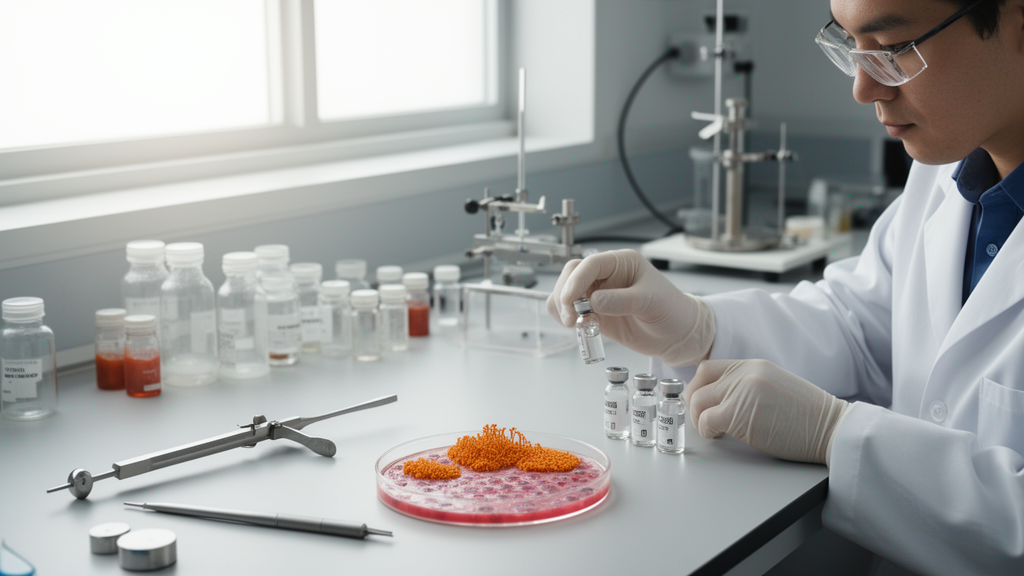
Fungal secondary metabolites can trigger programmed cell death, arrest cell division, suppress blood-vessel formation, alter immune responses and limit metastatic spread in experimental skin-cancer models, according to a review of laboratory studies and early clinical trials. The review focuses on compounds including cordycepin from Cordyceps fungi, ganoderic acid D and ergosterol peroxide from Ganoderma lucidum, and immunomodulatory polysaccharides such as lentinan. Most evidence comes from cultured cells or animals, and the authors describe the compounds as promising but still largely preclinical candidates rather than established treatments for melanoma, basal cell carcinoma or cutaneous squamous cell carcinoma.
Melanoma is the most aggressive of the major skin-cancer categories, representing about 1% of cases but approximately 80% of skin-cancer-related deaths. Cutaneous melanoma accounts for more than 90% of melanoma diagnoses and is strongly associated with ultraviolet radiation, which can contribute to oncogenic mutations and other genetic changes. Basal cell carcinoma is the most common keratinocyte cancer and generally grows slowly, although its incidence is difficult to estimate because many cases are not registered or confirmed by histopathology.
Squamous cell carcinoma arises from malignant keratinocytes and can metastasize to proximal lymph nodes. These differences in aggressiveness and clinical course make it important to examine which experimental findings apply specifically to skin cancer rather than to cancer in general. One of the clearest cell-culture mechanisms involves cordycepin, a nucleoside analogue known as 3′-deoxyadenosine.
In melanoma cells, cordycepin activated initiator caspases 8 and 9 and executioner caspase 3, cleaved the pro-apoptotic protein Bid, and promoted Bax translocation to mitochondria, facilitating cytochrome c release. It also activated stress-associated mitogen-activated protein kinase pathways, including c-Jun N-terminal kinase and p38 MAPK; other work summarized by the review additionally linked cordycepin to ERK activation. Hispolon, a polyphenol from Phellinus linteus, reduced the melanogenesis-associated factors MITF and tyrosinase, modulated Bcl-2-family proteins and arrested cells at G2/M phase.
These observations describe molecular effects in cultured melanoma cells, not responses in patients. Evidence for non-melanoma skin cancer was more limited and sometimes indirect. Ganoderic acid D, a lanostane-type triterpenoid from G. lucidum, inhibited proliferation and induced apoptosis and autophagic cell death in cultured esophageal squamous cell carcinoma cells exposed to 10, 20 or 40 µM.
The treatment reduced phosphorylation of PI3K, AKT and mTOR, a survival-signalling cascade affected in squamous cell carcinoma. Because these were esophageal rather than cutaneous carcinoma cells, the result identifies a mechanism for testing rather than evidence of benefit in basal or cutaneous squamous cell carcinoma. Other fungal metabolites—including ergosterol peroxide derivatives, apicidin, resorcylic acid lactones, naphtho-γ-pyrones, averufanin and gliocladicillins—have produced cytotoxic, cell-cycle or apoptotic effects in assorted cancer lines, but much of that evidence came from cancers outside the skin.
More direct data emerged from melanoma models in mice. A beta-glucan from Saccharomyces cerevisiae reduced tumour growth and improved survival in B16F10 models while expanding macrophages, dendritic cells, natural killer cells, NKT cells and cytokine-producing CD4+ and CD8+ T cells. A G. lucidum polysaccharide peptide reduced pulmonary metastatic burden, changed genes associated with focal adhesion and shifted tumour-associated macrophages from the M2 state toward M1.
In separate metastatic melanoma models, G. tsugae water extract reduced migration, metastatic colonization and lung metastases while lowering reactive oxygen species and suppressing PI3K/Akt signalling. These models provide biological and mechanistic support, but their doses, schedules and tumour settings do not establish corresponding effects in human melanoma. Anti-angiogenic and anti-metastatic activity provide additional experimental routes.
Polysaccharides from Trametes versicolor have been reported to suppress VEGF expression, endothelial-cell proliferation and signalling induced by basic fibroblast growth factor, while changing tumour-associated macrophage phenotypes and matrix metalloproteinase levels. Coumarin-derived fungal metabolites can inhibit VEGFR-2, and G. lucidum extracts have disrupted VEGF-mediated pathways in experimental systems. For metastasis, cordycepin has reduced beta-catenin-linked proliferation, migration and invasion in laboratory models and lowered lung metastases in animals.
In melanoma cells, it increased miR-33b and reduced HMGA2, Twist1, ZEB1, MMP-2 and MMP-9, while an in vivo study found fewer metastases to lungs, liver and bones. The review notes that much of the supporting evidence is preclinical and that relatively few studies use melanoma-specific models. Combination experiments produced some of the clearest evidence that fungal compounds may act as immune-modulating partners.
In a B16F10 melanoma experiment, beta-glucan from Aureobasidium pullulans inhibited tumour growth by 24.8% as monotherapy, while anti-PD-L1 antibody produced 19.3% inhibition. The combination achieved 54.9% inhibition, with a calculated Q value of 1.396 that the investigators classified as synergistic. A ferumoxytol-beta-glucan nanocomposite suppressed tumour growth more effectively than an unconjugated mixture and increased M1 macrophage infiltration, although no combination index or Q value was reported.
Another system combined melanoma cell-membrane antigens, chitin and beta-glucan with photothermal treatment; it rapidly ablated primary tumours and increased survival in mice, but this was a functional comparison rather than a formal demonstration of pharmacological synergy. Human evidence is limited and mixed. Rhizoxin, a 16-membered macrolide originally isolated from Rhizopus chinensis, was tested in a phase II study that enrolled 26 patients with advanced melanoma.
Intravenous rhizoxin at 2.0 mg/m² every 21 days was considered feasible, but no objective responses were observed. E6201, a synthetic analogue of fungal resorcylic acid lactones and primarily an intravenous MEK1 inhibitor, showed limited but notable activity in a first-in-human phase I study that included melanoma expansion cohorts. Partial responses occurred in patients with BRAF-mutated and BRAF-wild-type tumours, while a later report described survival exceeding eight years in one patient with BRAF V600E metastatic melanoma and brain metastases.
That exceptional single-patient observation cannot establish a general treatment effect. Two further approaches remain investigational. PX-866, an irreversible pan-PI3K inhibitor derived from the fungal metabolite wortmannin, has a mechanistic rationale in melanoma, but a trial combining it with vemurafenib was limited by slow recruitment and did not produce convincing published efficacy data.
NUC-7738 is a ProTide designed to protect cordycepin from rapid degradation by adenosine deaminase and improve intracellular activation of 3′-dATP. A phase I/II programme is evaluating it with pembrolizumab in cutaneous melanoma resistant to PD-1 inhibition; early data suggest antitumour activity, including partial responses, but mature peer-reviewed phase II results are still needed. For basal cell carcinoma, oral itraconazole reduced tumour-cell proliferation, Hedgehog-pathway activity and tumour area in an exploratory phase II trial, although itraconazole is a synthetic antifungal rather than a fungal natural product.
Translation is constrained as much by manufacturing and pharmacology as by cancer biology. Fungi can be difficult to cultivate, and some desired metabolites are recovered only in milligram quantities per litre of culture. Liquid fermentation may suffer from clumped mycelium, uneven oxygen distribution and impaired mass transfer.
Solid-state fermentation can offer higher productivity and product stability, and food-industry waste can serve as a low-cost substrate, but nutrient composition, light, temperature and associated microorganisms can alter the secondary-metabolite profile. Many candidates also have limited solubility, poor bioavailability or instability under physiological conditions, and some may be toxic at therapeutic concentrations. The review therefore presents fungal metabolites as possible adjuvants, immunomodulators and sources of drug leads whose clinical value for melanoma, cutaneous squamous cell carcinoma and basal cell carcinoma remains unproven, with standardized production, skin-cancer-specific experiments and controlled patient trials needed to determine whether laboratory activity can become meaningful clinical benefit.
Subject of Research: Preclinical and early clinical evaluation of fungal-derived compounds for skin-cancer therapy
Article Title: Antitumor properties of fungal-derived compounds: potential applications in skin cancer therapy
Article References: Kloc, M., Jonderko, L., Herbetko, K., Kublińska, K., Wojno, A., Cichy, O., Wojno, A., Karwowska, A., Suwała, S., & Choromańska, A. (2026). Antitumor properties of fungal-derived compounds: potential applications in skin cancer therapy. Molecular Biology Reports, 53(1), Article 1476. https://doi.org/10.1007/s11033-026-12654-5
Image Credits: AI Generated
DOI: 10.1007/s11033-026-12654-5
Keywords: fungal metabolites, skin cancer, melanoma, cordycepin, ganoderma, beta-glucans, apoptosis, immunotherapy, angiogenesis, drug development, Antitumor, properties