In a groundbreaking advancement poised to reshape the landscape of high-performance magnet technology, researchers at the Korea Institute of Materials Science (KIMS) have unveiled a pioneering manufacturing process that addresses longstanding limitations in thick neodymium–iron–boron (Nd–Fe–B) magnets. This novel approach promises uniform enhancement of magnetic performance across thick magnet structures while simultaneously curbing heat generation, a dual achievement that could dramatically improve the efficiency and reliability of electric motors in vehicles, wind turbines, and beyond.
Nd–Fe–B magnets have long been prized for their unparalleled magnetic strength, largely powering the electrification revolution in transportation and renewable energy sectors. However, as the demand for higher output drives the development of larger and thicker magnet components, maintaining coercivity—the magnet’s ability to withstand demagnetizing influences—throughout the entirety of the magnet has remained a formidable challenge. Traditional methods, reliant on incrementally diffusing heavy rare earth elements (HREEs) such as dysprosium or terbium from the magnet’s surface inward, offer improvements but fall short when applied to the interiors of thick magnets.
These conventional processes encounter inherent constraints due to their surface-limited diffusion mechanism. The HREEs coat the magnet’s exterior, slowly permeating inward along grain boundaries, but their penetration depth is insufficient to reinforce the core regions of thick magnets. This divergence results in nonuniform magnetic properties, where the external layers retain high coercivity while the interior remains vulnerable to demagnetization. Compounding this limitation, heavy rare earth elements are costly and subject to geopolitical supply uncertainties, making their widespread industrial use increasingly unsustainable.
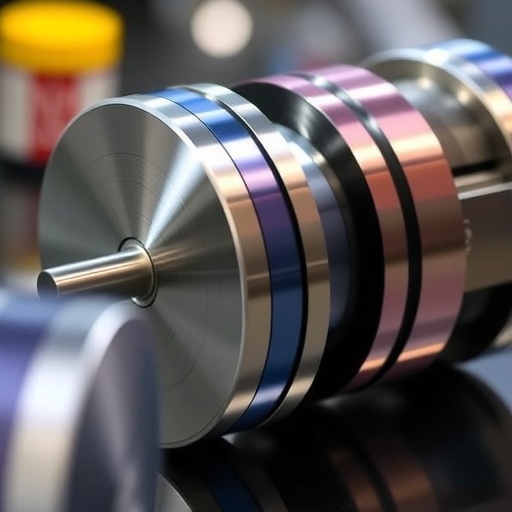
KIMS researchers tackled these challenges by conceptualizing and perfecting a sandwich-structured grain boundary diffusion strategy. The innovation lies in layering multiple magnet slices and integrating them with a low-melting-point alloy containing praseodymium—a light rare earth element (LREE). This composite structure effectively generates diffusion paths not only from the exterior surfaces but also from within the interfaces that connect the stacked layers. By introducing the diffusion agent at multiple depths, the technology achieves pervasive enhancement of coercivity throughout thick magnets, a feat previously unattainable.
This multilayered configuration marks a significant departure from established diffusion methodologies, enabling magnet interiors to benefit directly from the diffusion process. Moreover, the selection of praseodymium over traditional HREEs presents a strategic advantage by reducing reliance on scarce, expensive materials without compromising magnetic performance. Through meticulous control of alloy composition and diffusion parameters, the team secured uniform magnetic properties, making thick magnets more viable for high-power applications.
Beyond augmenting coercivity, the researchers addressed another critical issue—eddy current-induced heat generation within magnets operating at high speed. Such heat not only degrades magnetic performance but also diminishes motor efficiency and lifespan. The novel process engineering fosters the formation of a high-resistivity grain boundary structure. This architectural modification impedes the flow of eddy currents, thereby suppressing heat buildup during motor operation.
Importantly, this integration of properties—magnetic, electrical resistivity, and structural bonding—occurs within a single streamlined grain boundary diffusion step. By circumventing the need for separate segmentation, coating, and bonding processes common in traditional manufacturing, the new method promotes simplified and potentially more cost-effective production while enhancing the magnets’ functional characteristics.
The implications of this technological leap extend well beyond laboratory measurements. Enhanced coercivity and reduced heat generation directly translate into more stable, efficient motors that can operate at higher powers and speeds. Consequently, electric vehicles, industrial motors, and wind turbines could benefit from lighter, more powerful, and longer-lasting magnet components, accelerating the global transition toward sustainable energy solutions.
Furthermore, this innovation holds promise for emerging applications requiring exceptionally large and high-performance magnets, such as electric propulsion systems for marine vessels and aerospace components. The ability to manufacture thick magnets with uniform, superior properties broadens the horizons for advanced electromechanical designs and facilitates domestic production capabilities, thereby mitigating supply chain vulnerabilities.
The research team, spearheaded by Su-Min Kim and Jung-Goo Lee under the leadership of President Chul-jin Choi, underscores the transformative potential of integrating coercivity enhancement and resistivity improvements in a unified process. “What distinguishes our technology is its capacity to seamlessly combine enhanced magnetic strength, electrical insulation, and structural integration,” noted Kim. “This represents a paradigm shift in magnet manufacturing with widespread industrial repercussions.”
This technology was rigorously vetted in studies that investigated diffusion kinetics, microstructural evolution, and magnetic performance metrics, thereby affirming its feasibility for practical motor applications. With continued development, researchers envision commercial deployment in next-generation motors, fulfilling the stringent demands of electric vehicles and renewable energy systems.
Funded by South Korea’s Ministry of Trade, Industry and Energy through the Materials and Components Technology Development Program, this research was published in the reputable journal Scripta Materialia on March 18, 2026. The paper details not only the sandwich-structured grain boundary diffusion strategy but also quantitative analyses demonstrating improved coercivity and electrical resistivity in thick Nd–Fe–B magnets.
As the global push for electrification and sustainable energy adoption intensifies, this breakthrough from KIMS represents a seminal advancement in materials science and magnet technology. By resolving long-standing issues related to performance consistency and thermal management in thick magnets, the sandwich-structured diffusion method lays a foundation for more reliable, efficient, and cost-effective magnet-based devices across diverse sectors.
It heralds a future where high-power magnets are no longer hampered by core weakness or excessive heat, thereby enabling electric motors and turbines to achieve unprecedented levels of performance and durability. This technology could become instrumental in addressing energy consumption challenges, enhancing transportation systems, and fostering innovation in electromagnetic device design on a global scale.
Subject of Research: Development of advanced thick Nd–Fe–B magnets with uniform coercivity and high resistivity via sandwich-structured grain boundary diffusion.
Article Title: Development of thick Nd–Fe–B magnets with high coercivity and resistivity via a sandwich-structured grain boundary diffusion strategy.
News Publication Date: March 18, 2026.
Web References:
Korea Institute of Materials Science (KIMS), https://www.kims.re.kr/?lang=en
References:
Published article in Scripta Materialia, Impact Factor: 5.6, March 18, 2026.
Image Credits: Korea Institute of Materials Science (KIMS)
Keywords
Magnet technology, grain boundary diffusion, Neodymium–iron–boron magnets, coercivity enhancement, light rare earth elements, praseodymium diffusion, eddy current suppression, high resistivity magnets, electric vehicles, electric motors, renewable energy, materials science.
Tags: advanced magnet manufacturing processelectric motor efficiency improvementsenhancing magnetic strength for electric vehicleshigh-performance magnet technologyimproving coercivity in magnetsKorea Institute of Materials Science magnet researchnext-generation magnet materialsovercoming limitations in thick magnet designrare earth element diffusion in magnetsreducing heat generation in magnetssustainable magnet technology for renewable energythick neodymium iron boron magnets