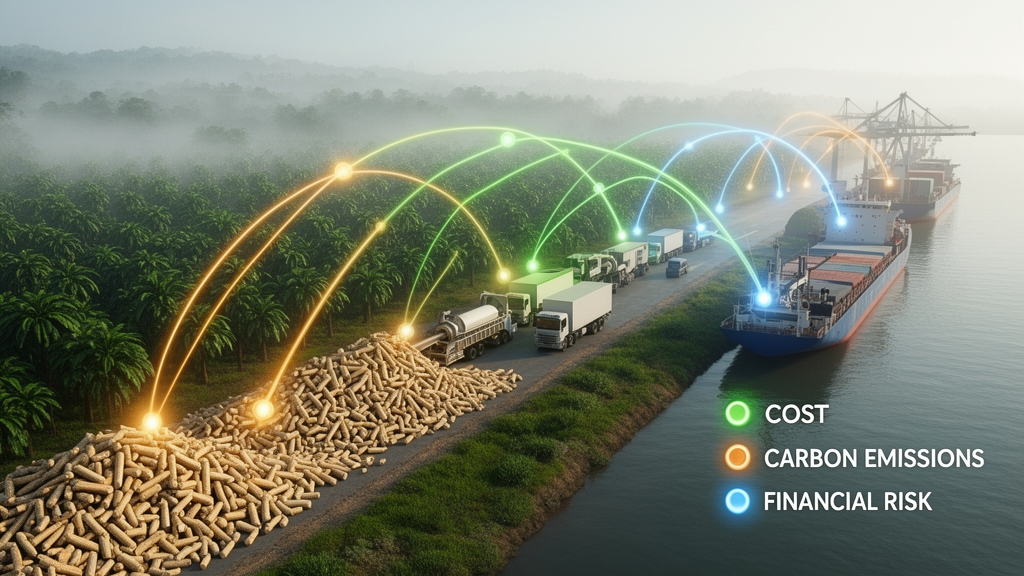
Open-field burning of sugarcane leaves, rice straw and other crop residues is a major source of fine particulate pollution and greenhouse gases in Southeast Asia, and Thailand generates enormous quantities of these materials each year. A new study presents a decision model that turns those residues into a commercially tradable fuel pellet while juggling the three things that make such a venture difficult to plan: cost, carbon and financial risk. The work, built around a risk-averse three-objective two-stage stochastic programming formulation, integrates seasonal feedstock availability, storage degradation, product-quality blending and an avoided-burning carbon credit within a single optimization framework calibrated to Thai field data.
The model addresses a gap in the biomass supply chain literature. Most prior studies treat supply chain design either deterministically, which cannot capture the correlated season-wide swings of agricultural yields, or with risk-neutral objectives that hide how badly an operator can be hurt in a bad harvest year. The new formulation goes further by simultaneously minimizing expected total cost, expected net carbon dioxide equivalent emissions and the Conditional Value-at-Risk, or CVaR, of total cost, a measure of the average cost in the worst-case tail of scenarios. It is the first study, according to the authors’ positioning table, to combine the Thai residue system’s seasonal multi-feedstock character, ISO 17225 blending and calorific requirements, a seasonal collection network with an operating calendar, an avoided-burning credit and a genuinely three-objective risk-averse treatment in one model.
The decision structure is split into two stages. Before uncertainty is resolved, the model commits to strategic and tactical choices: which feedstock suppliers to contract, the design of a capacitated collection network for each harvesting season, the calendar of periods in which the network is dispatched, and the size of the vehicle fleet. After a particular scenario of supply and demand materializes, second-stage operational decisions adapt through collection, processing, storage and delivery quantities. Uncertainty is represented by Monte Carlo scenarios that preserve the temporal and spatial correlation inherent in agriculture, so an unfavorable season depresses the entire harvesting window rather than individual weeks independently.
Because this formulation is computationally brutal, the researchers paired a commercial-solver benchmark with a scalable matheuristic. The design layer embeds a capacitated routing structure, a class of problem known to be NP-hard, and evaluating the expected recourse of a two-stage program is itself #P-hard, while constructing a three-dimensional Pareto surface multiplies the burden across a grid of scalarization parameters. The matheuristic, an instantiation of success-history adaptive differential evolution called MO-SHADE, searches the combinatorial first-stage design while the second-stage recourse is evaluated exactly by linear programming, scenario by scenario, with the CVaR of the resulting policy computed afterwards. The authors prove that this ex-post risk evaluation is exact for the cost-minimizing recourse: because no constraint couples scenarios, the policy that minimizes expected cost also minimizes any monotone risk measure, CVaR included.
Seven metaheuristics were compared under identical evaluation budgets using hypervolume and IGD+ indicators with Friedman and Holm statistical testing. The self-adaptive differential-evolution variants ranked highest, though MO-SHADE and its cousin JADE were not statistically separable from one another, so no single variant is claimed as superior. On smaller instances the solver proved optimality quickly, but on a long-horizon instance with 102,845 variables it failed to converge within its budget, leaving a 2.1 percent gap even after an hour; there the matheuristic returned a design 3.42 percent cheaper at a matched budget, certified within 5.08 percent of optimal by the solver’s own dual bound. The two approaches are therefore complementary by problem size rather than competitors in the abstract.
Several modeling details turn out to carry quantifiable economic weight. Ablation experiments show that the latent-heat correction in the net-calorific-value constraint, which deducts the energy needed to vaporize retained moisture under the ISO 17225 convention, changes cost by 3.74 percent; omitting it would overstate delivered calorific value and misclassify premium grades. A terminal-inventory condition prevents a subtle accounting artifact: without it, the emission-minimizing solution would strand an average of 199 tonnes of pellets and 119 tonnes of feedstock as unsold stock whose production accrues carbon credit without any corresponding delivery. The operating calendar, which deactivates the collection network in unproductive periods, saves between 0.01 and 1.08 percent of cost depending on how concentrated the harvest is within each season, and is worth modeling only when idle periods fall inside a harvesting season rather than occupying a whole season.
The policy analysis yields what may be the study’s most consequential finding: the avoided-burning carbon credit, not the network design, decides whether the pellet pathway is carbon-negative. As the credit is scaled from zero to twice its nominal value, the net emissions of the cost-optimal solution fall monotonically from plus 105,681 to minus 400,266 kilograms of CO2-equivalent. In the primary case, where bagasse receives no credit because it is combusted in mill boilers rather than open-burned in fields, carbon negativity is reached at 0.60 of the nominal credit, compared with 0.42 when the full credit is granted. Strikingly, the cost-minimal design is invariant to the credit, and even a monetized carbon price of up to 4,000 baht per tonne of CO2-equivalent fails to change the design, because the cost-optimal solution already captures about 98 percent of the attainable avoided emissions.
A second policy lever, residue availability, behaves differently. As availability rises from 0.6 to 1.4 of the nominal level, modeling the residue released to the plant by a stricter open-burning ban, cost falls from 7.66 to 6.74 million baht while net emissions become more negative, moving from minus 89,298 to minus 182,181 kilograms of CO2-equivalent. Under the model’s fixed-price assumption, a stricter burning ban is simultaneously cheaper and cleaner for the plant operator. The authors caution that this is a statement about the operator’s response to feedstock availability at unchanged prices, not a market-equilibrium prediction, since a real ban would also move residue prices and suppliers’ outside options.
The risk axis of the three-objective trade-off proved nearly degenerate on the studied instances. A design that lexicographically minimizes CVaR reduces tail cost by about 0.37 percent at a 0.38 percent premium in expected cost, and the value of the stochastic solution is small, between 0.24 and 0.31 percent in risk-neutral form and at most 2.12 percent in pure CVaR form, because the recourse layer absorbs scenario variation at nearly the same cost under either first-stage design. The authors argue that the three-objective formulation is justified by the emission axis, which does not co-move closely with cost or risk, and by the generality of the framework rather than by large expected-cost or tail-cost gains.
The study is framed as a demonstrative Thai-calibrated case rather than an operational case study: fuel properties, moisture contents and residue ratios rest on published Thai field measurements, but the monetary and logistics parameters are not calibrated to any particular mill’s accounts, and the largest instance has eight suppliers and a single plant. The collection layer is an aggregated relaxation whose solutions require a route-decomposition step, and route-duration limits are not represented. Within those limits, the work delivers a transferable optimization tool whose clear message for policy is that calibrating the avoided-burning credit, the parameter of greatest consequence, deserves priority field measurement if residue diversion is to be promoted as a climate strategy.
Subject of Research: Risk-averse three-objective two-stage stochastic optimization of a seasonal sugarcane and rice residue pellet supply chain in Thailand
Article Title: Risk-averse three-objective two-stage stochastic design of a seasonal biomass pellet supply chain
Article References: Moonsri, K., & Worasan, K. (2026). Risk-averse three-objective two-stage stochastic design of a seasonal biomass pellet supply chain. Results in Engineering, 32, Article 113676. https://doi.org/10.1016/j.rineng.2026.113676
Image Credits: AI Generated
DOI: 10.1016/j.rineng.2026.113676
Keywords: biomass pellets, supply chain optimization, two-stage stochastic programming, CVaR, avoided open burning, differential evolution, Thailand, sugarcane bagasse, rice straw, ISO 17225, carbon emissions, matheuristic