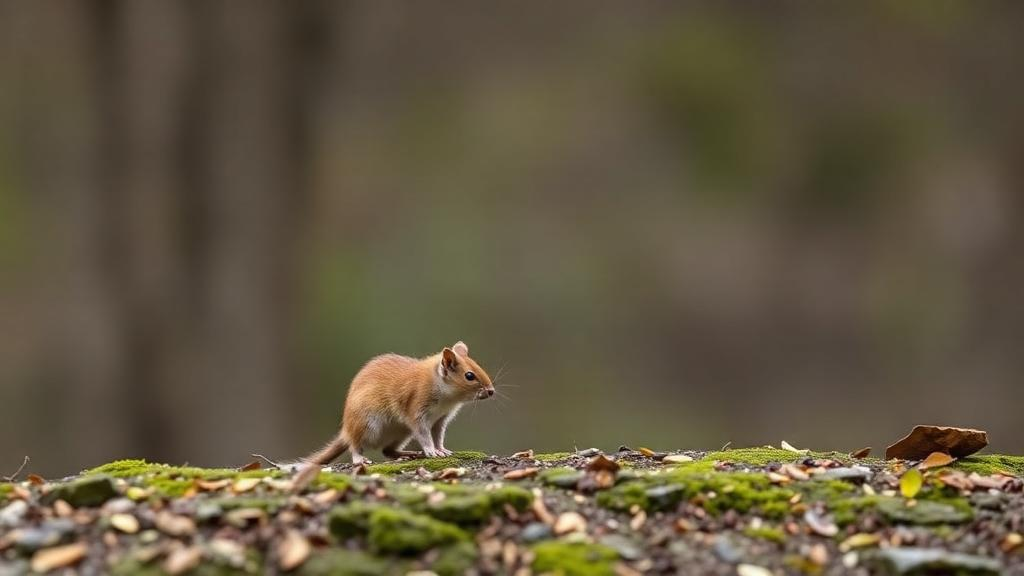
Deep in the forests of the Qinling Mountains in central China, an invisible contest plays out every autumn on the forest floor. Three species of oak—Quercus variabilis, Quercus aliena, and Quercus glandulifera—drop their acorns side by side and then rely on the same workforce of rodents to carry their offspring away from the parent tree. A new long-term study published in Ecology and Evolution reveals that the outcome of this contest is far from random: it is dictated by the physical and chemical traits of each seed and, crucially, by how many seeds are available in any given year. The findings offer one of the most detailed pictures yet of how coexisting plants compete for the services of animal dispersers, and how the rules of that competition shift with the boom-and-bust rhythm of mast seeding.
The research, conducted in Foping National Nature Reserve on the southern slopes of the Qinling range, tracked seed production and seed fates across nearly a decade. The team monitored annual seed crops of the three oak species from 2016 to 2021 using seed rain traps suspended beneath the canopies of mature trees, and then ran seed-tagging experiments each autumn to follow what happened to individual acorns after rodents found them. In the springs of 2022 to 2024, they repeated the dispersal experiments to capture the other end of the seasonal cycle, when overwintered seeds face a very different rodent community. Live-trapping surveys showed that the local rodent community was dominated by two species, the Chinese white-bellied rat Niviventer confucianus and the wood mouse Apodemus draco, which together accounted for roughly 80 percent of captures.
The three oaks present rodents with strikingly different packages. Quercus variabilis produces the largest seeds of the trio, averaging about 3 grams fresh weight with a thick pericarp of roughly half a millimeter, relatively high fat content, and the lowest tannin concentration of the three. Quercus glandulifera sits at the opposite extreme: its seeds are small, thin-coated, and loaded with tannins, the bitter defensive compounds that deter many herbivores. Quercus aliena falls in between, though its seeds carry the highest crude protein content. Because rodents must balance the energetic reward of a seed against the time and predator exposure required to open and transport it, these trait differences set the stage for predictable, species-specific foraging decisions.
That predictability showed up clearly in the data. Across almost every autumn of the study, rodents harvested Quercus variabilis seeds fastest, cached them most often, and ate the fewest of them outright. Quercus glandulifera seeds, by contrast, were harvested slowly, consumed in place more frequently, and cached least often. Quercus aliena occupied the middle ground, and although its nutritional profile closely resembled that of Q. glandulifera, rodents still preferred it, apparently on the strength of its larger size. The authors interpret this pattern through the lens of optimal foraging: rodents favor seeds that deliver greater energetic returns per unit of handling time, and thick-shelled seeds are often carried away to safer locations before being opened, because cracking them in the open leaves the animal vulnerable to its own predators.
The study also quantified seed dispersal effectiveness, a framework that combines the quantity of seeds removed with the quality of that dispersal, measured here as the proportion of released seeds that survived the winter after rodent handling. By this measure, Quercus variabilis held a consistent competitive advantage, recording the highest effectiveness in four of the six autumn study years, followed by Q. aliena and then Q. glandulifera. Dispersal distances did not differ significantly among the species, but there was a tendency for the large-seeded Q. variabilis to be carried farther before being eaten or cached, consistent with the optimal caching space model, which predicts that rodents transport higher-value foods to more distant cache sites.
Perhaps the most striking result concerns abundance. The three oaks mast in rough synchrony, producing large seed crops in some years and meager crops in others. Annual seed production varied dramatically: Quercus variabilis peaked at about 21.7 seeds per square meter in 2017 and collapsed to just over one seed per square meter by 2021. When the researchers combined seed crop with rodent availability into a single measure of per capita seed availability, a clear pattern emerged. In years when seeds were abundant relative to the number of rodents, harvest rates slowed markedly—the slowest of the entire study occurred in 2017, the peak mast year. This supports the classic predator satiation hypothesis, which holds that plants overwhelm seed predators by flooding the market, so that a smaller fraction of the crop is consumed.
Yet satiation tells only half the story. In high-availability years, rodents also shifted their behavior after harvesting: a greater proportion of seeds were eaten, both in place and after removal, while a smaller proportion were cached. This aligns with the predator dispersal hypothesis, which proposes that when food is plentiful, rodents have less incentive to invest in long-term storage and instead consume seeds immediately. When seeds were scarce, caching became relatively more attractive as a hedge against future shortage. The authors conclude that the mechanisms underlying both hypotheses can operate at the same time, with satiation governing how quickly seeds are taken and dispersal dynamics governing what rodents do with them once captured.
Seasonality added another layer of complexity. Spring experiments revealed a dramatically different dispersal landscape. Harvest rates were substantially lower than in autumn, and in 2023 the effect was extreme: roughly 15 percent of Quercus variabilis seeds, half of Q. aliena seeds, and 95 percent of Q. glandulifera seeds were still sitting untouched at the release stations fifty days after deployment. The researchers attribute this to reduced rodent abundance in spring following the lean winter months, and to the fact that when all three oak species were simultaneously scarce, rodents switched almost entirely to immediate consumption. No Q. aliena or Q. glandulifera seeds were cached at all in the springs of 2022 or 2023, and overall dispersal effectiveness showed no significant differences among the species in spring, because so few seeds of any kind were cached.
For the oaks, these results carry real evolutionary implications. Quercus variabilis appears to have evolved a winning combination: a large, nutritious seed with enough tannin defense to remain palatable but enough shell to reward caching rather than instant consumption. Quercus glandulifera, with its small, tannin-rich, thin-coated seeds, consistently loses out in the scramble for rodent dispersal services, suggesting it must compensate through other life-history strategies, such as producing seeds in years or microhabitats where competitors are absent, or relying on the simple arithmetic of producing many cheap seeds and accepting high predation. The study’s authors suggest that seed-trait-mediated selection by rodents may modulate the effects of masting itself, shaping indirect seed-seed interactions that ultimately influence how these sympatric species coexist.
The work also underscores how fragile the mutualism between oaks and rodents can be. Scatter-hoarding only translates into forest regeneration when cached seeds are forgotten, and the balance between predation and dispersal tips with every fluctuation in seed crop, rodent population, and season. As climate change alters the frequency and synchrony of mast events across the globe, understanding these trait- and abundance-dependent rules becomes essential for predicting which tree species will regenerate successfully and which will quietly lose their place in the forest. In the Qinling Mountains, at least, the verdict is clear: when it comes to recruiting rodents as gardeners, size, nutrition, and timing are everything.
Subject of Research: Rodent-mediated seed predation and dispersal among sympatric Quercus species in relation to seed traits and mast seeding in the Qinling Mountains, China
Article Title: Trait‐Mediated Seed Predation and Dispersal Are Regulated by Seed Abundance for Sympatric Tree Species in the Qinling Mountains, China
Article References: Wang, J., Han, G., Zhang, B., Han, N., Feng, T., Zhao, J., An, X., Hou, X., & Chang, G. (2026). Trait‐Mediated Seed Predation and Dispersal Are Regulated by Seed Abundance for Sympatric Tree Species in the Qinling Mountains, China. Ecology and Evolution, 16(10), Article e74453. https://doi.org/10.1002/ece3.74453
Image Credits: AI Generated
DOI: 10.1002/ece3.74453
Keywords: seed dispersal, seed predation, rodents, mast seeding, Quercus, Qinling Mountains, seed traits, scatter-hoarding, forest ecology, plant-animal mutualism, seed dispersal effectiveness, China