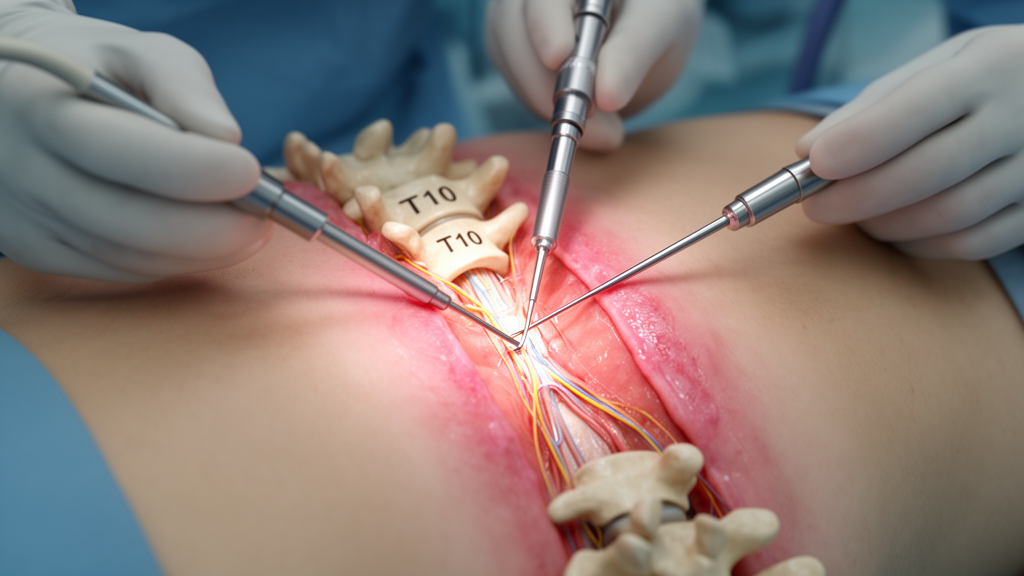
A case report published in BMC Surgery describes the use of selective nerve block-guided bilateral T10 nerve root transection using unilateral biportal endoscopy (UBE) to treat persistent severe intercostal neuralgia. The condition was caused by cement leakage following percutaneous vertebroplasty in an 83-year-old woman. The study highlights the diagnostic challenges associated with thoracic foraminal cement leakage and the potential utility of functional nerve blocks in localizing the symptomatic level when imaging is inconclusive.
Symptomatic cement leakage after percutaneous vertebroplasty is an uncommon complication, but it can lead to severe radicular pain or neurological deficits if the leaked cement involves the spinal canal or neural foramen. The authors note that thoracic foraminal cement leakage presenting as persistent severe intercostal neuralgia is particularly rare. In such cases, identifying the specific nerve root responsible for the pain can be difficult, especially when multiple adjacent foramina are involved, as was the case in this patient.
The patient, an 83-year-old woman, underwent percutaneous vertebroplasty for fresh osteoporotic compression fractures at the T10 and L5 vertebral levels. While her preoperative low back pain resolved after the procedure, she immediately developed severe bilateral intercostal neuralgia. The pain radiated from the costal arches to the periumbilical region and was rated at 8 on the visual analog scale. Computed tomography imaging revealed cement occupation of the bilateral T9/10 and T10/11 foraminal regions, confirming the presence of leakage at multiple levels.
Because imaging alone could not reliably identify the specific symptomatic level among the affected foramina, the clinical team performed sequential bilateral selective nerve root blocks. These blocks served as an adjunctive functional test to localize the source of the pain. Blockade of the T9/10 nerve roots produced no clinically apparent pain relief. In contrast, blockade of the T10/11 nerve roots resulted in marked relief of the characteristic pain, providing functional evidence that supported the involvement of the bilateral T10 nerve roots.
Given that severe pain persisted despite initial conservative treatment, the team proceeded with UBE-assisted surgery. The procedure utilized separate mirror-image bilateral portal configurations to access the affected areas. Under direct endoscopic visualization, the surgeons performed limited cement removal and foraminal enlargement. This was followed by bilateral T10 nerve root transection, an irreversible procedure intended to eliminate the source of the neuralgia.
The intercostal neuralgia resolved immediately following the surgical intervention. No recurrence of the pain was documented during the available three-month postoperative follow-up period. However, the authors explicitly state that longer-term follow-up data were unavailable, limiting the ability to assess the durability of the pain relief over an extended timeframe.
The study concludes that selective nerve root blocks may provide valuable adjunctive functional information for localization when multilevel foraminal cement leakage is present. In this single case, the UBE-assisted bilateral T10 nerve root transection was followed by short-term pain relief. The authors emphasize that this irreversible procedure should be regarded only as an individualized salvage approach for highly selected patients.
It is critical to note that this case report does not establish the feasibility, long-term safety, comparative effectiveness, or general applicability of the procedure. The findings are limited to a single patient with a specific complication profile. Therefore, the results should not be interpreted as a standard of care or a broadly applicable solution for all cases of cement leakage after percutaneous vertebroplasty.
Subject of Research: Endoscopic nerve root transection for post-vertebroplasty neuralgia
Article Title: Selective nerve block-guided bilateral T10 nerve root transection using unilateral biportal endoscopy for persistent severe intercostal neuralgia caused by cement leakage after percutaneous vertebroplasty: a case report and literature review
Article References: Wang, F., Zhang, Z., Xu, X., Shen, L., Li, X., & Song, R. (2026). Selective nerve block-guided bilateral T10 nerve root transection using unilateral biportal endoscopy for persistent severe intercostal neuralgia caused by cement leakage after percutaneous vertebroplasty: a case report and literature review. BMC Surgery. https://doi.org/10.1186/s12893-026-04310-3
Image Credits: AI Generated
DOI: 10.1186/s12893-026-04310-3
Keywords: percutaneous vertebroplasty, cement leakage, intercostal neuralgia, unilateral biportal endoscopy, nerve root transection, case report, spine surgery, T10 nerve root, Selective, nerve, block-guided, bilateral