
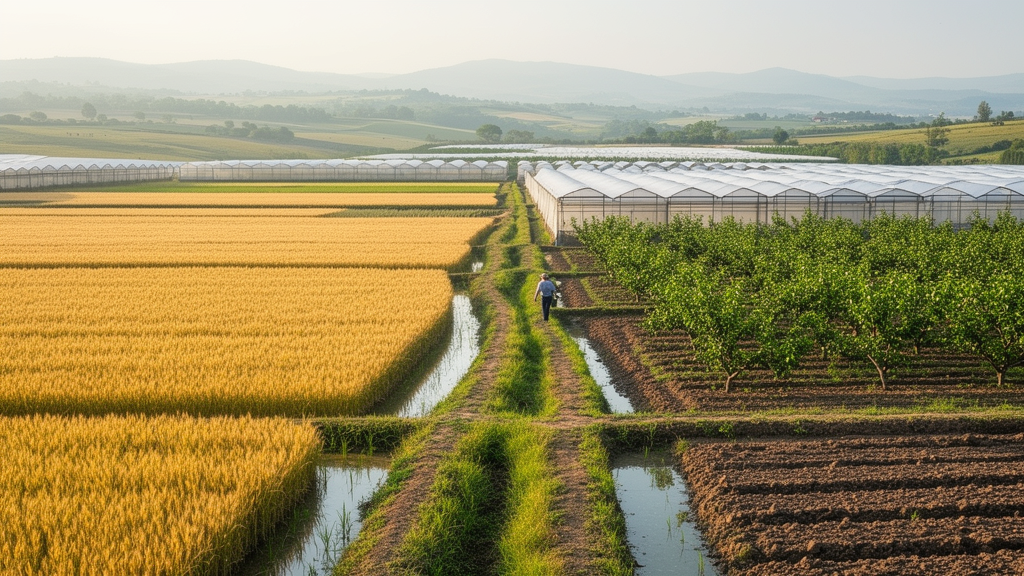
A long-term empirical investigation covering 291 prefecture-level cities in China across the 2004 to 2024 period demonstrates that expanding non-grain crop cultivation onto land historically dedicated to staple crops systematically undermines the resilience of regional grain production. Using satellite-derived crop maps and causal machine-learning estimators, researchers Fangyan Li and Ling Zhang found that a 10-percentage-point increase in the cultivated-land non-grain production rate reduces overall grain production resilience by an average of 0.00261, representing a decline of approximately 4.1 percent relative to the sample mean. The investigation evaluates how replacing rice, wheat, and maize with cash crops alters not only the total physical space available for staple grains but also the organizational frameworks, factor allocations, and technological infrastructures that allow regional agricultural sectors to withstand external disruptions, restore harvest yields following disasters, and adapt to long-term environmental transformations.
The conceptual framework underpinning the analysis defines grain production resilience as a dynamic, three-dimensional property encompassing resistance capacity, recovery capacity, and adaptive capacity. Rather than viewing agricultural performance solely through static annual output figures or short-run volume fluctuations, the research assesses the structural robustness of the farming sector under shocks such as extreme weather events, market turbulence, and input volatility. Resistance capacity reflects the direct ability of an agricultural system to withstand immediate shocks without suffering severe supply disruptions, measured through the stability of total grain output, low vulnerability to crop disasters, the effective irrigation rate, and per capita grain availability. Recovery capacity denotes the speed and ease with which production conditions can be restored following an adverse event, evaluated through fiscal support intensity, agricultural mechanization, rural disposable income, and employment stability. Adaptive capacity captures longer-term structural adjustments to shifting conditions through chemical fertilizer use efficiency, grain yield, and the construction ratio of upgraded and newly built high-standard farmland.
To capture cropping patterns across China with spatial precision, the researchers matched remote-sensing land-cover datasets from the China Land Cover Dataset with annual crop-distribution maps for rice, wheat, and maize. The mapping utilized one-kilometer resolution crop rasters spanning from 2000 through 2016 alongside high-resolution distribution maps covering 2017 through 2024, in which wheat was tracked specifically as winter wheat. Because the two distinct geospatial datasets relied on differing spatial resolutions and crop-identification methodologies, the authors corrected for spatial measurement discrepancies by calculating the mean prefecture-level city bias across their overlapping observation period of 2017 to 2019. Applying this empirical adjustment across the 2000 to 2016 sequence allowed the construction of a harmonized, continuous panel of city-level non-grain production rates across two and a half decades, while data from 2000 to 2003 provided pre-sample exposure baselines for subsequent instrumental-variable identification strategies.
The primary outcome metric, the grain production resilience index, was assembled using a two-stage entropy-weighting procedure to avoid subjective weighting biases while preserving the three-tier conceptual architecture. After standardizing eleven secondary indicators across the 291 administrative cities, entropy weights were calculated within each dimension to establish distinct intermediate scores for resistance, recovery, and adaptive capacity. A second entropy-weighting stage was then applied to these three dimension scores to determine aggregate weights and compile the overall resilience score. Within the sample, the baseline grain production resilience index exhibited a mean of 0.0630, a standard deviation of 0.0251, a minimum of 0.0196, and a maximum of 0.3016. In parallel, the non-grain production rate showed a sample mean of 0.6939 with a standard deviation of 0.2017, ranging from a minimum of 0.0257 to a maximum of 1.0000, illustrating substantial spatial and temporal variation across prefectures.
To isolate the relationship between non-grain cultivation and resilience while minimizing functional misspecification and omitted-variable bias, the authors employed a double machine learning framework using random forest algorithms as base learners. The causal econometric models incorporated city and year fixed effects, alongside first-order and second-order polynomial terms for key socioeconomic, infrastructure, demographic, and meteorological control variables. These control measures included the natural logarithm of rural population, total municipal highway mileage, higher education enrollment scaled by permanent resident population, mean annual temperature, average annual precipitation, and financial institution loan-to-deposit ratios. Under the preferred sample split of 1:2 with three-fold cross-fitting, the estimated non-grain production rate coefficient was minus 0.0261 with a robust standard error of 0.0021, statistically significant at the 1 percent level. Model stability was corroborated across five-fold and seven-fold cross-fitting structures, which yielded highly consistent negative point estimates of minus 0.0255 and minus 0.0251, respectively.
The adverse impact of non-grain crop expansion remained pronounced across all three constituent sub-dimensions of the resilience framework when analyzed individually. Dimensional regressions showed that a higher non-grain production rate exerted a negative effect on resistance capacity of minus 0.0204, on recovery capacity of minus 0.0027, and on adaptive capacity of minus 0.0014, with all three coefficients achieving statistical significance at the 1 percent level. These findings indicate that the systematic displacement of staple grains weakens immediate shock-buffering capabilities while simultaneously eroding the underlying conditions required for post-disaster rehabilitation and long-term yield enhancements. When crops such as vegetables, fruit, or ornamental nursery plants supplant grains, specialized grain machinery, operational knowledge, and public agricultural support mechanisms become dispersed, leaving the remaining cereal production systems increasingly fragile when exposed to climatic or economic disturbances.
Extensive robustness evaluations verified that the baseline findings were not artifacts of algorithmic selection, index construction choices, or unobserved administrative shocks. Re-estimating the causal models with alternative machine-learning base learners confirmed the pattern: gradient boosting yielded an estimated coefficient of minus 0.0305, support vector machines produced minus 0.0307, and cross-validated ridge regression yielded minus 0.0038, all maintaining statistical significance. Re-aggregating the eleven resilience indicators directly through single-stage entropy weighting produced consistent negative coefficients between minus 0.0043 and minus 0.0045 across specifications. The negative relationship also persisted when incorporating province-by-year interaction fixed effects to account for regional policy variations, when excluding the four centrally administered municipalities of Beijing, Tianjin, Shanghai, and Chongqing, and when controlling directly for the concurrent implementation of the farmland chief system policy.
To rule out potential endogeneity stemming from reverse causality or unobserved local confounders, the researchers constructed a Bartik-style shift-share instrumental variable. This instrument interacted each prefecture’s average historical non-grain production rate from the pre-sample period of 2000 to 2003 with the lagged annual percentage change in international price ratios between non-staple commodities and staple grains. The instrumental-variable double machine learning estimation produced a negative coefficient of minus 0.2294 with a standard error of 0.0720, significant at the 1 percent level. Because this instrumental-variable estimate leverages exogenous variation driven by global commodity market fluctuations interacting with historic cropping exposure, its larger magnitude compared to the baseline estimate of minus 0.0261 indicates that the detrimental effect of non-grain agricultural shifts on regional grain production resilience remains robust under strict causal identification.
The investigation identified regional agricultural technology innovation capacity as an active mediating channel through which non-grain cultivation harms resilience. Measured by the annual volume of granted agricultural patents obtained from the National Intellectual Property Administration, innovation capacity declined significantly as non-grain production increased, showing a regression coefficient of minus 0.0637 with a standard error of 0.0182. Large-scale and standardized cultivation of rice, wheat, and maize sustains stable market demand and broad field-testing grounds for specialized agricultural machinery, improved crop varieties, pest control, and water-saving irrigation systems. When staple acreage contracts and farming layouts become fragmented by diverse cash crops, demand for grain-specific innovations weakens and technology extension networks face higher adaptation costs. Formal mediation analysis corroborated this mechanism, generating a Sobel test statistic of minus 4.2074 with a p-value below 0.001 and an estimated mediated share of 20.71 percent, while a 1,000-replication bootstrap yielded a 95 percent confidence interval of minus 0.0013 to minus 0.0005.
The study further revealed that the detrimental effects of non-grain production are strongly moderated by regional economic development levels, measured by per capita gross domestic product. Moderation models produced a negative interaction coefficient of minus 0.0019 between the non-grain production rate and economic development, significant at the 1 percent level. Advanced economic regions exhibit higher rural household incomes, greater demand for high-value horticultural crops, and elevated opportunity costs for farmland and agricultural labor. These factors widen the profitability gap between cash crops and staple cereals, creating structural lock-in where labor, commercial capital, and specialized socialized services migrate permanently away from grain farming. Once such production assets are tied to high-value agricultural operations, reallocating land and assembling machinery to restore staple grain production after an adverse shock becomes substantially slower and more expensive.
Threshold regression modeling demonstrated that this moderating influence operates nonlinearly across distinct economic development stages, identifying two critical thresholds at per capita gross domestic product values of 11.0440 and 11.6521. In the lowest development regime where economic levels remain below 11.0440, the estimated impact of non-grain production on resilience was minus 0.0012 and statistically indistinguishable from zero, reflecting settings where crop shifts remain localized and service infrastructures are not yet rigidly entrenched. In the intermediate regime between the two thresholds, the coefficient dropped to minus 0.0057, significant at the 1 percent level. In the most developed regime exceeding 11.6521, the negative coefficient expanded to minus 0.0118, demonstrating that the erosion of grain production resilience intensifies sharply once regional economies surpass higher thresholds of industrialization and wealth accumulation.
Heterogeneity analyses revealed that natural terrain and operational scale further differentiate the vulnerability of farming systems. Splitting the sample at the median terrain slope showed a significantly larger negative coefficient of minus 0.0210 in low-slope regions compared to minus 0.0061 in high-slope areas, with a bootstrap between-group difference test yielding a p-value of 0.028. Flatter plains depend extensively on contiguous field layouts and synchronized mechanization, meaning that cropping fragmentation causes immediate disruptions to operational networks. Similarly, dividing prefectures at the median scale of agricultural operations—measured as grain sown area per primary-sector worker—revealed a much stronger negative effect in larger-scale operations at minus 0.0276 versus minus 0.0092 in smaller-scale settings, with a between-group bootstrap p-value of 0.012. Because larger-scale systems rely heavily on standardized management and commercial service coordination, displacing staple grains introduces elevated reorganization costs that leave production systems especially vulnerable.
Subject of Research: Impact of non-grain crop expansion on regional grain production resilience
Article Title: Non-grain production on cultivated land and grain production resilience: evidence from 291 prefecture-level cities in China
Article References: Li, F., & Zhang, L. (2026). Non-grain production on cultivated land and grain production resilience: evidence from 291 prefecture-level cities in China. Frontiers in Sustainable Food Systems, 10, 1982644. https://doi.org/10.3389/fsufs.2026.1982644
Image Credits: AI Generated
DOI: 10.3389/fsufs.2026.1982644
Keywords: grain production resilience, non-grain production rate, agricultural technology innovation, double machine learning, cultivated land protection, food security, staple crops, agricultural economics, Non-grain, production, cultivated, land

