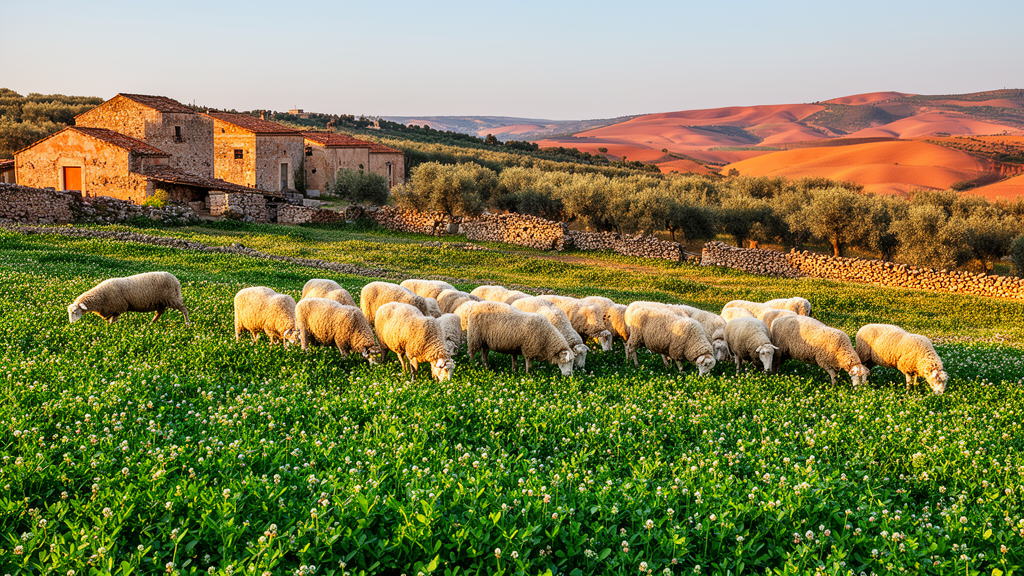
Researchers in Sicily have evaluated whether organic mixed crop-livestock systems can achieve integrated sustainability outcomes by incorporating legumes into crop rotations. The study, published in Agricultural and Food Economics, utilized a Living Lab approach to assess environmental performance, economic viability, and social outcomes in a semi-arid Mediterranean region. The central finding indicates that legume-based rotations enhance environmental integrity, economic resilience, and social well-being, although governance dimensions show greater scope for improvement. This exploratory research provides context-specific insights for agroecological transitions and European Union Common Agricultural Policy objectives.
The investigation addressed three primary research questions regarding the sustainability of organic livestock farming in less-favoured rural areas. First, it examined the extent to which legume-based rotations ensure adequate production performance while maintaining environmental sustainability, particularly concerning soil and natural resource conservation. Second, it assessed whether the adopted crop rotations comply with the requirements of the European Union’s 2023–2027 Common Agricultural Policy, specifically eco-schemes supporting crop diversification. Third, it explored whether livestock systems in these areas can serve as transferable reference models for other EU regions under comparable conditions.
The study was conducted in inland areas of Sicily, characterized by a predominantly Mediterranean climate with semi-arid conditions. Average annual rainfall in the region is approximately 600 mm, with significant spatial variability driven by topography and distance from the coast. These agro-climatic conditions expose agriculture to climate variability, soil degradation, and water scarcity. Sicily was selected for its representativeness in Italian organic livestock farming, accounting for 16.5% of the national organic agricultural area and 16% of organic operators. The region hosts approximately 30.1% of Italian organic sheep farms and 23.8% of organic goat farms, making small ruminants a central component of the local agricultural landscape.
Four organic mixed crop-livestock farms were selected as case studies through purposive criteria designed to capture relevant configurations of the regional sector. The farms were located in Piana degli Albanesi, Campobello di Licata, and Villarosa, all classified as less-favoured areas under EU regulation. Total farm area ranged from 35.8 to 134.7 hectares, with utilised agricultural area accounting for almost the entire farm area. Three farms were cattle-based systems and one was a goat-based system, with production oriented toward milk or meat. Livestock size varied between 16 and 53 Livestock Units, corresponding to stocking densities between 0.27 and 0.66 Livestock Units per hectare, indicating extensive management systems consistent with organic production standards.
Crop rotations in the selected farms were centred on cereal and fodder crops integrated with legumes, primarily field beans, within multi-year rotational schemes. Field beans were adopted as a locally adapted protein source aimed at reducing reliance on imported soybean meal within organic livestock feeding systems. Two farms also included perennial crops, such as vineyards or tree crops, contributing to land-use diversification. The Living Lab framework involved diverse stakeholders, including universities, public administrations, civil society actors, and 55 individual and associated livestock farmers. This participatory approach facilitated the contextualisation of sustainability indicators and the joint interpretation of results through iterative interaction with farmers.
Sustainability performance was assessed using the FAO Sustainability Assessment of Food and Agriculture Systems (SAFA) framework, which evaluates environmental integrity, economic resilience, social well-being, and good governance. SAFA indicators were translated into practice-oriented, locally meaningful questions through the Living Lab process. The assessment was complemented by a quantitative farm-level economic analysis to provide measurable performance metrics for cost structure, revenues, and profitability. Data were collected through a single integrated questionnaire administered face-to-face between September 2022 and June 2023, with on-farm visits conducted to verify selected responses and enrich contextual understanding.
Economic results revealed that variable costs represent the largest share of total production costs, accounting for between 64 and 79% of Gross Production Value across the sample. In absolute terms, variable costs ranged from approximately 485 EUR per hectare to 1,900 EUR per hectare, with labour, energy, supplementary livestock feeding, and seed purchases being the main components. Fixed costs accounted for a smaller share, ranging from 11% to 22% of Gross Production Value, and were primarily associated with depreciation of buildings, machinery, and other long-term capital investments. Gross Production Value varied substantially among farms, ranging from 615 EUR per hectare to 2,834 EUR per hectare.
Profitability, expressed as net profit per hectare, ranged from 63 EUR to 509 EUR. When expressed as a share of Gross Production Value, profitability ranged between approximately 10 and 18%, indicating that farms remained economically viable, although profit margins were relatively narrow. Most of the gross production value was absorbed by production costs, highlighting the importance of cost management strategies. Total farm income derived from multiple sources, including livestock production, miscellaneous sales, increases in livestock value, and direct payments, with the relative importance of these components differing across farms.
Sustainability performance assessments showed that environmental integrity indicators achieved consistently high scores across all farms. Soil management, crop diversity, fertiliser management, water use, and animal welfare indicators were predominantly positioned within the green performance range. These results reflect the widespread adoption of organic management practices, crop rotations including legumes, and extensive livestock systems. Water management indicators showed generally high scores, reflecting limited irrigation use and reliance on rainfed cropping systems under semi-arid conditions. Animal welfare indicators achieved high scores, consistent with extensive grazing practices and compliance with organic livestock standards.
Economic resilience indicators showed moderate-to-good performance, with Farm Business Resilience scores ranging between 3.2 and 3.4. While all farms displayed positive economic margins, variability emerged across cases in terms of investment capacity, planning horizon, and income composition. Social well-being indicators exhibited greater heterogeneity, with scores varying according to labour organisation, training activities, and engagement in community-oriented initiatives. Labour organisation in the surveyed farms was largely based on family labour and extensive grazing systems, which imply low permanent labour requirements per hectare and per animal. Governance indicators also showed variability, with lower scores observed in relation to participation in collective organisations and the adoption of formal planning or assessment tools.
The results suggest that organic mixed crop-livestock systems adopting legume-based rotations can maintain satisfactory production performance while supporting key environmental functions, particularly soil management, nutrient cycling, and water resource conservation. The sustainability profiles observed are largely aligned with the objectives of the CAP 2023–2027, particularly eco-schemes promoting extensive forage systems, crop rotation, and organic livestock management. However, the economic analysis indicates that farm income remains structurally linked to policy support, suggesting that policy instruments play a stabilising role in contexts characterised by environmental constraints and limited market power. Alignment with CAP objectives does not automatically translate into economic autonomy, as eco-schemes function as enabling mechanisms that support but do not replace farm-level strategies.
Several limitations of the study should be acknowledged, including the exploratory design and the limited number of case-study farms, which do not allow statistical generalisation. The results should be interpreted as indicative patterns rather than definitive evidence, and the analysis captures a specific temporal window without fully accounting for interannual variability in climatic conditions, market dynamics, or policy implementation. The study does not allow isolating the independent effect of legume rotations from other agroecological practices, and future comparative research including farms without legumes or under different management regimes would help to further clarify these relationships. Governance and social dimensions would benefit from deeper qualitative investigation to capture power relations and collective action mechanisms more explicitly.
Within these limitations, the findings contribute to understanding how diversified crop-livestock systems based on locally adapted legumes can operate under semi-arid Mediterranean conditions. The Living Lab approach emerged as a promising platform for bridging scientific knowledge, farm-level experimentation, and policy design, contributing to evidence-based strategies for fostering sustainable and resilient livestock farming systems. The transferability of the proposed approach extends beyond agronomic practices to include the methodological configuration of the Living Lab, which could enhance the contextual adaptation of agroecological strategies while strengthening local governance and coordination mechanisms in other semi-arid and disadvantaged regions.
Subject of Research: Living Labs for sustainable farming: evaluating crop rotations and sustainability of livestock systems in a semi-arid Mediterranean area
Article Title: Living Labs for sustainable farming: evaluating crop rotations and sustainability of livestock systems in a semi-arid Mediterranean area
Article References: Timpanaro, G., Foti, V. T., Incardona, S., & Cammarata, M. (2026). Living Labs for sustainable farming: evaluating crop rotations and sustainability of livestock systems in a semi-arid Mediterranean area. Agricultural and Food Economics, 14(1), Article 43. https://doi.org/10.1186/s40100-026-00487-6
Image Credits: AI Generated
DOI: 10.1186/s40100-026-00487-6
Keywords: Living, Labs, sustainable, farming, evaluating, crop, rotations, sustainability, livestock, systems, semi-arid, Mediterranean