
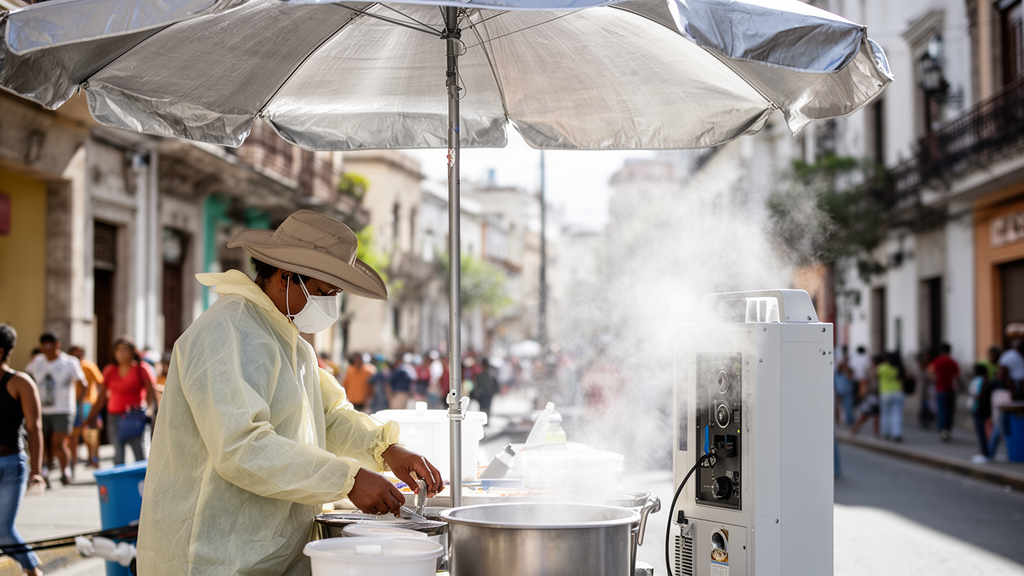
An exploratory review of academic and grey literature published in Public Health Reviews demonstrates that Latin America and the Caribbean can draw on South Asian experiences to design urban extreme heat protections tailored specifically to informal workers. Researchers Maria Sol Saliva, Juan Manuel Menéndez, Flávia Guerra, Simone Sandholz, and Antonella Risso analyzed documented urban heat responses across both regions to determine how existing interventions address the health risks of informal urban laborers. In Latin America and the Caribbean, 82 percent of the population resides in urban environments and over half of the active labor force, specifically 51.7 percent, works in informal employment. The authors established that while resource-constrained municipalities in South Asia have developed extensive heat intervention portfolios capable of lowering mortality at scale, these mechanisms only reach informal urban laborers when explicitly designed to encompass their living, commuting, and working conditions from the initial planning stages.
The imperative for structural heat adaptation arises amid unprecedented global temperature surges recorded over recent decades, with the last three years marking the warmest on record. In South America, an early 2025 heatwave drove local temperatures to record-breaking extremes of 44 degrees Celsius, reflecting broader global trends where extreme heat episodes have become substantially more frequent, severe, and prolonged. The physical toll across Latin America is already evident in documented epidemiological records, with regional heat-related mortality increasing by 103 percent during the decade spanning 2012 to 2021 when compared against the baseline decade of 1990 to 1999. Projections compiled by climate researchers indicate that heatwaves will continue to lengthen in duration across coming years, heightening the urgency of establishing coordinated public health preparedness and inter-regional cooperation to counter escalating climate-driven thermal threats before systemic crises overwhelm municipal emergency systems.
Elevated exposure to environmental heat severely strains human thermoregulatory systems, producing physiological damage that is distributed unequally across diverse urban communities. While infants, young children, the elderly, and individuals diagnosed with chronic cardiovascular, metabolic, renal, or respiratory conditions exhibit high biological susceptibility to severe heat stress, thermal danger is not determined solely by medical vulnerabilities. Biological mechanisms intersect with sex-specific physiological factors and distinct gender differences in daily occupational exposure and adaptive capacity. Climate change functions as an active health-risk multiplier by compounding structural vulnerabilities, including marginalization, poverty, substandard living environments, and deficient access to formal healthcare. Consequently, heat-related health risks reflect the cumulative convergence of environmental hazard intensity, physiological pre-conditions, and socioeconomic determinants that govern the physical circumstances under which marginalized populations live, travel, and perform daily labor.
Urban informal employment represents a defining structural reality across Latin America and the Caribbean, encompassing 51.7 percent of overall workers and rising to 60 percent among youth. Informal urban labor encompasses vital socioeconomic occupations, including street vending, domestic caregiving, manual construction, domestic and municipal waste picking, and informal transport operation. As noted in the analytical framework, widespread informality stems directly from the combination of deficient public services, burdensome regulatory frameworks, and weak monitoring and enforcement capabilities within state institutions. Operating without legal registration, statutory protection, or occupational safety coverage, informal workers routinely experience high baseline exposure to outdoor heat alongside limited adaptive capacity. Many informal laborers contend simultaneously with multidimensional poverty, substandard housing, and precarious worksites, forming an occupational demographic that requires public intervention protocols specifically calibrated around structural informality rather than conventional formal workplace regulations.
South Asian cities have generated the most extensive body of documented urban heat adaptation evidence in the Global South over the past decade, establishing a valuable foundation for South-South knowledge transfer. Regional momentum developed following the deadly 1998 Odisha heatwave in India and accelerated dramatically after the catastrophic 2010 Ahmedabad heatwave, which resulted in more than 1,300 excess deaths within a single month. In response, municipal and state authorities formulated comprehensive Heat Action Plans that have expanded across more than a dozen metropolitan centers throughout India, Bangladesh, and Pakistan. Quantitative evaluations confirm that the Ahmedabad Heat Action Plan model prevented approximately 1,190 annualized excess deaths through coordinated multi-agency warnings and health sector readiness, demonstrating that resource-constrained cities operating within high-informality contexts can implement life-saving interventions when evidence-based planning guides public heat administration.
Conventional diagnostic and occupational standards routinely underestimate the thermal hazards experienced by informal workers because standard metrics fail to capture the cumulative realities of informal labor. Internationally recognized indices, such as the Wet-Bulb Globe Temperature and the Universal Thermal Climate Index, capture ambient environmental parameters and physiological factors but presuppose healthy, well-hydrated individuals and rely on expensive measurement equipment that municipal agencies rarely possess. Furthermore, existing thermal thresholds are typically formulated around structured shift patterns, regulated break spaces, and compliance enforcement mechanisms characteristic of formal indoor worksites. Because these technical tools ignore cumulative daily heat exposure, pre-existing chronic conditions, and the severe financial penalties informal workers face if they halt daily operations, standard surveillance mechanisms miscalculate the actual physiological burden borne by laborers operating throughout irregular, unregulated urban spaces.
Documented interventions across Latin America remain geographically isolated in flagship municipal projects that rarely incorporate informal laborers into core delivery mechanisms. City-level investigations illustrate acute climate vulnerabilities, such as the 2013 heatwave in Buenos Aires, Argentina, which generated an estimated 50 percent increase in municipal heat-related mortality. In response to recurring climate hazards, Rio de Janeiro, Brazil, operationalized a tiered heat alert protocol in 2024 through its municipal Centro de Operações, representing the region’s most institutionally advanced early warning platform, while Medellín, Colombia, established international prominence through its 2016 Green Corridors nature-based cooling network. However, existing programs in Latin America and South Asia still fail to establish integrated protections that span the full daily exposure continuum of informal laborers, treating heat as an episodic meteorological anomaly rather than a pervasive, multi-environment occupational risk factor.
To overcome identification challenges associated with populations excluded from legal registries, the review highlights satellite-based diagnostic visualization as a foundational policy domain. Granular thermal imaging reveals that dense built environments with artificial surfaces, compact high-rises, and scarce vegetation generate intense local microclimates compared to shaded districts. Local governments in Rajshahi, Bangladesh, and Nepalgunj, Nepal, have utilized freely available Landsat satellite data to identify urban thermal hotspots and map vulnerability intersections for groups such as rickshaw pullers. For Latin America, the Inter-American Development Bank’s Cities LAB developed an analytical pipeline linking Urban Reporting Based on Satellite Analysis with an artificial-intelligence informal settlement mapping algorithm known as MAIIA. Overlaying high-resolution heat distribution maps onto automated settlement locations generates spatial heat-vulnerability prioritization layers, a capability complemented globally by the World Resources Institute’s Cool Cities Lab platform across more than 20 cities.
Transforming Heat Action Plans constitutes the second essential policy domain, requiring structural adaptations to overcome documented delivery barriers that leave informal workers unreached by official communications. Systematic assessments of eight Indian city heat plans confirmed strong coordination in hospital preparedness but identified recurring failures in vulnerable population outreach, real-time surveillance, and urban planning. Survey data from Dhaka, Bangladesh, revealed that over 83 percent of surveyed informal workers lacked access to public shade or green space, while only 15 percent indicated willingness to utilize municipal cooling centers due to physical accessibility barriers and institutional distrust. The review recommends that heat plans in cities like Rio de Janeiro, Cordoba, and across Saint Lucia transition from fixed-address notices to mobile-first communications utilizing location-based SMS, cell broadcasts, and Interactive Voice Response, while expanding vulnerability definitions to include occupational exposure alongside age and comorbidity.
Governance innovation represents the third policy domain, focusing on institutional mechanisms that establish lasting cross-departmental accountability for urban thermal management. Global evaluations by the Global Heat Health Information Network, the United Nations Office for Disaster Risk Reduction, and the World Meteorological Organization indicate that weak institutionalization is the principal failure mode of heat planning worldwide. Standalone governance models, including Chief Heat Officer appointments piloted in Dhaka North, Bangladesh, and Freetown, Sierra Leone, have frequently depended on external philanthropic funding rather than sustained municipal budgets. The authors advise Latin American administrations to embed heat governance directly into pre-existing disaster risk reduction, climate adaptation, and social protection frameworks. Anchoring heat responsibilities within statutory disaster agencies provides durable inter-agency coordination mandates and financing structures that can bridge fragmented metropolitan jurisdictions between peri-urban informal settlements and urban commercial districts.
The fourth policy domain centers on physical exposure reduction deployed across the continuous daily movement cycle encompassing household, transit, and worksite environments. Empirical studies demonstrate that targeted structural interventions provide measurable cooling benefits; cool roofs evaluated in Dhaka lowered daytime surface temperatures, while nature-based greening in comparable subtropical cities achieved mean air temperature reductions of up to 1.2 degrees Celsius and localized drops reaching 3.9 degrees Celsius. In Latin America, urban green infrastructure exhibits a documented luxury effect, clustering disproportionately within affluent, formal districts. Addressing heat illness across mild, moderate, and severe stages requires expanding accessible climate shelters equipped with secure storage for vendor carts, cargo bicycles, and tools. Furthermore, action protocols must account for cumulative physiological strain across consecutive heatwave days, while municipal nature-based cooling investments within informal settlements must incorporate explicit anti-displacement safeguards and secure land tenure provisions.
Subject of Research: Urban extreme heat response strategies and occupational protections for informal workers in Latin America and South Asia
Article Title: Extreme heat and informal urban workers’ health – lessons for Latin America and the Caribbean from South Asia
Article References: Saliva, M. S., Menéndez, J. M., Guerra, F., Sandholz, S., & Risso, A. (2026). Extreme heat and informal urban workers’ health – lessons for Latin America and the Caribbean from South Asia. Public Health Reviews, 47, Article 1610226. https://doi.org/10.3389/phrs.2026.1610226
Image Credits: AI Generated
DOI: 10.3389/phrs.2026.1610226
Keywords: extreme heat, informal employment, heat action plans, urban health, Latin America, South Asia, climate adaptation, occupational heat stress, early warning systems, satellite diagnostic mapping, urban microclimates, nature-based solutions, Ahmedabad heat plan, disaster risk reduction, heat-related mortality, public health policy, multidimensional poverty

