
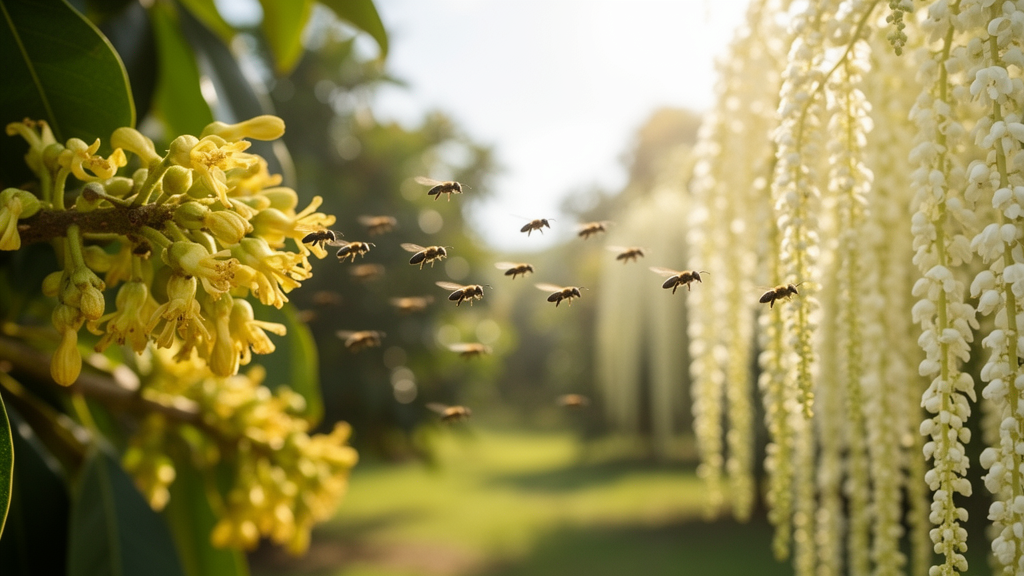
Managed stingless bees placed inside mixed-crop agricultural orchards will bypass immediately adjacent avocado blooms to collect pollen from preferred macadamia flowers located hundreds of meters away, according to an investigation into pollinator foraging dynamics. The research reveals that floral preference, rather than physical proximity to blooming crops, serves as the dominant behavioral driver governing resource collection in multi-crop systems. While stingless bees are increasingly deployed to supplement agricultural pollination across tropical and subtropical regions, their practical performance in settings with concurrent blooms has remained difficult to evaluate. By tracking the individual pollen loads of Tetragonula carbonaria in an orchard where avocado and macadamia flower concurrently, researchers demonstrated that proximity does not guarantee target crop visitation. Even when hives were stationed within fifteen meters of flowering avocado trees, worker bees consistently ignored avocado inflorescences, traveling extended distances to forage on macadamia blossom and herbaceous orchard weeds instead.
The study addressed persistent operational challenges facing commercial fruit and nut production, where animal pollination underpins crop yield and fruit quality. Both avocado and macadamia produce copious numbers of flowers during concentrated spring blooms yet frequently suffer from low fruit set stemming from inadequate pollen transfer. Avocado trees can bear up to one million flowers in a single reproductive season, while individual macadamia trees yield between two hundred thousand and four hundred thousand blossoms. Despite this abundance, both crops exhibit reproductive bottlenecks: macadamia yield can increase by up to one hundred and nine percent with supplementary cross-pollination, and inadequate cross-pollination in avocado reduces harvest yields by twenty-five to forty-four percent. In commercial settings, honeybees traditionally provide the bulk of managed pollination services, but growers have increasingly turned to native stingless bees to diversify pollination networks. However, because stingless bees are recognized generalist foragers that gather pollen from diverse plant taxa, understanding how they balance competing floral densities, distances, and rewards in co-flowering plantations is essential for optimizing hive placement.
To investigate these resource interactions, the researchers evaluated a commercial mixed orchard in Queensland, Australia, situated at coordinates 25°8’22”S, 152°16’1”E. The experimental site featured extensive contiguous plantings of avocado, Persea americana, and macadamia, comprising Macadamia integrifolia and its hybrids with Macadamia tetraphylla. The avocado plantation consisted of seventy rows alternating between four rows of the cultivar Hass and two rows of Shepard, configured with ten-meter inter-row spacing and five-meter tree intervals. Directly adjacent stood large commercial blocks of macadamia trees, split into seventy rows of cultivar A203 and sixty rows of cultivar 741 with 9.5-meter inter-row spacing. Because the two crops grew in close proximity and exhibited overlapping spring bloom periods, the plantation provided an ideal landscape to test whether stingless bees prioritize flight economy by visiting the nearest available canopy or actively discriminate between co-occurring mass-flowering species.
The experimental design deployed ten established colonies of Tetragonula carbonaria across two distinct spatial configurations two weeks prior to sampling to allow colony acclimatization. Five hives were positioned directly alongside avocado rows, situated approximately fifteen meters from avocado trees, 203 meters from the nearest A203 macadamia planting, and 830 meters from the 741 macadamia block. A second group of five hives was established between the two crops, positioned twelve meters from both avocado and A203 macadamia trees and 675 meters from the 741 block. All selected colonies demonstrated strong baseline health, weighing between eight and nine kilograms at installation and maintaining active flight rates exceeding twenty returning workers per minute. Standard agricultural chemical applications were suspended throughout the duration of bloom. In addition to the commercial tree canopies, the orchard understory contained flowering weed populations, primarily wild radish, Raphanus raphanistrum, flatweed, Hypochaeris radicata, and cobbler’s pegs, Bidens pilosa, while native eucalypts, cadaghi trees, and lantana grew within surrounding vegetation roughly one hundred meters away.
Sampling occurred over six distinct observation dates across September 2020, capturing morning and afternoon flight windows during peak floral availability. Pollen foragers were intercepted individually at hive entrances using specialized aspirators pre-rinsed with ethanol, collecting three returning bees per hive during each three-hour collection window to yield a total sample of 351 bees. Concurrently, observers measured colony activity by counting every returning forager carrying visible corbicular pollen loads during five-minute intervals in morning and afternoon sessions. To quantify competing resource availability, field teams monitored floral density weekly across four weeks. Observers counted open flowers within one-cubic-meter quadrats positioned on the eastern and western aspects of randomly selected trees. Because avocado flowers exhibit protogynous dichogamy—opening first in a receptive female phase before closing overnight and reopening in a staminate male phase—counts tallied both functional stages, while macadamia surveys monitored open racemes displaying style emergence across at least eighty percent of individual florets.
To identify the botanical composition of collected pollen without the biases inherent in visual microscopy, the researchers implemented high-throughput DNA metabarcoding of the nuclear internal transcribed spacer 2, or ITS2, ribosomal marker. Dislodged pollen pellets were separated by centrifugation at 18,407 g, dried, homogenized with silica beads in a high-speed tissue disruptor, and extracted using commercial column kits alongside positive and negative extraction controls. The ITS2 region was amplified in triplicate polymerase chain reactions using adapted ITS-S2F and ITS4R primers fitted with Illumina dual-index adapters. Amplified libraries were normalized, verified for fragment size distribution and concentration, pooled in equimolar amounts, and sequenced on an Illumina MiSeq platform using paired-end 500-cycle chemistry. Bioinformatic processing dereplicated raw sequence reads, filtered chimeric amplicons, and denoised sequences into amplicon sequence variants through the VSEARCH pipeline before taxonomic classification against regional reference databases curated from the Atlas of Living Australia and NCBI GenBank.
Sequence reads were mapped to established taxonomic identities to determine relative read abundance across three designated resource categories: avocado, macadamia, and non-crop species. Stringent quality thresholds eliminated minor contaminants identified in negative extraction blanks below one percent relative read abundance, alongside samples yielding fewer than one thousand total reads. To evaluate how hive location and seasonal progression influenced foraging choices, the research team modeled proportional intake using generalized linear mixed models incorporating zero-inflated beta distributions for macadamia and non-crop pollen, while treating hive identity as a random effect. Because avocado pollen counts contained an excess of zero values exceeding eighty percent, those proportions were evaluated via generalized linear models using a quasibinomial distribution and logit link function. Forager flight frequencies across observation intervals were similarly examined using quasi-Poisson generalized linear models to account for empirical data overdispersion.
Metabarcoding resolved pollen collected by Tetragonula carbonaria into at least ninety-three distinct plant taxa spanning twenty-three orders, thirty-five families, seventy-four genera, and eighty-one species, confirming that the bees utilized broad botanical sources. Despite this overall taxonomic breadth, foraging remained heavily skewed toward macadamia blossom, which constituted 65.38 to 80.59 percent of total pollen reads. Non-crop ruderal species in the orchard floor formed the primary secondary resource, dominated by Raphanus raphanistrum at 4.15 to 5.37 percent and Hypochaeris radicata at 2.95 to 6.47 percent. In contrast, avocado pollen representation remained strikingly minimal across all dates and locations, failing to exceed seven percent relative read abundance and registering median values of only 6.7 percent on September 9 and 2.4 percent on September 10, before dropping to negligible median levels of zero percent across subsequent collection rounds.
Spatial hive placement exerted a pronounced effect during early bloom stages before converging as tree phenology peaked. Early in September, when the adjacent A203 macadamia block had not yet opened its racemes, bees originating from between-crop hives foraged significantly more heavily on macadamia than bees housed at avocado hives. To access macadamia pollen during this initial period, foragers flew more than 675 meters from between-crop hives and more than 830 meters from avocado hives to reach blooming cultivar 741 trees, bypassing blooming avocado rows situated mere meters from their nest entrances. During these opening days, colonies positioned beside avocado rows compensated for distance by gathering substantial quantities of herbaceous non-crop pollen rather than foraging on avocado flowers. Once the adjacent A203 macadamia trees reached peak flowering later in September, both hive groups shifted overwhelmingly to macadamia collection, eliminating earlier differences in crop and non-crop pollen proportions between the two apiary positions.
Colony traffic counts further reflected the metabolic and spatial realities of resource distribution. Forager return rates were significantly lower at avocado-adjacent hives than at between-crop hives during morning observations on September 15, 23, and 24, aligning with the onset of peak flowering in the neighboring A203 macadamia block. While colonies nestled directly beside opening macadamia canopies sustained intense, localized foraging cycles, workers from avocado-placed hives were obliged to commute at least two hundred meters to reach the same resource, depressing the total volume of round-trip foraging journeys completed per unit time. Afternoon counts exhibited fewer differences between hive placements, likely driven by diel flowering patterns where the afternoon availability of staminate Hass avocado flowers provided brief local pollen pulses, though this failed to shift proportional collection away from macadamia.
The persistent avoidance of avocado bloom challenges traditional assumptions that stingless bees forage opportunistically on whichever mass-flowering crop is situated closest to the hive. While foraging theory assumes insects minimize transit costs when abundant nectar or pollen sources exist nearby, Tetragonula carbonaria exhibited active selectivity, undertaking energetically taxing long-distance flights exceeding eight hundred meters to harvest macadamia pollen. This avoidance mirrors known honeybee behaviors, where avocado pollen frequently represents less than one percent of gathered reserves despite overwhelming canopy dominance. Researchers suggest this reluctance may stem from the chemical characteristics of avocado nectar, which contains deterrent concentrations of minerals such as potassium and phosphorus that persist across both male and female floral phases. Although avocado pollen itself offers high protein content, the sensory deterrents of the flower appear sufficient to drive foragers toward alternative floral targets, including weedy inter-row flora and distant proteaceous tree canopies.
These behavioral observations carry direct implications for agricultural orchard planning and commercial pollination agreements. Deploying stingless bee colonies inside avocado blocks will not reliably deliver desired cross-pollination services if preferred competing crops, such as macadamia, are flowering within eight hundred meters of the hives. To improve avocado pollination efficiency and induce higher visitation to target flowers, growers must adopt strategic hive placement protocols that deliberately isolate colonies from competing floral reservoirs. The authors note that while their investigation provides molecular insight into resource utilization, its findings derive from a single growing season within one geographic orchard system, with foraging activity inferred indirectly from returning corbicular loads. Future investigations extending across multi-year cycles and varied multi-cropping landscapes will help refine spatial isolation thresholds, enabling growers to harness stingless bee pollination services effectively while accommodating the fixed sensory and nutritional preferences of these managed insects.
Subject of Research: Pollen foraging preferences and spatial movement of stingless bees in mixed-crop orchards
Article Title: Pollen foraging patterns of stingless bees (Tetragonula carbonaria) in a mixed cropping system
Article References: Chakma, N., Wilson, R. S., Cannizzaro, C., Hosseini Bai, S., Trueman, S. J., & Wallace, H. M. (2026). Pollen foraging patterns of stingless bees (Tetragonula carbonaria) in a mixed cropping system. Frontiers in Bee Science, 4, Article 1991097. https://doi.org/10.3389/frbee.2026.1991097
Image Credits: AI Generated
DOI: 10.3389/frbee.2026.1991097
Keywords: Tetragonula carbonaria, stingless bees, crop pollination, pollen foraging, DNA metabarcoding, avocado pollination, macadamia pollination, orchard management, floral preference, Persea americana, Macadamia integrifolia, foraging distance, corbicular pollen, agricultural ecosystems, relative read abundance, mixed cropping systems, internal transcribed spacer 2, pollinator behavior
