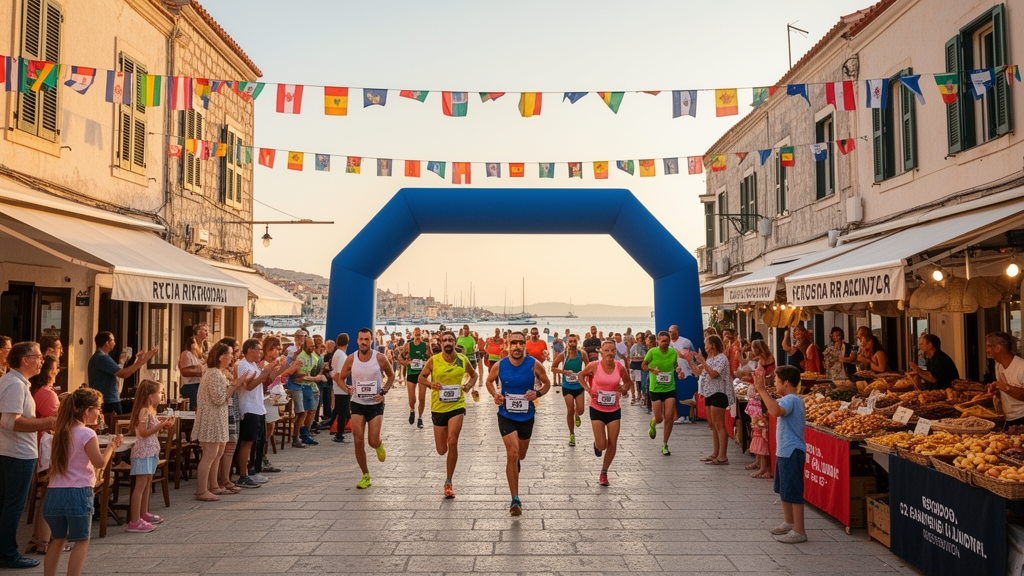
A growing body of research on sport and event tourism is converging on a conclusion that challenges one of the industry’s most comfortable assumptions: that a successful event is simply one that fills stadiums, hotels and restaurants. According to a new editorial collection published in Frontiers in Sports and Active Living, the value of sport and event tourism for a destination is shaped not only by visitor satisfaction and economic activity, but also by safety, resident attitudes, visitor behavior, cultural heritage, community participation, spatial development and the capacity of local institutions. The collection, introduced by an editorial from Wadih Ishac of Qatar University and Jae Won Kang of the International College of Management in Australia, assembles studies that examine both sides of the ledger—how events enhance destination value, and how they generate social problems that demand careful management.
The editorial frames the research around a central tension. Sport events, from urban marathons to heritage-based tourism products, can strengthen regional economies and cultural identity, attract visitors and differentiate destinations in a crowded global market. But the same events can produce misbehavior by tourists, crowding, affordability pressures on local housing, uneven distribution of benefits and resistance from the residents who live with the consequences. The studies gathered in the Research Topic argue that these social dimensions are not peripheral concerns to be addressed with public relations; they are core determinants of whether sport tourism actually adds durable value to a place.
One strand of the collection shifts attention from the individual visitor experience to the social factors that can enhance or limit a destination’s value. A study by Zhang and colleagues published in 2026 investigated why tourists misbehave when traveling away from home, using behavioral experiments combined with electroencephalography, or EEG, evidence. The findings indicate that non-local contexts increase misbehavior intention by weakening informal social control through an abstract mindset. In other words, when people perceive themselves as being outside their usual social environment, the informal pressures that normally restrain misconduct loosen. By contrast, local contexts strengthen cognitive control and normative sensitivity, thereby reducing the intention to misbehave. For destination managers, the implication is that the psychological framing of a place—whether visitors feel embedded in a local community or detached from it—can measurably alter behavior.
A second study by Zhang and colleagues, published in 2025, examined a different but equally consequential relationship: how local residents’ perceptions of the economic, image and spatial impacts of events shape their support for urban marathons. The results show that perceived economic and urban image impacts influence residents’ support intentions indirectly, through their attitudes, while perceived spatial impacts show both direct and indirect associations with support. The editorial draws a blunt lesson from this pattern: resident support is neither a public-relations outcome nor a permanent resource. It depends on how people experience the economic, symbolic and spatial consequences of events in their own communities. A marathon that boosts a city’s image but disrupts neighborhoods may win hearts through perceived prestige while losing them through lived inconvenience—and the two pathways operate differently, which matters for how planners communicate and design events.
Heritage and spatial development extend the argument to longer time horizons. A systematic review by Rangkuti and colleagues published in 2025 explored the intersection of cultural heritage and sport tourism. The review found that while integrating sports heritage boosts regional economies and cultural identity, sustainable management requires explicit safeguards to prevent over-commercialization, spatial crowding and local housing and affordability pressures.
At a broader geographical scale, a study by Zhao and Han published in 2026 examined the spatial distribution and aggregation characteristics of sport tourism products, or STPs, across China. The researchers report marked regional imbalances in where these products cluster. Among the factors they tested, financial institutions, general public budget expenditures and tertiary industry operating income exerted the greatest explanatory power for the observed spatial patterns, whereas transportation and environmental indicators were less influential. That result is technically significant because it suggests that the geography of sport tourism development follows money and service-sector capacity more closely than physical connectivity or environmental endowments. For policymakers hoping to spread the benefits of sport tourism to lagging regions, the finding implies that financial infrastructure and a strong tertiary economy may matter more than new roads or environmental branding.
Complementing these structural perspectives, the collection includes conceptual and planning-oriented contributions. Khalimova and Ibragimov, writing in 2026, propose what they call the Creative Sport-Event Tourism Nexus, arguing that creative placemaking can connect sport events with local cultural production, community participation and destination differentiation. The idea is that events gain distinctive value when they are woven into a destination’s creative life—its artists, cultural institutions and community practices—rather than staged as standalone spectacles. In parallel, Qodirov and colleagues, also in 2026, advocate that sustainability planning must be incorporated from the initial phases of event bidding rather than treated as a post-hoc consideration.
Qodirov and Urakova, in a further 2026 contribution, propose a community-focused framework for emerging destinations that brings together community-based tourism, legacy planning and the concept of a social license to operate. The editorial summarizes the evidence from emerging destinations as indicating that community benefit programs, participatory governance and heritage integration produce greater stakeholder acceptance than infrastructure investments alone. This is a pointed challenge to the traditional development model in which a stadium or sports complex is expected to win public goodwill on its own. According to the evidence assembled here, buildings do not buy legitimacy; processes do. Destinations that involve communities in governance and ensure that benefits flow locally appear to secure broader acceptance of event-driven tourism than those that rely on physical investment as the primary deliverable.
Two opinion articles in the collection focus on accommodation, a component of the sport-tourism system that the editorial describes as often overlooked but consequential. Toyirova and Juraev, writing in 2026, argue that hotels can pursue economic performance and social responsibility together through pricing strategies, event partnerships, workforce development, community engagement and environmental practice. Atoevna and colleagues, also in 2026, similarly position sustainability-led accommodation management as a dynamic accelerator of destination competitiveness. The contributions also raise questions the editorial identifies as requiring stronger empirical examination: who gains from event-time revenue, who bears the costs of price increases and labor demand, and what mechanisms ensure that sustainability commitments extend beyond promotional statements.
Taken together, the editorial concludes that the articles in the Research Topic provide a broad understanding of how sport and event tourism can strengthen destinations while also creating social challenges that need careful attention. The studies offer directions for destination managers and policymakers: improve event and service quality, involve local communities, protect heritage, manage accommodation and visitor pressures, and consider sustainability from the early stages of planning. At the same time, the collection highlights the need to look beyond short-term economic results and pay greater attention to inclusion, affordability, environmental impacts and the fair distribution of benefits. The overall message is that successful sport and event tourism depends on creating experiences and destinations that are valuable not only for visitors, but also for the people and communities who live there—a reframing that places residents, rather than event calendars, at the center of destination strategy.
Subject of Research: How sport and event tourism shapes destination value and social outcomes for host communities
Article Title: Editorial: Optimizing sport and event tourism: enhancing destination value and addressing social issues
Article References: Ishac, W., & Kang, J. W. (2026). Editorial: Optimizing sport and event tourism: enhancing destination value and addressing social issues. Frontiers in Sports and Active Living, 8, Article 2001351. https://doi.org/10.3389/fspor.2026.2001351
Image Credits: AI Generated
DOI: 10.3389/fspor.2026.2001351
Keywords: sport tourism, event tourism, destination value, resident perceptions, social sustainability, event legacy, heritage tourism, community participation, accommodation, urban marathons, creative placemaking, destination planning