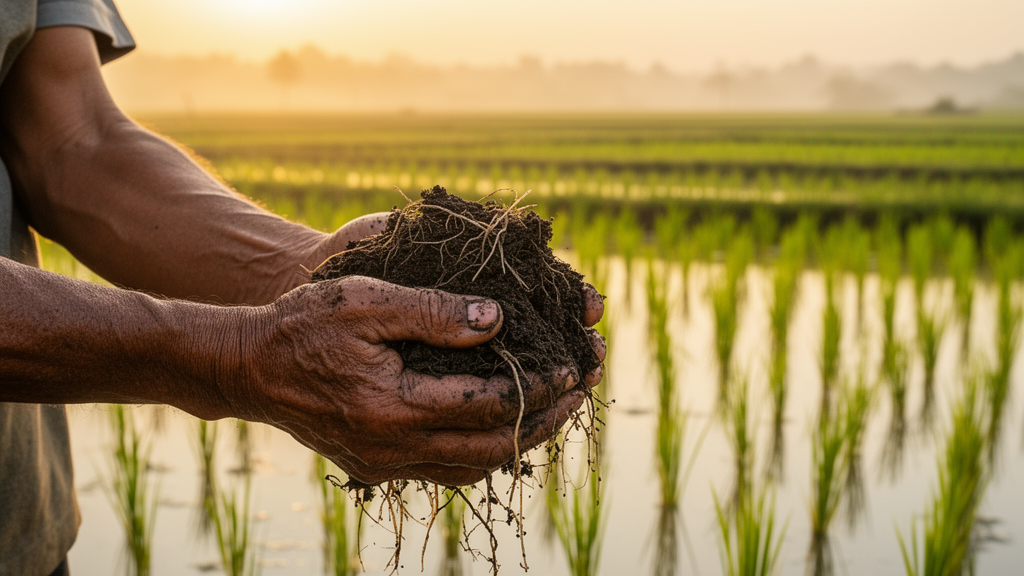
Rice feeds more than half of the world’s population, with annual global production exceeding 750 million tons, yet the crop is acutely vulnerable to drought, flooding, salinity, extreme temperatures, and heavy metal contamination. A new review published in Frontiers in Systems Biology examines how stress-tolerant plant growth-promoting rhizobacteria, or PGPR, could help rice withstand these pressures while also reducing the environmental footprint of cultivation. The authors, led by Ma. del Carmen Orozco-Mosqueda of the National Technological Institute of Mexico in Celaya, argue that these soil and plant-associated bacteria offer a sustainable alternative to the synthetic fertilizers and pesticides that have long sustained, but also degraded, rice agroecosystems.
The review frames the problem in stark climatic terms. Since 1750, atmospheric concentrations of greenhouse gases have risen by roughly 150 percent for methane, 40 percent for carbon dioxide, and 20 percent for nitrous oxide, and the authors note that average global temperatures could climb by about 2 degrees Celsius within the next 50 to 70 years. Rice is caught in a feedback loop: its cultivation in flooded soils promotes methane emissions, a potent greenhouse gas that in turn intensifies the very climate stresses that threaten the crop. Modeling cited in the review suggests that irrigated rice production could fall by 7 percent by 2050 under global warming, while rainfed yields may decline by up to 6 percent, or more conservatively around 2.5 percent.
Stress-tolerant PGPR are bacteria that live in or around plant roots and enhance growth while withstanding harsh conditions themselves. The most studied genera include Pseudomonas, Bacillus, Burkholderia, Gluconacetobacter, Azospirillum, Enterobacter, and Serratia. According to the review, these microbes trigger physiological and biochemical responses in rice, including the production of antioxidant enzymes such as catalase, peroxidase, and superoxide dismutase, the accumulation of osmoprotectants like proline, trehalose, and glycine betaine, and the activation of defense-related genes, including those tied to abscisic acid, a key hormone in drought and salinity responses.
A central mechanism highlighted in the review is the enzyme 1-aminocyclopropane-1-carboxylic acid, or ACC, deaminase. Ethylene, often called the stress hormone, rises sharply in plants under adverse conditions and can inhibit growth, cause leaf yellowing, senescence, and even premature plant death. ACC deaminase breaks down ACC, the immediate precursor of ethylene, into alpha-ketobutyrate and ammonia, thereby lowering ethylene levels and easing stress damage. The evidence for this mechanism is unusually direct: mutants of Pseudomonas fluorescens YsS6 and P. migulae 8R6 lacking a functional acdS gene failed to promote tomato growth under salinity stress, while wild-type strains with the intact gene succeeded, leading the cited researchers to conclude that ACC deaminase is directly responsible for the improved salinity response.
Concrete examples from rice research illustrate the potential. A Bacillus altitudinis strain designated FD48 significantly increased root number, lateral root number, root area, thickness, volume, and bushiness in drought-stressed rice, while modulating the expression of auxin-responsive genes including OsIAA11 and OsIAA13, involved in lateral root formation, and OsIAA1 and OsIAA4, involved in primary root shortening. Separately, two osmotic stress-tolerant Priestia megaterium strains, CACC109 and CACC119, improved seed germination under osmotic stress, stimulated root growth, increased chlorophyll content and proline synthesis, and upregulated drought-responsive genes including WRKY47, DREB2, NAC066, AREB1, and AREB2, along with oxidative stress genes such as CAT, POD, APX, and SOD.
Salinity tolerance is a particularly active frontier. From saline Pokkali rice fields in Kerala, South India, researchers isolated 50 bacterial strains, among which Pseudomonas taiwanensis PK7 stood out, enhancing seedling growth, chlorophyll concentration, and proline content in both salt-sensitive and salt-tolerant rice varieties. A salt-tolerant endophyte, Bacillus altitudinis NKA32, isolated from rice roots, improved fresh and dry weight, chlorophyll, phenols, flavonoids, protein, carbohydrate content, relative water content, and grain yield in pot experiments at 300 and 600 millimolar sodium chloride, reducing ethylene levels in inoculated plants by up to 71.53 percent. The review also points to mangrove phyllosphere isolates such as Pantoea stewartii A and Rossellomorea marisflavi Y25, pre-adapted to salinity by natural selection in coastal intertidal zones, as promising bioinoculants for saline rice soils.
Flooding poses a distinct challenge because rice, despite being grown in water, can suffer when submerged unexpectedly. Low oxygen inhibits the tricarboxylic acid cycle in root mitochondria, activates fermentation, and leads to toxic ethanol accumulation, while ethylene buildup in aerial tissues closes stomata and suppresses leaf growth. Four ACC deaminase-producing strains, Bacillus sp. AR-ACC1, Microbacterium sp. AR-ACC2, Methylophaga sp. AR-ACC, and Paenibacillus sp. ANR-ACC3, increased germination rates, seedling vigor, root and shoot length, and chlorophyll content in submerged rice seedlings, with Microbacterium sp. AR-ACC2 cutting ethylene levels by roughly 85 percent compared with untreated controls. The review notes this matters in India alone, where more than five million hectares of rainfed lowland rice are affected by flooding.
Perhaps the most surprising angle is methane mitigation. The bacterium Paenibacillus yonginensis DCY84T, coated onto rice seeds, significantly reduced methane emissions in cultivated fields, apparently by modulating the mxaF gene encoding methanol dehydrogenase and, with added silicate, by boosting bacterial families such as Anaerolinaceae, Clostridiaceae, and Nitrospirae that compete with methanogens for organic substrates. In a separate study, 30 methane-utilizing isolates from five rice-growing regions in India, spanning genera including Hyphomicrobium, Burkholderia, Methylobacterium, and Pseudomonas, showed strong methane oxidation alongside plant growth-promoting traits such as phosphorus, potassium, and zinc solubilization, nitrogen fixation, and indole-3-acetic acid production. The authors caution, however, that effectiveness depends on rhizosphere colonization and maintaining both methane-oxidizing and growth-promoting activities under flooded field conditions.
Heavy metals and pesticides add another layer of stress. Rice readily accumulates cadmium, chromium, lead, mercury, and arsenic in tissues, including grains, posing health risks through the food chain. In West Bengal, India, researchers isolated 663 bacteria from arsenic-affected rice field soils, and two strains, Priestia flexa NBRI4As1 and Pseudomonas chengduensis NBRI12As1, tolerated both arsenite and arsenate while promoting rice growth and alleviating arsenic stress in greenhouse tests. Other isolates reduced combined salt and chromium stress, with Arthrobacter woluwensis M1R2 decreasing chromium-6 translocation by 38 percent and bioaccumulation by 42 percent. Four pesticide-tolerant strains, including Enterobacter cancerogenus E50S2 4 and Bacillus velezensis M100S1 4, degraded the herbicide 2,4-D and fungicide mancozeb residues in soil while alleviating salinity and drought.
The review is candid about the obstacles between laboratory promise and field reality. PGPR effects are often inconsistent in open fields, where native soil microbiota, dynamic abiotic factors, soil heterogeneity, and crop management practices interact in ways controlled experiments cannot capture. The authors stress that survival under stress alone is insufficient evidence of effective plant-microbe interaction, since dormant spores of Bacillota species are not metabolically active and provide no growth promotion, and they call for pre-evaluation of colonization ability and field validation before deployment. Formulation is another hurdle: liquid inoculants suffer viability losses during storage and transport, particularly for Gram-negative genera such as Azospirillum and Pseudomonas, and bioencapsulation in biopolymers like sodium alginate and chitosan, though promising, still faces cost, scalability, and regulatory challenges. The authors also flag emerging directions, including CRISPR-Cas9 enhancement of genes such as acdS, which they insist must proceed under strict biosafety assessment of off-target effects, horizontal gene transfer, and ecological impact, and omics approaches to map how stress-tolerant PGPR reshape the native rice rhizosphere microbiome. For a crop that anchors food security for billions, the message is that the microbes in the soil may be as important as the seeds in the ground.
Subject of Research: The potential of stress-tolerant plant growth-promoting rhizobacteria to improve rice resilience to abiotic stresses and reduce methane emissions
Article Title: Harnessing stress-tolerant plant growth-promoting rhizobacteria for climate-resilient rice agroecosystems
Article References: Orozco-Mosqueda, M. D. C., Carrión, V. J., Babalola, O. O., Schoebitz, M., & Santoyo, G. (2026). Harnessing stress-tolerant plant growth-promoting rhizobacteria for climate-resilient rice agroecosystems. Frontiers in Systems Biology, 6, 1998786. https://doi.org/10.3389/fsysb.2026.1998786
Image Credits: AI Generated
DOI: 10.3389/fsysb.2026.1998786
Keywords: rice, PGPR, plant growth-promoting rhizobacteria, drought stress, salinity stress, ACC deaminase, methane emissions, heavy metals, rhizosphere microbiome, bioformulation, climate resilience, abiotic stress