
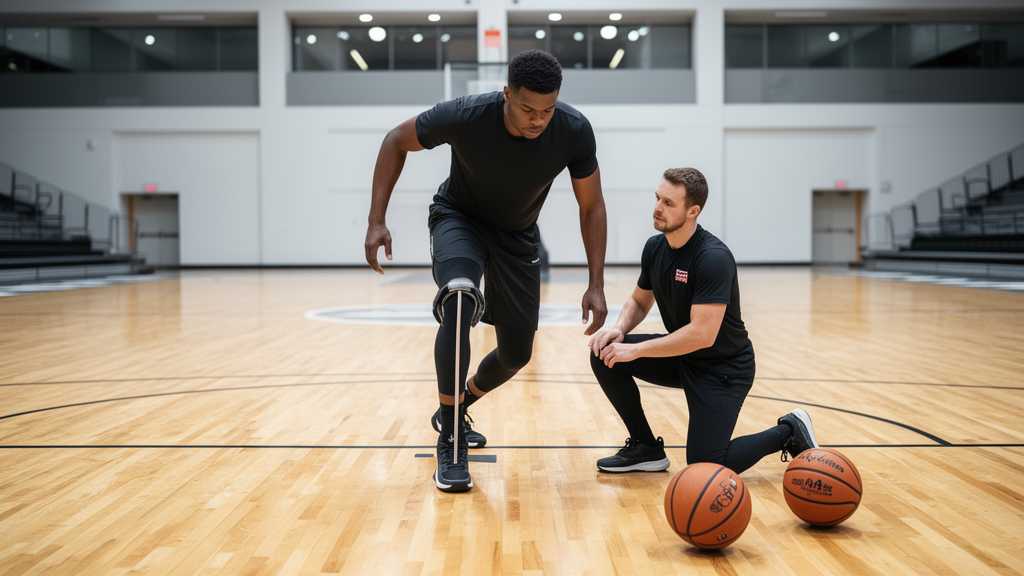
In an updated descriptive case series published in Frontiers in Sports and Active Living, researchers led by David Maman examined career trajectories following surgically treated major lower-extremity tendon injuries among National Basketball Association athletes. Evaluating thirty-three documented injury events across thirty-two players between the 2000–2001 and 2025–2026 seasons, the research team found that twenty-eight events, or 84.8 percent, were followed by an observed return to an official regular-season or postseason game. However, the investigation demonstrated that returning to the court was characterized by highly variable recovery timelines, reduced game appearances, diminished playing time, and lower scoring per unit of time during the initial postinjury campaign, showing that an appearance alone does not equate to a complete restoration of prior role or functional baseline.
The study specifically focused on major operative ruptures and tears affecting three critical anatomical structures: the Achilles tendon, the patellar tendon, and the quadriceps tendon. The identified cohort consisted of twenty-three Achilles tendon injuries, eight patellar tendon tears, and two quadriceps tendon events. To assemble this historical series, the authors reconciled an existing thirty-event clinical table, a previous research workbook tracking Achilles ruptures through 2026, official league player career-season profiles, and targeted public media databases. Player age at the time of injury was verified for thirty-two of the thirty-three events, establishing a sample mean age of 28.7 years with a standard deviation of 3.2 years and an overall range from 22.8 to 35.0 years. Based on first-listed roster roles, guards accounted for twenty events while forwards and centers comprised thirteen events, reflecting the athletic distribution of players who sustained these substantial soft-tissue disruptions during competitive basketball careers across the twenty-five-year surveillance window.
To maintain methodological transparency, the investigators defined an observed return strictly as appearing in at least one official NBA regular-season or playoff contest following operative treatment. The return date was verified using public game logs rather than roster activations, team press releases, or preseason scrimmages. Among the thirty-three documented events, twenty-eight produced an observed return to competition by the study cutoff. Of the five events without a recorded return, two were historical cases where athletes never logged another official game, while three were recent injuries whose recovery windows remained ongoing at the conclusion of data collection. When the investigators excluded these three recent occurrences, the observed return proportion reached 93.3 percent, or twenty-eight of thirty events. By anatomical category, returns were documented in twenty of twenty-three Achilles ruptures, six of eight patellar tendon tears, and both of the two quadriceps tendon repairs, though the researchers emphasized that these descriptive fractions do not constitute league-wide prognosis estimates.
Elapsed recovery time exhibited broad variation across individual athletes and injured tendon types. Both the exact calendar date of injury and the date of the first postinjury NBA game could be confirmed for twenty-seven of the twenty-eight returning players, while one returner had an unverified injury day and was excluded from timing calculations. Across these twenty-seven athletes, the mean elapsed interval from injury to game appearance was 12.2 months with a standard deviation of 5.7 months, spanning a median of 11.4 months and a range from 5.5 to 30.1 months. For the nineteen Achilles returners with confirmed dates, the mean recovery duration was 10.8 months with a standard deviation of 2.9 months, closely mirroring earlier orthopedic literature. In contrast, the six patellar tendon returners averaged 17.4 months with a standard deviation of 9.5 months and a median of 11.9 months, influenced by two players whose rehabilitation periods exceeded twenty-nine months before their next league appearance.
Beyond merely documenting game appearances, the investigators conducted paired comparisons to evaluate on-court workload and performance changes during the athlete’s first return season. For twenty-seven returning players with separable season statistics, metrics from the first postinjury regular season were compared against the final completed regular season immediately preceding the injury. Playing volume experienced marked curtailment: average games played dropped from 67.96 before injury to 38.89 during the initial return campaign, representing a mean within-player reduction of 29.07 games. Average playing time decreased from 30.22 minutes per contest to 21.77 minutes, reflecting a paired loss of 8.45 minutes per game. Traditional per-game offensive production declined in tandem, with average scoring dropping from 15.68 points to 10.47 points per game, alongside decreases in average rebounds from 5.34 to 3.83 and assists from 3.48 to 2.67 per contest.
Because aggregate per-game figures inevitably reflect diminished playing time and incomplete comeback seasons, the authors evaluated rate-adjusted performance using points per forty-eight minutes. This calculation scales total points scored by minutes played to examine scoring output per unit of playing time independently of raw game volume. In paired within-player analyses across twenty-seven returners, scoring output fell from 24.07 points per forty-eight minutes prior to injury to 21.08 points in the first return season, establishing a statistically descriptive decrease of 3.00 points per forty-eight minutes. Overall shooting accuracy also declined, with field goal percentage slipping by 3.82 percentage points, dropping from 47.33 percent to 43.51 percent. A secondary sensitivity analysis using a games-weighted baseline of up to three preinjury seasons yielded similar downward shifts of 7.91 minutes per game, 4.99 points per game, and 2.84 points per forty-eight minutes, confirming that the observed workload and scoring contractions were not artifacts of a single anomalous preinjury season.
The study also examined multi-year league retention through three scheduled postinjury seasons to understand career longevity following surgical intervention. Among twenty-three injury events eligible for three complete scheduled seasons of follow-up by the study cutoff date, nineteen players, or 82.6 percent, logged an official NBA appearance during their second scheduled season. By the third scheduled campaign, thirteen of the twenty-three eligible athletes, or 56.5 percent, remained active with an appearance in the league. Across those who actually played in subsequent seasons, average workload partially stabilized, with players logging an average of 48.47 games and 23.61 minutes per game in year two, and 48.15 games and 23.59 minutes per game in year three. The authors cautioned that these conditional means reflect changing subsets of surviving athletes rather than within-player longitudinal recovery trajectories, noting that the overall median observed span from return to last recorded appearance was 2.5 scheduled seasons.
Contextualizing their findings within sports orthopedics, the authors compared their results to previous peer-reviewed investigations of elite basketball players. Prior research on Achilles ruptures by Amin and colleagues documented return in eleven of eighteen players, accompanied by reductions in playing time and efficiency metrics relative to matched peers. Khalil and coauthors observed return in thirty-four of forty-seven Achilles injuries, noting lower game utilization through three years but no persistent performance deficit compared to controls. In extensor-mechanism literature, Nguyen and colleagues identified thirteen patellar tendon tears with ten returns, noting significant declines in minutes and games without detectable falls in rate-adjusted scoring. Meanwhile, Morikawa and associates examined nine quadriceps tears, observing return in seven athletes after an average of 214 days. The authors highlighted that variations in inclusion criteria, partial versus complete tear definitions, and control group designs account for differing numerical observations across historical studies.
Biomechanical considerations underscore why rehabilitation trajectories differ substantially across these tendon disruptions. The Achilles tendon functions as the primary mechanical conduit for transmitting force generated by the triceps surae to the calcaneus, enabling plantarflexion and propulsion during sprinting, cutting, and jumping. Conversely, the quadriceps and patellar tendons form the knee extensor chain on proximal and distal sides of the patella, transmitting force generated by the quadriceps muscle group to control knee extension, decelerate momentum, absorb landing impact, and stabilize directional changes. Because each anatomical site experiences distinctive mechanical demands, surgical repairs, loading constraints, and tissue remodeling timelines, the clinical pathway back to professional competition inevitably varies. The authors emphasized, however, that these biomechanical distinctions remain explanatory hypotheses rather than proven causal drivers of outcome variations in a small, descriptive case series that included only two quadriceps repairs.
The researchers explicitly identified multiple methodological limitations inherent in analyzing publicly available sports records. The case series relied on media reports and statistical databases rather than standardized medical records or operative reports, preventing uniform confirmation of full-thickness rupture status, surgical repair techniques, or formal rehabilitation protocols. Furthermore, calculating time to return necessarily excludes nonreturning athletes and is influenced by external factors such as seasonal calendar scheduling and contract status rather than purely biological healing. Crucially, the investigation lacked an uninjured control group matched by age, position, and baseline productivity, meaning observed declines in playing time and scoring cannot be isolated as direct causal consequences of the tendon injuries rather than normal athletic aging or tactical role evolution. Consequently, the authors conclude that these historical findings should serve as practical examples of potential recovery trajectories for clinician and athlete counseling rather than definitive prognostic formulas.
Subject of Research: NBA player return rates and performance following surgically treated lower-extremity tendon injuries
Article Title: Surgically treated major lower-extremity tendon injuries in NBA players: a selected public-source case series
Article References: Maman, D., Ginesin, E., Steinfeld, Y., Yonai, Y., & Berkovich, Y. (2026). Surgically treated major lower-extremity tendon injuries in NBA players: a selected public-source case series. Frontiers in Sports and Active Living, 8, Article 1955140. https://doi.org/10.3389/fspor.2026.1955140
Image Credits: AI Generated
DOI: 10.3389/fspor.2026.1955140
Keywords: NBA injuries, sports medicine, tendon repair, Achilles rupture, patellar tendon, quadriceps tendon, orthopedic surgery, athlete rehabilitation, Surgically, treated, major, lower-extremity
