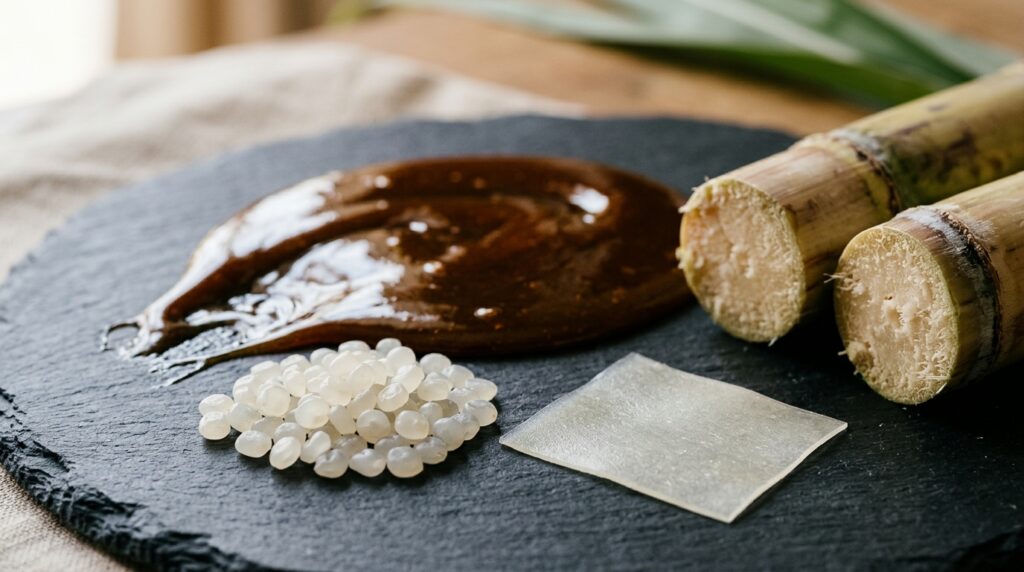
Researchers have demonstrated that sugarcane molasses, a common agro-industrial waste product, can serve as an effective low-cost carbon source for the production of polyhydroxybutyrate (PHB). The study, published in BMC Biotechnology, focuses on the strain Pseudomonas plecoglossicida MK-6, which was isolated from dumping soil and identified through partial 16S rRNA gene sequencing. The primary objective of the research was to address the high production costs associated with PHB, a biodegradable alternative to petrochemical plastics, by replacing conventional carbon sources such as glucose with waste-derived substrates.
The production of PHB has long been hindered by the expense of the carbon sources typically used in fermentation processes.
The bacterial isolate, designated GSBB-5a2-2, was initially screened for its ability to produce PHB using Sudan Black B and Nile Blue A staining techniques. Following positive screening, the strain was formally identified as Pseudomonas plecoglossicida MK-6 based on genetic sequencing, with the sequence deposited in GenBank under accession number OQ236410.
To determine the most effective conditions for PHB synthesis, the researchers employed a one-variable-at-a-time optimization approach. The results indicated that a concentration of 5% sugarcane molasses served as the optimal carbon substrate. For nitrogen, ammonium sulfate was used, with a carbon-to-nitrogen ratio of 8:1 proving most favorable for production.
Physiological conditions were also optimized to enhance the fermentation process. The study found that a pH of 7, a temperature of 37 degrees Celsius, an agitation rate of 200 rpm, and an incubation time of 48 hours constituted the optimal environment for the bacteria. Under these specific conditions, the maximum PHB production reached 7.3 grams per liter.
Following the initial optimization, the researchers utilized Response Surface Methodology (RSM) based on a Box–Behnken Design to validate and refine the experimental process.
The extracted polymer was characterized using Fourier-transform infrared spectroscopy (FT-IR), which confirmed the chemical structure of the produced material as PHB. The confirmation of PHB production by Pseudomonas plecoglossicida MK-6 using sugarcane molasses validates the feasibility of the proposed bioprocess.
While PHB production by Pseudomonas plecoglossicida has been reported in previous studies, this research distinguishes itself by focusing on the optimization of synthesis using a low-cost, waste-derived carbon source. The study highlights the potential for sustainable and cost-effective bioprocess development, where waste streams are converted into valuable materials.
Subject of Research: Optimization of polyhydroxybutyrate production from sugarcane molasses using Pseudomonas plecoglossicida MK-6
Article Title: Sustainable valorization of sugarcane molasses into polyhydroxybutyrate by Pseudomonas plecoglossicida MK-6 and optimization using response surface methodology
Article References: Begum, H., Bibi, A., Bibi, N., Mahmood, T., Ghani, A., Mosa, W. F. A., Almutairi, K. F., Omar, A. A., & Afzal, S. (2026). Sustainable valorization of sugarcane molasses into polyhydroxybutyrate by Pseudomonas plecoglossicida MK-6 and optimization using response surface methodology. BMC Biotechnology. https://doi.org/10.1186/s12896-026-01213-2
Image Credits: AI Generated
DOI: 10.1186/s12896-026-01213-2
Keywords: polyhydroxybutyrate, sugarcane molasses, Pseudomonas plecoglossicida, biodegradable plastics, response surface methodology, fermentation optimization, agro-industrial waste, bioprocess engineering, Sustainable, valorization, sugarcane, molasses