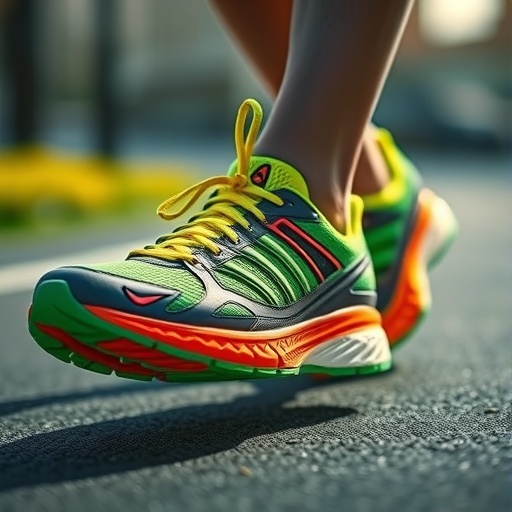
In a groundbreaking study conducted by researchers at Mass General Brigham, compelling evidence has emerged revealing the complex biomechanical implications of advanced footwear technology (AFT), colloquially known as “super shoes,” on elite distance runners. While these technologically enhanced running shoes are widely celebrated for their capacity to dramatically boost athletic performance, the investigation unveils subtle yet significant alterations in running mechanics that may predispose athletes to bone stress injuries. The intricate balance between performance enhancement and injury risk poses critical questions for the future integration of AFT in endurance sports, with findings published in the esteemed journal PM&R, the official publication of the American Academy of Physical Medicine and Rehabilitation.
This meticulous observational study recruited a cohort of 23 elite runners, comprising 11 females and 12 males, each possessing a high level of athletic conditioning. Participants were subjected to running trials using three distinct categories of footwear: a neutral shoe design, a lightweight responsive foam model, and an advanced footwear technology shoe characterized by highly cushioned foam integrated with a rigid embedded plate. The experimental design incorporated randomized trial sequences across three self-selected running intensities—training effort, tempo pace, and the elevated velocity representative of a 5-kilometer race—allowing for a comprehensive assessment of performance and biomechanical adaptations.
A central focus of the study was the evaluation of biomechanical variables intricately associated with bone stress injuries, which are insidious overuse conditions prevalent among endurance athletes. These injuries can manifest as bone marrow edema or stress fractures, typically resulting from repetitive mechanical loading that exceeds the adaptive capacity of bone tissue. By quantifying alterations in gait parameters and joint kinetics, the research team sought to elucidate how different footwear technologies modulate biomechanical stresses that underpin these pathological conditions, thereby contributing to the optimization of injury prevention strategies.
The empirical data revealed that runners equipped with AFT shoes exhibited a notable decrease in cadence, defined as the number of steps per minute. This reduction in cadence correlates biomechanically with an increased propensity for overstriding, wherein the foot lands excessively ahead of the body’s center of mass. Overstriding is biomechanically disadvantageous, as it amplifies impact forces and loading rates transmitted through the lower extremities, thereby heightening the risk of cumulative bone microdamage. Furthermore, the study documented augmented medial collapse of the arches in runners wearing AFT shoes relative to neutral models, signifying increased pronation that could exacerbate biomechanical strain on osseous structures.
Intriguingly, despite the biomechanical alterations that ostensibly elevate injury susceptibility, the researchers also observed a diminution in ankle push-off force among AFT shoe users. This attenuation of plantar flexion propulsion potentially serves as a mechanical adaptation to mitigate excessive loading on the ankle joint and tibial structures, hinting at an intrinsic protective mechanism. Such a nuanced biomechanical response underscores the complexity of human locomotor adaptations to novel footwear technologies and invites deeper exploration into the interplay between performance benefits and musculoskeletal risks.
Dr. Adam Tenforde, director of Running Medicine at Mass General Brigham and a senior author on the study, emphasized the dual-edged nature of advanced footwear integration in elite training. He advocates for a judicious approach wherein athletes and coaches acknowledge the significant performance gains offered by super shoes while concurrently addressing the latent biomechanical modifications that may predispose to injury. The imperative for longitudinal research is clear, focusing on strategic protocols that harmonize injury reduction without compromising competitive advantage.
Lead author Michelle M. Bruneau further elaborated on practical recommendations emerging from these findings. She highlighted the potential efficacy of rotating between different shoe types as a means to diversify biomechanical loads and enable physiological adaptation. Gradual introduction of AFT footwear into training regimes, rather than abrupt transitions, may also attenuate maladaptive mechanical stresses. These insights provide a valuable framework for practitioners and athletes seeking to optimize performance sustainably amidst evolving technological innovations.
The study leveraged state-of-the-art motion capture and force measurement technologies to dissect gait dynamics with granular precision. Variables such as step frequency, ground reaction forces, joint angles, and kinematic trajectories were meticulously analyzed to paint a comprehensive portrait of biomechanical outcomes. Such sophisticated methodologies enhance the fidelity of biomechanical assessment, reinforcing the validity of observed correlations between footwear-induced changes and bone stress injury risks.
In addition to biomechanical quantifications, the research team acknowledged the multifactorial etiology of bone stress injuries, recognizing that footwear represents one axis within a constellation of intrinsic and extrinsic factors including training load, bone mineral density, and nutritional status. The integration of biomechanical data within this multifactorial context enriches the interpretative power of the findings, facilitating more personalized approaches to injury mitigation in elite running populations.
The footwear examined in this study was generously donated by a leading industry partner, New Balance, thereby reflecting a collaborative interface between academic inquiry and commercial innovation. Transparency regarding conflict of interest was maintained, and the study’s scholarly rigor was further buttressed by a multidisciplinary team of experts encompassing physical therapy, sports medicine, biomechanics, and rehabilitation sciences.
Ultimately, this research represents a significant stride towards elucidating the biomechanical impacts of advanced footwear technology. It invites a nuanced understanding that recognizes AFT as a powerful tool with dualistic effects: amplifying performance capabilities while subtly modifying biomechanical patterns linked to injury susceptibility. As the sporting world embraces technological advancements, such evidence-based insights will be pivotal in crafting training paradigms that prioritize athlete health alongside competitive success.
Future investigations are encouraged to explore longitudinal effects of sustained AFT use, interactions with individual anatomical variability, and potential compensatory neuromuscular adaptations. The confluence of biomechanical expertise and clinical acumen will be essential to navigate the evolving landscape of sports technology and its implications for athlete well-being at all levels of competition.
Subject of Research: People
Article Title: Biomechanics associated with bone stress injuries while using advanced footwear technology in elite distance runners
News Publication Date: 23-Apr-2026
Web References: https://doi.org/10.1002/pmrj.70153
References: Bruneau MM et al. “Biomechanics associated with bone stress injuries while using advanced footwear technology in elite distance runners.” PM&R. DOI: 10.1002/pmrj.70153
Keywords: Advanced footwear technology, Biomechanics, Bone stress injuries, Elite runners, Running mechanics, Overstriding, Medial arch collapse, Ankle push-off, Injury risk, Performance enhancement, Gait analysis, Sports medicine