
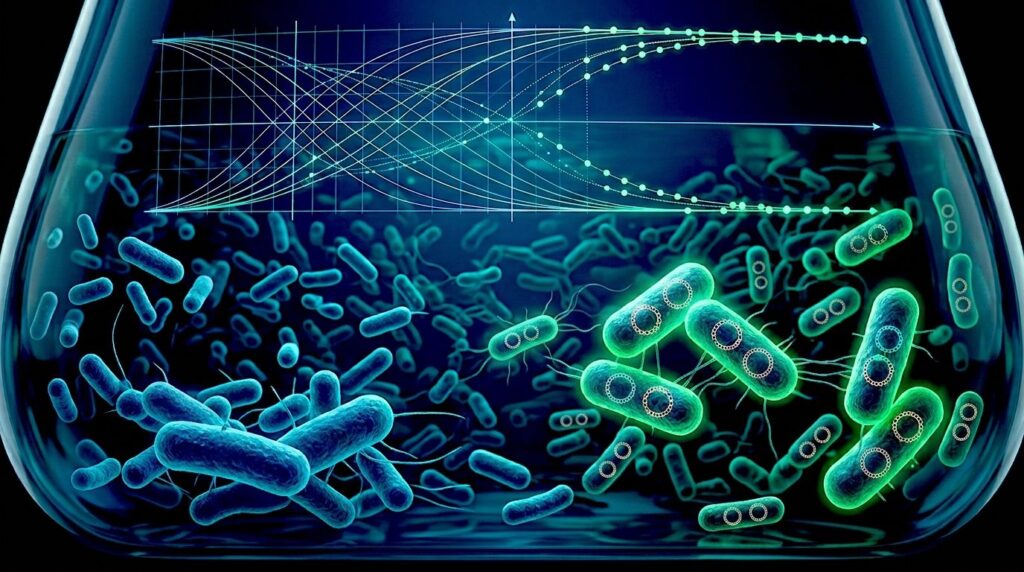
Inside a flask of E. coli, a microscopic power struggle is constantly unfolding. Some bacteria carry plasmids—small, extra pieces of DNA that can provide useful traits such as antibiotic resistance—while others go without them. A new study suggests mathematics can help predict which group ultimately comes out ahead.
Hristo Kojouharov, PhD, chair of the department of mathematics at the University of Texas at Arlington, and his colleagues introduced a model that follows plasmids as they are lost, picked up, or transferred between bacterial cells. The researchers say the approach could help scientists better control bacterial cultures used to manufacture proteins and other biological products, while potentially informing how engineered probiotics behave in the gut.
Plasmids can give bacteria powerful advantages, but they are not free. Maintaining and replicating the extra DNA consumes resources. Experiments underpinning the model found that plasmid-carrying E. coli had a net growth rate of 0.25 per hour, compared with 0.30 for plasmid-free bacteria. Their estimated carrying capacity was also lower—4.81 million cells per microliter versus 7.11 million. That creates a trade-off: bacteria without plasmids might grow faster, but carrying plasmids can become advantageous when environmental pressure rewards the genes it contains.
The model shows that the eventual bacterial mix depends strongly on plasmid loss and transfer rates. Under certain conditions, plasmid-carrying and plasmid-free bacteria coexist; under others, the population eventually loses the plasmid entirely. Selection pressure can shift that balance by changing how worthwhile the genetic cargo is to its host.
The researchers describe plasmid dynamics as “highly dependent on the benefit vs. burden imparted on the bacterial system.” That balancing act could matter beyond laboratory flasks.
One potential application is engineered probiotic E. coli. The team envisions using the model to design dosing strategies that provide a “consistent and controlled presence of the plasmid” without allowing it to permanently persist in the gut. A sufficiently high plasmid-loss rate could eventually leave the bacteria free of the introduced DNA, which is important because, as the authors note, “permanent modifications of the gut bacterial function are not desirable.”
The work remains a model rather than a ready-made clinical dosing tool. The researchers assume plasmid gain and loss rates remain constant during an experiment, and future studies will investigate whether those rates change over time. Doing that, they say, will require finer measurements capable of distinguishing plasmid-carrying and plasmid-free populations as cultures evolve.
For biotechnology, though, the message is already useful: understanding when extra DNA is an advantage—and when it becomes baggage—could make bacterial cultures more predictable and productive.