Vast stockpiles of industrial mineral processing residues represent both an environmental burden and an underutilized reserve of aluminosilicate precursors for sustainable construction engineering. In China alone, historical accumulations of iron tailings exceed five billion tons, with fresh discharges surpassing six hundred million tons annually, leading to extensive land occupation, elevated maintenance costs, and ongoing risks associated with trace element migration from open-air tailings ponds. Although these residues are predominantly rich in silica and alumina, their inherent crystalline stability and low chemical reactivity have historically restricted their direct incorporation into binder formulations, where unactivated additions typically degrade matrix strength. To address this limitation, researchers investigated whether controlled thermal pre-activation could convert unreactive crystalline phases in iron tailings into amorphous precursors suitable for salt-activated composite binders, thereby establishing a low-carbon recycling pathway that minimizes reliance on traditional Portland cement and corrosive alkali activators.
Conventional alkali activation systems generally rely on aggressive chemical activators, including concentrated sodium hydroxide and waterglass, which present severe handling hazards, high carbon costs, and tendencies toward rapid flash setting that complicate field application. In contrast, neutral or mildly alkaline salt activators like sodium sulfate offer safer, cost-effective alternatives, but their efficacy has predominantly been documented in systems based on granulated blast furnace slag and coal fly ash rather than stubborn crystalline tailings. Because sodium sulfate-activated systems often exhibit sluggish early hydration kinetics and lower terminal strength when burdened with poorly reactive fillers, chemical or thermal modification of the precursor is essential. The investigative team evaluated the effect of calcining raw iron tailings at target temperatures of 600, 800, and 1000 degrees Celsius, tracking how thermal energy restructures the fundamental mineral lattice and subsequently influences the hydration, mechanical properties, and pore structures of composite cementitious pastes activated by sodium sulfate.
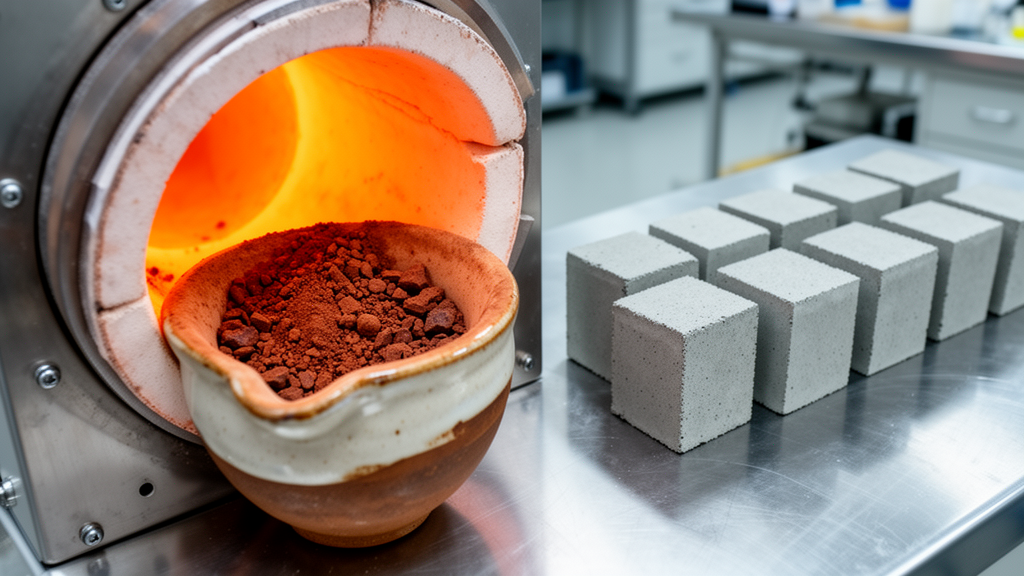
The experimental framework utilized raw iron tailings harvested from a tailings repository in Changjiang, Hainan, China, which were systematically crushed, pulverized, and sieved through a 200-mesh screen to yield a uniform fine powder. The mineral mixture combined these processed tailings with S95-grade granulated blast furnace slag sourced from Henan and Tianya brand P·O 42.5 ordinary Portland cement in a fixed mass ratio of 3 to 7 to 3. Analytical-grade sodium sulfate powder with a purity of 96 percent was introduced at a concentration of 9 percent relative to the total mass of the precursor blend, and the water-to-solid ratio was maintained at 0.45 across all formulations to ensure uniform mixing consistency. Thermal treatment of the raw tailings was executed in a high-temperature resistance furnace heated at a steady rate of 25 kelvins per minute up to the designated temperatures, where the material was soaked for 60 minutes before controlled cooling and blending.
Advanced crystallographic and spectroscopic analyses revealed profound structural alterations within the mineral constituents of the tailings across the selected thermal thresholds. X-ray diffraction patterns demonstrated that the original uncalcined tailings were predominantly composed of crystalline chlorite, nontronite, calcite, quartz, hematite, muscovite, and kaolinite. While exposure to 600 degrees Celsius caused the complete disappearance of the nontronite reflection peaks, the primary crystal peaks of the other phases remained largely undisturbed. Raising the activation temperature to 800 degrees Celsius, however, triggered extensive structural collapse, causing the diffraction peaks corresponding to kaolinite, chlorite, and nontronite to vanish entirely alongside the decomposition of calcite and a pronounced weakening of the muscovite reflections. Fourier transform infrared spectroscopy corroborated these findings, recording a sharp decline in the absorption bands at 3695 and 3639 reciprocal centimeters associated with kaolinite hydroxyl stretching vibrations, confirming that thorough dehydroxylation converts structured clays into disordered, highly pozzolanic amorphous phases such as metakaolin.
Microstructural examination of the tailing powders via scanning electron microscopy demonstrated a clear morphological transition from smooth, angular, mechanically cleaved grains in the raw state to irregular, melt-like agglomerated particles following calcination. The generation of thermal microcracks and lattice defects significantly expanded the specific surface area of the powders, as verified through nitrogen adsorption measurements using the Brunauer-Emmett-Teller method. The specific surface area expanded monotonically from an initial value of 3.44 square meters per gram in the raw tailings to 5.18 square meters per gram following treatment at 1000 degrees Celsius. This progressive structural opening and surface coarsening contributed directly to the enhanced exposure of reactive siliceous and aluminous sites, facilitating greater dissolution when the calcined particles entered the aqueous alkaline environment created during initial binder hydration.
Mechanical evaluation of the resulting hardened pastes demonstrated that thermal treatment of the tailings produced substantial strength enhancements, with the optimal performance achieved exclusively at the 800 degrees Celsius threshold. When compared against the baseline reference system containing unactivated iron tailings, the composite specimens prepared with 800-degree-activated tailings exhibited compressive strength improvements of 17.6 percent at 3 days, 23.6 percent at 7 days, and 21.9 percent at 28 days of curing. Flexural strength showed corresponding gains of 15.0 percent, 15.6 percent, and 12.4 percent across the same curing intervals, ultimately reaching a 28-day compressive strength of 24.75 megapascals and a flexural strength of 5.29 megapascals. While treatment at 600 degrees Celsius provided negligible performance gains over the control, elevating the activation temperature to 1000 degrees Celsius led to a slight plateau and regression in mechanical strength, which the authors linked to the exhaustion of activatable silica and alumina species combined with high-temperature recrystallization phenomena.
The physical fresh-state properties of the composite slurries exhibited consistent operational dependencies on the calcination temperature of the tailings fraction. Incorporating thermally activated tailings resulted in a progressive reduction in paste fluidity, a consequence of the enlarged specific surface area and particle micro-roughness promoting water adsorption and reducing the free lubricating water available in the matrix. Setting time measurements conducted in accordance with standard test criteria revealed that the initial and final setting times shortened when moving from the unactivated baseline to intermediate activation temperatures, driven by rapid surface hydration at newly generated active sites, before slightly lengthening again at 1000 degrees Celsius due to diminished ion release. Crucially, all tested mixtures satisfied the operational workability bounds mandated by the GB 175–2023 construction specification, showing initial setting times above 45 minutes and final setting times well within the 390-minute regulatory ceiling.
Microstructural and porosimetry analyses conducted after 28 days of hydration provided physical confirmation of the macro-scale strength gains observed in the 800-degree system. Mercury intrusion porosimetry established that total porosity followed a distinctive trough-shaped trajectory with activation temperature, with the material containing 800-degree-activated tailings recording the lowest total porosity at 11.94 percent alongside a water absorption value of 3.37 percent. Detailed pore size distribution analysis indicated a pronounced reduction in the harmful volume fractions of wide capillary pores and macropores larger than 100 nanometers, accompanied by a shift toward harmless nanoscale gel pores. Scanning electron microscopy confirmed that the paste matrix in the 800-degree formulation achieved exceptional compactness, wherein dense, flocculent hydration gels completely engulfed unhydrated mineral cores and interpenetrating crystalline needles, eliminating the extensive microcracking and void clustering seen in the baseline and 600-degree specimens.
The internal chemical cascade driving strength development in this salt-activated system operates through a synergistic multi-stage dissolution and precipitation mechanism. During the earliest hydration phase, the alite and belite phases of the Portland cement component hydrate to generate initial calcium silicate hydrate gel while liberating substantial quantities of aqueous calcium ions and calcium hydroxide, concurrently initiating early ettringite precipitation through the reaction of tricalcium aluminate with gypsum. The liberated calcium hydroxide subsequently undergoes a metathesis reaction with the dissolved sodium sulfate activator, forming gypsum dihydrate while precipitating sodium hydroxide directly into the pore fluid. This generated sodium hydroxide dramatically increases the alkalinity of the liquid phase without introducing exterior caustic agents, driving the chemical depolymerization of the glassy aluminosilicate networks of the slag and the thermally activated tailings. The release of soluble silicate and aluminate monomers into solution leads to continuous formation of ettringite and calcium aluminosilicate hydrate gels, characterized by an observed calcium-to-silicon ratio of 1.71, progressively sealing interstitial voids.
The study demonstrates the technical viability of converting low-reactivity iron processing waste into functional structural binders through moderate thermal activation paired with sodium sulfate salt activation. The resulting 28-day compressive strength of 24.75 megapascals significantly exceeds the standard mechanical thresholds required for cemented paste backfill operations, which typically demand compressive values ranging between 0.4 and 4.0 megapascals in underground mining contexts, while simultaneously reducing cement consumption. However, the researchers emphasized that their investigation focused strictly on short-term mechanical metrics, fresh-state behavior, and initial microstructural evolution under laboratory conditions. Because durability challenges such as long-term volume stability, resistance to environmental chemical attack, and heavy metal leaching behavior remain unassessed, comprehensive long-term testing will be required before large-scale commercial deployments can be implemented in structural construction.
Subject of Research: High-temperature activation of iron tailings for sodium sulfate-activated composite cementitious binders
Article Title: Preparation of salt-activated cementitious materials from high-temperature activated iron tailings and micromechanism
Article References: Wang, Z., Xue, F., Duan, S., Li, L., Li, N., & Wang, G. (2026). Preparation of salt-activated cementitious materials from high-temperature activated iron tailings and micromechanism. Low-carbon Materials and Green Construction, 4(1), Article 22. https://doi.org/10.1007/s44242-026-00119-8
Image Credits: AI Generated
DOI: 10.1007/s44242-026-00119-8
Keywords: iron tailings, thermal activation, sodium sulfate activator, cementitious materials, blast furnace slag, compressive strength, flexural strength, pozzolanic activity, ettringite, calcium aluminosilicate hydrate, phase transformation, pore structure, mercury intrusion porosimetry, industrial solid waste, cemented paste backfill, mineral dehydroxylation, scanning electron microscopy, microstructure densification