A quiet revolution is unfolding at the scale of a human hair. In work highlighted in a News and Views piece by Wenqi Hu of the Hong Kong University of Science and Technology, published in Nature Electronics on 23 September 2026, researchers have demonstrated microrobotic cilia that are integrated directly with complementary metal–oxide–semiconductor, or CMOS, circuitry. These microscopic hair-like actuators do something remarkable: they sense the temperature of their surroundings and, in response, actively pump fluid. In other words, they do not merely react to their environment passively — they measure it and then reshape it, closing a loop between perception and action at a scale where conventional robotics has long struggled to operate.
The concept of engineered cilia draws its inspiration directly from biology. Cilia are the tiny, hair-like appendages that line surfaces throughout living organisms, from the airways of the human lung, where they sweep mucus and trapped debris along in coordinated waves, to the surfaces of single-celled organisms that use them to swim and to feed. Biological cilia achieve their remarkable effectiveness through dense, coordinated arrays in which individual filaments beat in synchrony, generating directed fluid flow with exquisite efficiency. Replicating that behavior in artificial microsystems has been a long-standing goal of microfluidics and microrobotics, because arrays of artificial cilia could, in principle, replace bulky external pumps and valves with silent, solid-state surfaces that move fluids on demand.
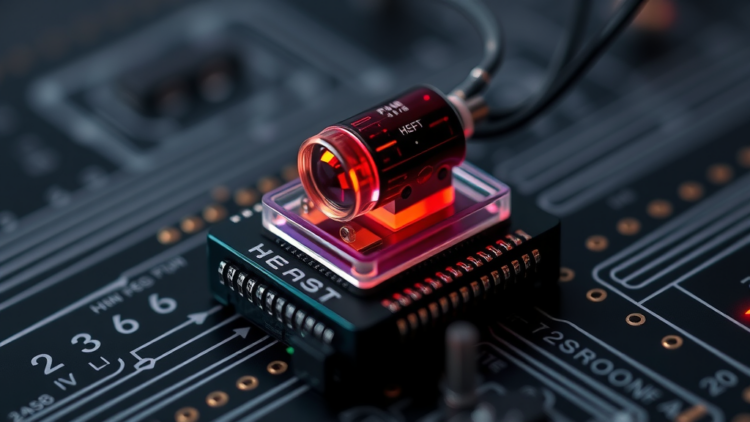
What sets the new work apart is the marriage of actuation with sensing and with mainstream semiconductor manufacturing. CMOS technology is the workhorse of the modern electronics industry, responsible for the billions of transistors that power everything from smartphones to data centers. By integrating microrobotic cilia onto CMOS platforms, the researchers inherit the maturity, scalability and precision of chip fabrication. Each cilium can be addressed and driven by underlying circuitry, and the same silicon infrastructure that powers the actuators can also host the sensors that monitor local conditions. In the demonstration discussed by Hu, the relevant environmental variable is temperature: the cilia respond to thermal cues by adjusting their beating, and in doing so they pump fluid across the chip surface.
The technical significance of this sensing-actuation coupling is difficult to overstate. Most microscale actuators to date have been open-loop devices: they perform a prescribed motion when stimulated, blind to the consequences of that motion. A cilium that can detect temperature and then modify fluid flow creates a feedback system embedded in the material itself. Temperature affects fluid viscosity, density gradients and chemical reaction rates, so a surface that senses heat and stirs fluid in response can, for example, redistribute thermal energy, homogenize concentration gradients or deliver reagents to where they are needed. The microrobotic cilia thus function simultaneously as sensors, actuators and pumps — three components that traditionally occupy separate devices and separate design disciplines.
This achievement builds on a decade of steady progress in microrobotics. Earlier landmark work by Marc Miskin and colleagues, published in Nature in 2020, introduced microscopic robots small enough to be invisible to the naked eye, capable of crawling under external stimulation and fabricated using processes compatible with existing semiconductor foundries. Subsequent work by the same community, including studies published in Proceedings of the National Academy of Sciences in 2018 and by Wang and colleagues in Nature in 2022, pushed toward ever more capable and controllable microrobotic systems. The new CMOS-integrated cilia represent a conceptual step beyond locomotion: rather than robots that move themselves through an environment, these are robots that stay put and transform the environment around them, one fluid pulse at a time.
Coordination is the second pillar of the achievement. A single cilium, whether biological or artificial, moves very little fluid. The power of ciliary systems emerges from collective behavior — thousands or millions of filaments beating in metachronal waves, the traveling patterns of motion that make biological cilia so effective. The theoretical foundations for such collective synchrony were laid long ago: the Kuramoto model, formalized by Mirollo and Strogatz in 1990, describes how large populations of coupled oscillators spontaneously fall into step, and the elegant geometry of ciliary coordination was analyzed by King, Ocko and Mahadevan in 2015. Nature offers a striking biological parallel in the aggregation patterns of bacteria such as E. coli, documented by Budrene and Berg in 1991, where individual cells following simple rules produce elaborate collective structures. The new microrobotic cilia tap into this same physics, using engineered coupling — mediated in part by the fluid they share and in part by their CMOS control layer — to generate coordinated pumping from individually simple units.
The fluid itself plays a crucial role in this coordination. At the microscale, fluid dynamics is dominated by viscosity rather than inertia, a regime characterized by low Reynolds numbers where momentum essentially does not exist and motion is entirely determined by the forces applied at each instant. Hydrodynamic interactions between neighboring cilia are strong and long-ranged in this regime, so the beating of one filament physically influences its neighbors through the surrounding fluid. This creates natural pathways for synchronization and wave propagation, and it means that the cilia and the fluid form a single coupled dynamical system. When the cilia sense a temperature change and alter their beating, they are not merely responding to their environment — they are renegotiating their collective behavior with it, moment by moment.
Potential applications span several fields. In microfluidics, CMOS-integrated ciliary surfaces could replace external pumps in lab-on-a-chip diagnostic devices, enabling fully portable analysis systems in which fluid handling is performed by the chip surface itself. In thermal management, the ability to sense hot spots and direct cooling flow toward them could transform how heat is removed from densely packed electronics, from high-performance processors to power electronics. In biology and medicine, surfaces that sense local conditions and stir fluid accordingly could improve cell culture systems, tissue engineering scaffolds and implantable devices, where gentle, distributed fluid motion is often essential for nutrient delivery and waste removal. Because the technology is CMOS-compatible, it could in principle be scaled to large areas using existing foundry infrastructure, a decisive advantage over exotic microfabrication approaches that never leave the laboratory.
The work also signals a broader philosophical shift in how researchers think about microscale machines. The traditional paradigm treats sensing and actuation as separate subsystems, connected by a controller — an architecture inherited from macroscopic robotics. At the microscale, where power, space and computational resources are all severely constrained, that separation becomes a liability. Systems in which sensing, computation and actuation are fused into a single integrated platform, as the CMOS cilia demonstrate, point toward microrobots that behave less like programmed machines and more like adaptive materials — surfaces whose mechanical response is inseparable from their perception of the world. Hu’s commentary frames this as a demonstration of how microscale actuators can both sense and actively modify their surroundings, a formulation that captures the essence of embodied intelligence at the smallest scales.
Challenges remain before such systems become commonplace. Driving dense arrays of actuators requires careful power management on-chip; long-term reliability of moving micromechanical structures in fluid environments must be established; and the repertoire of sensed variables will need to expand beyond temperature to include chemical composition, pressure and biological signals if the full vision of environment-shaping microrobotic surfaces is to be realized. Yet the trajectory is clear. From the first demonstrations of microscopic robots to today’s CMOS-integrated cilia that feel heat and answer with fluid motion, the field is converging on machines that live in, understand and reshape their microscopic worlds. As the boundaries between sensors, actuators and electronics continue to dissolve, the humble cilium — nature’s oldest micromachine — may prove to be the blueprint for the next generation of intelligent surfaces.
Subject of Research: CMOS-integrated microrobotic cilia that sense temperature and pump fluid to modify their microscale environment
Article Title: Microrobotic cilia that sense and reshape their surroundings
Article References: Hu, W. (2026). Microrobotic cilia that sense and reshape their surroundings. Nature Electronics. https://doi.org/10.1038/s41928-026-01716-y
Image Credits: AI Generated
DOI: 10.1038/s41928-026-01716-y
Keywords: microrobotics, CMOS integration, artificial cilia, microfluidics, temperature sensing, actuators, fluid pumping, collective synchronization, lab-on-a-chip, thermal management, Nature Electronics, microscale robotics
Cite Scienmag News
APA MLA Chicago
Copy citation Download RIS
Tags: actuatorsartificial biological ciliaartificial ciliabio-inspired microactuatorsbio-mimetic fluid dynamicsCMOS integrationcollective synchronizationfluid pumpingfluid pumping on a chipheat-responsive microdeviceslab-on-a-chipmicrofluidicsMicrorobotic ciliamicroroboticsmicroscale fluid manipulationmicroscale roboticsmicrosystem roboticsnanoscale robotic sensorsNature Electronicsscalable microfluidic controltemperature sensingthermal management