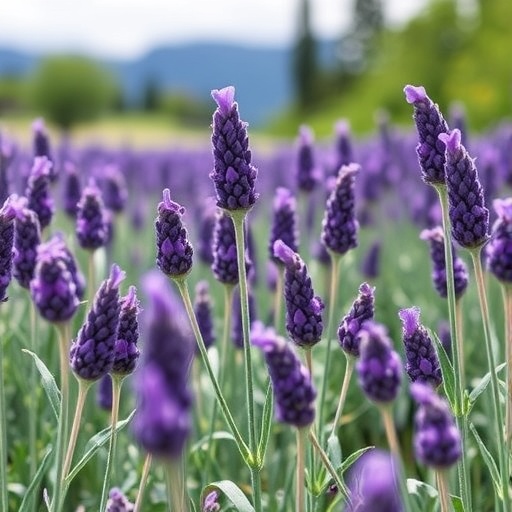
In an age where sustainability and circular economy principles are gaining paramount importance, a groundbreaking study unveils how the abundant waste generated from lavender essential oil distillation can be transformed into a valuable carbon-rich material known as biochar. This innovation paves the way for reimagining waste not as a disposal challenge but as a resource ripe with potential for energy, environmental, and agricultural applications.
Lavender, cherished globally for its fragrant essential oils, leaves behind significant amounts of solid residue post-extraction. Traditionally, this plant biomass has often been discarded through burning, landfilling, or relegated to low-value uses, leading to missed opportunities in harnessing its inherent value. Recognizing this, a team of researchers has developed a novel, mechanism-resolved framework that provides a meticulous guide to convert lavender distillation residue into high-quality biochar through pyrolysis.
Pyrolysis, the thermal decomposition process carried out in oxygen-limited conditions, has been explored extensively for biomass conversion, but this study takes it a step further by systematically linking the thermal decomposition pathways and kinetics to resultant biochar quality, energy consumption, and environmental impact metrics. The experimental investigation encompassed 13 distinct pyrolysis treatments, varying critical parameters such as final temperatures (ranging from 200 °C to 600 °C), heating rates (from 10 °C to 40 °C per minute), and residence times (up to 30 minutes) under nitrogen atmospheres.
Unlike traditional singular-focus optimization approaches that prioritize yield or carbon content alone, this research adopted a holistic methodology. The team integrated thermal behavior data, kinetic modeling, energetic demands, and comprehensive life-cycle environmental footprint assessments into a robust, multi-criteria decision framework. This balance-driven approach addresses the quintessential trade-offs faced in biochar production—maximizing yield and fixed carbon content while minimizing energy consumption and environmental burdens.
Thermogravimetric analyses revealed complex decomposition behavior inherent to lavender residue. The primary decomposition peak shifted conspicuously towards higher temperatures with increased heating rates, indicating a strong influence of heat transfer dynamics on biomass breakdown. Furthermore, kinetic analysis demonstrated a relatively stable activation energy during early to mid-stage pyrolysis, followed by a sharp elevation as conversion proceeded, signaling structural transitions toward more condensed carbon networks during later stages.
An in-depth characterization of produced biochar displayed remarkable physicochemical transformations induced by pyrolysis. Carbon content was significantly enriched, while oxygen and hydrogen levels diminished, culminating in biochar with enhanced fixed carbon fraction and elevated higher heating value (HHV). Morphological studies via scanning electron microscopy illustrated a transition from dense plant matrices to an interconnected porous carbon framework—critical for applications demanding high surface area and reactivity. Complementary Fourier-transform infrared spectroscopy (FTIR) analyses confirmed the loss of oxygen-rich functional groups, replaced by more stable aromatic carbon structures, indicative of enhanced carbonization.
The study’s pivotal strength lies in its application of the entropy-weighted TOPSIS (Technique for Order Preference by Similarity to Ideal Solution) method, a sophisticated multi-criteria ranking system. This analytical technique assessed conditions based not only on yield and carbon content but also accounted for electricity intensity and five mid-point indicators from Environmental Footprint 3.0. The comprehensive evaluation identified a particular pyrolysis condition, termed Run 5, as the optimal balance point—achieving nearly 49% biochar yield at moderate energy input and environmental impacts. Upon imposing a stringent minimum fixed carbon requirement of 60%, the preferred setting shifted to Run 4, which delivered highly carbonized biochar suitable for advanced applications.
Lead researcher Ahsanullah Soomro emphasized the transformative potential of this research: “By bridging the mechanistic understanding of pyrolysis with practical environmental and energy criteria, we empower decision-makers to select biochar production conditions that are not only technically sound but truly sustainable.” This synergy of science and sustainability could catalyze the adoption of lavender waste valorization strategies, fostering circular bioeconomy models and reducing biomass disposal burdens in lavender-processing regions worldwide.
Furthermore, the outcomes offer valuable insights into optimizing pyrolysis parameters tailored to aromatic plant residues, shedding light on the interplay between thermal kinetics, structural evolution, and multi-dimensional sustainability metrics. This could serve as a template for converting other lignocellulosic residues into functional carbon materials for soil enhancement, carbon sequestration, bioenergy, and pollution remediation.
The implications of this research extend beyond lavender residue utilization. By advancing a transparent, scientifically grounded decision-making framework, it opens pathways for industry stakeholders to design biochar production systems that align with environmental commitments, energy efficiency goals, and economic viability. It represents a meaningful stride toward integrated biomass management practices and contributes to expanding the global knowledge base on biochar’s role in mitigating climate change and supporting sustainable agriculture.
Published in the prestigious journal Biochar, this study marks a significant contribution to the burgeoning field of biochar science, amalgamating rigorous experimental evidence with comprehensive sustainability analysis. It not only underscores lavender waste’s untapped value but also champions innovative methodologies for advancing green technologies and carbon management strategies that are crucial in today’s climate-conscious world.
As global demand for sustainable solutions escalates, studies like this exemplify how nuanced scientific insight combined with environmental pragmatism can revolutionize waste valorization. Transforming aromatic plant residues like lavender distillation waste from environmental liabilities into multi-functional biochar products is poised to inspire policymakers, researchers, and industry players alike to rethink bioresource utilization through a sustainability lens.
In conclusion, the research lays down a replicable, mechanism-informed roadmap for maximizing biochar production benefits while minimizing ecological footprints. By intelligently balancing thermal processing parameters with environmental and energetic factors, it establishes a new paradigm in biowaste conversion—empowering stakeholders to convert what was once considered waste into an invaluable asset for ecological restoration, climate mitigation, and sustainable bioeconomy pathways.
Subject of Research: Conversion of lavender distillation residue into biochar through optimized pyrolysis
Article Title: Mechanism-resolved operating windows for biochar production from lavender distillation residue
News Publication Date: 3 June 2026
Web References: http://dx.doi.org/10.1007/s42773-026-00617-9
References: Soomro, A., Koçer, A.T., Hassan, M. et al. Mechanism-resolved operating windows for biochar production from lavender distillation residue. Biochar 8, 105 (2026).
Image Credits: Ahsanullah Soomro, Anıl Tevfik Koçer, Mahdi Hassan & Didem Balkanlı
Keywords
biochar, pyrolysis, lavender residue, thermal kinetics, carbonization, sustainable biomass conversion, energy efficiency, environmental footprint, TOPSIS multi-criteria analysis, circular bioeconomy, soil amendment, renewable carbon materials
Tags: biochar for soil enhancementbiochar from essential oil residuesbiomass thermal decompositioncircular economy in agricultureclimate-smart biochar technologyenergy-efficient pyrolysis processesenvironmental impact of biocharhigh-value uses of plant residueslavender waste biochar productionoptimizing biochar qualitypyrolysis of lavender biomasssustainable lavender waste management