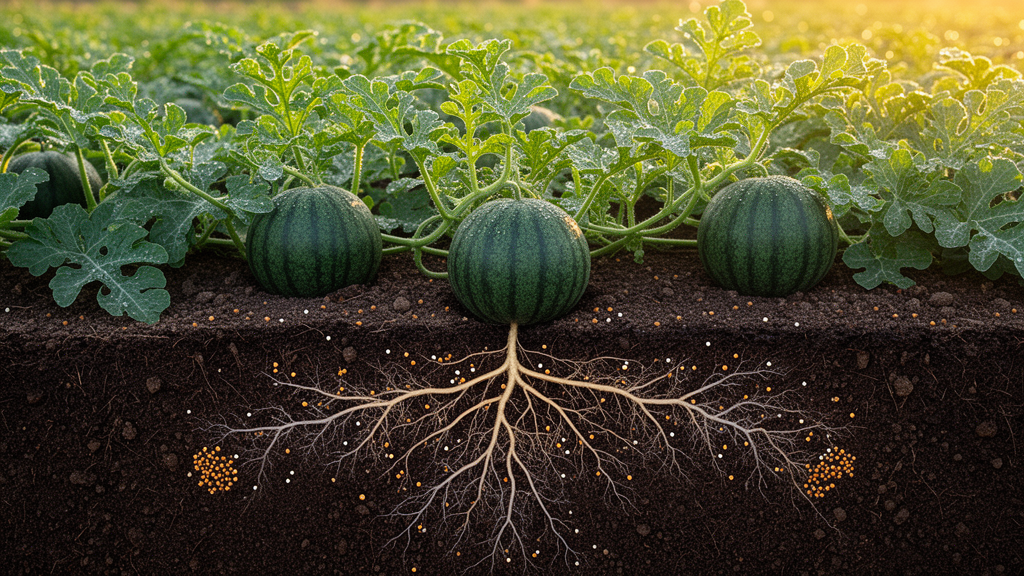
A combined application of the bioinoculant Trichoderma asperelloides and organomineral fertilizer improves photosynthetic performance and vegetative growth in ‘Sugar Baby’ mini watermelon plants subjected to salt stress. Reported in BMC Plant Biology, the findings evaluate an approach to address salinity constraints that limit agricultural production in semi-arid regions.
The researchers investigated both the isolated and joint effects of the fungal inoculant and organomineral fertilizer using a 4 by 5 factorial experimental scheme. The testing evaluated four mitigation strategies across five electrical conductivity levels of salinity, specifically 0.4, 1.5, 3.0, 4.5, and 6.0 deciSiemens per meter, conducted across two independent experimental cycles.
Exposure to severe salinity without mitigation caused substantial physiological damage to the crop. High salt levels reduced total dry mass by 46 percent, increased cellular electrolyte leakage by 48 percent, and lowered relative water content by 10.6 percent, alongside measurable declines in chlorophyll content and the quantum efficiency of photosystem II, expressed as the Fv/Fm ratio.
Applying the combination of Trichoderma asperelloides and organomineral fertilizer countered these growth reductions. Under the combined mitigation strategy, primary root length increased by 40 percent, total leaf area expanded by 26.0 percent, and the total number of leaves rose by 13.2 percent relative to unmitigated conditions.
The joint treatment also maintained physiological function and cellular membrane integrity under high salinity. Electrolyte leakage decreased by 22.5 percent in the first experimental cycle and by 25.2 percent in the second cycle, while normal chlorophyll levels and photosystem II quantum efficiency were preserved under severe stress. Furthermore, total carotenoids increased by 26.1 percent at 6.0 deciSiemens per meter exclusively in plants receiving the combined treatment.
Canonical correlation analysis demonstrated a close physiological coupling, indicating a shared variance of 87 to 89 percent between morphophysiological traits and photosynthetic variables. While the authors identify the combination of Trichoderma asperelloides and organomineral fertilizer as a promising strategy to enhance salinity tolerance in watermelon, they emphasize that field validation and complementary biochemical analyses remain necessary.
Subject of Research: Mitigation of salinity stress in watermelon using Trichoderma asperelloides and organomineral fertilizer
Article Title: Trichoderma and organomineral fertilizer improve photosynthesis and growth of watermelon under salt stress
Article References: Nogueira, J. C., Dias, T. J., da Silva, R. F., Feitosa de Souza, T. A., Bernardo, M. K. F., da Rocha Oliveira, A. C., da Silva, A. J., Barbosa da Silva, J. H., Targino, V. A., Alves, E. U., Silva Targino, M. D. M., de Moura, V. S., da Cunha Lima, M. A., de Rezende, A. Q., & Pereira, W. E. (2026). Trichoderma and organomineral fertilizer improve photosynthesis and growth of watermelon under salt stress. BMC Plant Biology. https://doi.org/10.1186/s12870-026-10276-4
Image Credits: AI Generated
DOI: 10.1186/s12870-026-10276-4
Keywords: watermelon, Trichoderma asperelloides, organomineral fertilizer, salt stress, photosynthesis, plant growth, semi-arid agriculture, Trichoderma, organomineral, fertilizer, improve, growth