A comprehensive ecological study tracking the Chinese wild grape Vitis quinquangularis from vineyard berry development through fermentation has revealed how autochthonous non-Saccharomyces yeasts are naturally recruited to shape distinctive fruity aromas. By integrating high-throughput sequencing with culture-dependent strain isolation and controlled co-fermentations, researchers demonstrated that wild grape surfaces enrich specialized yeasts during berry ripening that subsequently dominate spontaneous fermentations. While unmanaged spontaneous fermentations generated excessive levels of ethyl acetate that produced sensory defects resembling solvent or nail polish, co-inoculating the isolated indigenous non-Saccharomyces strains alongside commercial Saccharomyces cerevisiae at a ten-to-one ratio produced balanced volatile profiles. These validation trials elevated beneficial acetate esters by more than three-fold while restricting ethyl acetate concentrations to desirable ranges below sensory defect thresholds, revealing a practical microbiological approach for enhancing wine complexity in warm-climate viticulture.
The assembly of berry-associated microflora plays a defining role in microbial terroir, the geographically structured consortium of fungi and bacteria that imparts recognizable regional character to fermented wines. Most commercial winemaking relies on Eurasian Vitis vinifera cultivars, which thrive in temperate zones but suffer severe vulnerability to fungal diseases under hot, humid subtropical conditions. In contrast, Vitis quinquangularis is an East Asian red grape endemic to China that exhibits remarkable natural tolerance to high temperatures and powdery mildew resistance. Viticulturists have expanded the cultivation of V. quinquangularis to over six thousand hectares across subtropical Guangxi. However, the berries yield relatively low sugar concentrations of ten to sixteen degrees Brix at maturity, and spontaneously fermented wines reportedly exhibit predominantly fruity and floral notes alongside distinctive green and earthy characteristics.
To decipher how grapevine tissues assemble and preserve aroma-generating microorganisms, the research team conducted a field sampling campaign using the V. quinquangularis cultivar Ye Niang Number Two in Anyang Town, Du’an Yao Autonomous County, Guangxi. Meteorological records for the 2024 sampling season established a mean annual temperature of 22.8 degrees Celsius, annual rainfall of 1749.8 millimeters, and average relative humidity of 75 percent. Utilizing a five-point spatial grid across the vineyard, the team collected grape clusters across five distinct phenological stages on the Eichhorn-Lorenz scale: fruit set, early veraison, late veraison, mid-maturity, and commercial harvest. Epiphytic microorganisms were gathered from cluster surfaces using sterile cotton swabs, while endophytic communities were isolated from interior fruit tissues following sequential surface disinfection with 75 percent ethanol, 10 percent hydrogen peroxide, and verified sterile water rinses.
Following harvest, sorted and crushed berries were divided into experimental fermentations conducted in triplicate within static 500-milliliter glass bioreactors fitted with glycerol airlocks to limit oxygen diffusion at 25 degrees Celsius. The experimental design compared uninoculated spontaneous fermentations against inoculated fermentations initiated with two million cells per milliliter of commercial Saccharomyces cerevisiae strain RV002. Total microbial DNA was extracted across five metabolic checkpoints defined by sugar consumption, from unfermented must to terminal dryness where residual sugar dropped below two grams per liter. The investigators amplified the fungal internal transcribed spacer two region and the bacterial 16S ribosomal DNA V3 to V4 hypervariable region on an Illumina NovaSeq platform. High-throughput sequencing yielded 22,254 operational taxonomic units at 97 percent sequence similarity, comprising 3,525 fungal and 18,729 bacterial units, with rarefaction curves confirming thorough ecological coverage.
Ecological diversity profiling using the Shannon index showed marked structural differences between epiphytic and endophytic compartments, as well as between spontaneous and inoculated fermentations. Fungal diversity on berry exteriors exceeded internal tissues during early development, but endophytic diversity climbed sharply following late veraison, marking an internal niche transition synchronized with grape sugar accumulation. Epiphytic surfaces were sequentially dominated by the fungal genera Fusarium, Gliocephalotrichum, Hanseniaspora, and Digitopodium, with Hanseniaspora predominating at veraison and gradually declining thereafter. In interior tissues, Fusarium and Cladosporium prevailed throughout berry development, followed by Gliocephalotrichum during veraison and Digitopodium at later stages. Bacterial communities on berry surfaces maintained stable Shannon diversity across development, dominated by Methylobacterium at ten to thirty-three percent relative abundance, followed by Actinomycetospora and Sphingomonas. Internal bacterial populations experienced compositional reorganization after veraison, establishing distinct tissue-specific baselines prior to harvest.
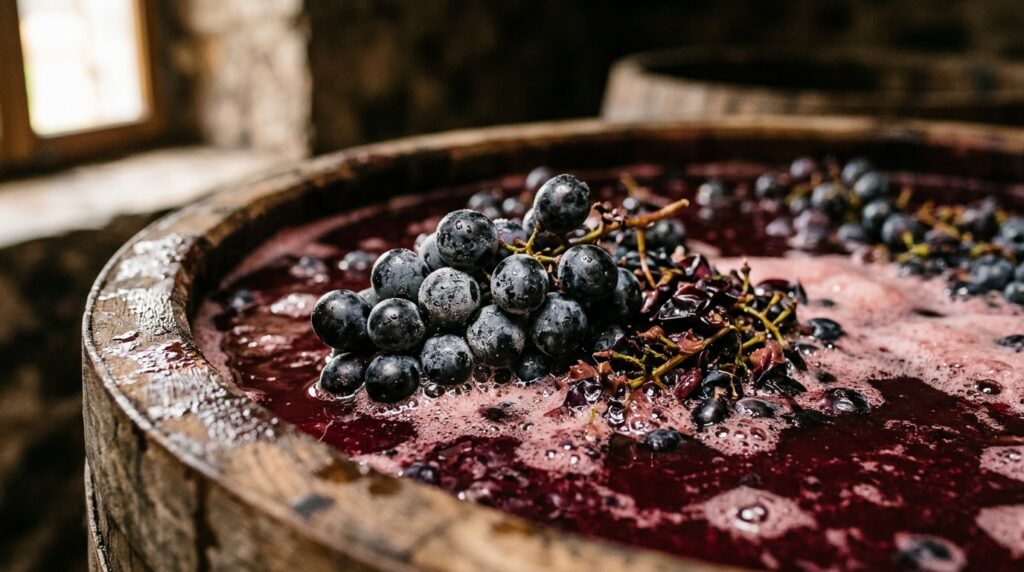
Berry crushing completely dismantled pre-harvest microbial architecture, triggering sharp declines in both fungal and bacterial diversity as the grape must environment exerted severe selective pressure. Filamentous field fungi including Fusarium, Gliocephalotrichum, and Digitopodium, which dominated intact fruit tissues, vanished rapidly from the fermenting liquid. In spontaneous fermentations, non-Saccharomyces yeasts immediately claimed numerical dominance, led by Hanseniaspora exceeding 65 percent relative abundance and Starmerella surpassing 23 percent, before indigenous Saccharomyces reached 25 percent and Pichia attained 4.8 percent at fermentation completion. Conversely, in inoculated fermentations, the commercial RV002 strain asserted aggressive dominance, occupying 78 to 90 percent of fungal communities and outcompeting wild non-Saccharomyces populations. Bacterial successions followed a parallel divergence: epiphytic taxa were replaced by Tatumella, Acetobacter, and Gluconobacter, with Tatumella exceeding 47 percent in spontaneous musts but being suppressed to 8 to 15 percent in inoculated fermentations.
Both fermentation regimes completed primary fermentation within nine days, converting must sugars into approximately 6.6 percent alcohol by volume due to the naturally low initial hexose content of the berries. Spontaneous fermentations exhibited slower initial sugar consumption and delayed ethanol production, consistent with the alternative carbon allocation and lower fermentative efficiency characteristic of non-Saccharomyces yeasts. Organic acid analysis revealed that spontaneous wines contained significantly higher concentrations of lactic acid and acetic acid, alongside lower levels of citric, tartaric, malic, and succinic acids compared to inoculated wines. The pronounced drop in malic acid accompanied by elevated lactic acid indicated spontaneous malolactic conversion, which the authors correlated with the proliferation of Liquorilactobacillus bacteria in late spontaneous fermentation. Headspace solid-phase microextraction coupled with gas chromatography-mass spectrometry identified 56 volatile compounds, revealing 42 discriminatory odorants between spontaneous and inoculated finished wines.
Concentration dynamics grouped the quantified volatiles into four distinct kinetic clusters based on odor activity values exceeding the 0.1 sensory relevance threshold. Cluster one comprised acetate esters that accumulated rapidly from early stages in spontaneous musts, whereas cluster three encompassed higher alcohols and fatty acid ethyl esters that reached peak levels under Saccharomyces dominance in inoculated musts. Spontaneous wines accumulated enormous quantities of acetate esters, led by ethyl acetate at 190 milligrams per liter and isoamyl acetate at 5.18 milligrams per liter, representing fifteen-fold and four-fold increases over inoculated controls. However, the accumulation of ethyl acetate far exceeded the accepted sensory threshold of 100 milligrams per liter, imparting an undesirable solvent-like defect to the wine. Additionally, spontaneous wines retained 1.9-fold higher total C6 alcohols, including 1-hexanol and (Z)-3-hexen-1-ol, preserving the pronounced green and grassy sensory notes typical of unmanaged wild grape fermentations.
Machine learning and multivariate statistical models applied to the dataset identified key microbial taxa and volatile compounds that differentiated spontaneous from inoculated fermentations. Random forest analysis established that fungal genera possessed overwhelming discriminatory power compared to bacteria, with Hanseniaspora yielding the highest mean decrease accuracy of 0.125, followed by Lachancea, Saccharomycodes, Starmerella, and Saccharomyces. Orthogonal partial least squares discriminant analysis isolated thirteen key volatiles exhibiting variable importance in projection scores above 0.95. Spearman correlation heatmaps revealed that Hanseniaspora, Starmerella, Lachancea, and Saccharomycodes correlated positively with acetate ester synthesis, whereas Saccharomyces exhibited significant negative correlations with acetate esters. Instead, Saccharomyces correlated positively with higher alcohols, volatile fatty acids, and fatty acid ethyl esters, reflecting its superior metabolic utilization of amino acids via the Ehrlich pathway and efficient fatty acid lipid synthesis during rapid sugar catabolism.
To transition from statistical associations to functional verification, the investigators plated late-stage spontaneous fermentation samples onto Wallerstein Laboratory nutrient agar, isolating and taxonomically identifying seven dominant yeast strains via ribosomal sequencing. These isolates comprised Hanseniaspora vineae HVE2, Hanseniaspora lindneri strains HLC7 and HLC9, Pichia sporocuriosa strains PSD7 and PSE5, and Lachancea fermentati strains LFE1 and LFE4. Each strain was co-inoculated with S. cerevisiae RV002 at a ten-to-one cell ratio into authentic V. quinquangularis grape must pretreated with dimethyl dicarbonate to eliminate wild background microflora. All co-fermentations successfully fermented to dryness, generating 53 volatile metabolites. All three Hanseniaspora co-fermentations elevated total acetate esters by 3.06- to 3.58-fold compared to single S. cerevisiae fermentations while reducing higher alcohol formation by 8.3 to 34.8 percent. Crucially, co-fermentation capped ethyl acetate production between 44 and 63 milligrams per liter, safely below the 100 milligram defect ceiling while maintaining C6 alcohols at restrained concentrations.
Functional screening demonstrated clear metabolic specialization at species and strain levels: H. lindneri strains HLC7 and HLC9 functioned as the most prolific synthesizers of fatty acid ethyl esters, whereas H. vineae HVE2 produced extraordinary amounts of the rose-scented ester 2-phenethyl acetate and C13-norisoprenoids like beta-damascenone. In contrast, L. fermentati LFE1 uniquely induced ethyl lactate accumulation via active lactic acid pathways, while Pichia strains acted as specialized accessory cultures. The researchers highlighted that correlation-based multi-omics alone failed to predict these specific strain capabilities, noting that negative genus-level correlations between Hanseniaspora and certain ethyl esters were contradicted by the high ester yields of HLC9. The authors acknowledged critical study limitations, emphasizing that their findings derived from a single grapevine cultivar, vineyard, and vintage under static laboratory airlocks without dissolved oxygen monitoring. Rigorous safety evaluations and trained human sensory descriptive panels will be necessary before these candidate indigenous starters can be applied in commercial warm-climate winemaking.
Subject of Research: Microbial succession and aroma modulation by indigenous non-Saccharomyces yeasts in Vitis quinquangularis winemaking
Article Title: Recruitment of aroma-producing non- Saccharomyces yeasts by Vitis quinquangularis : Tracking microbial succession from grape berries to wine fermentation
Article References: Chang, Y., Fan, B., Jia, X., Wang, B., Xia, Y., Tao, Y., Zhao, H., & Hu, K. (2026). Recruitment of aroma-producing non-Saccharomyces yeasts by Vitis quinquangularis: Tracking microbial succession from grape berries to wine fermentation. Food Chemistry: X, 40, Article 104845. https://doi.org/10.1016/j.fochx.2026.104845
Image Credits: AI Generated
DOI: 10.1016/j.fochx.2026.104845
Keywords: Vitis quinquangularis, non-Saccharomyces yeasts, Hanseniaspora, microbial terroir, wine fermentation, aroma compounds, acetate esters, ethyl acetate, high-throughput sequencing, spontaneous fermentation, Saccharomyces cerevisiae, Lachancea fermentati, Pichia sporocuriosa, Hanseniaspora lindneri, Hanseniaspora vineae, volatile organic compounds, enology, Guangxi viticulture